Key Points
- Enterprise email management must integrate with endpoint systems to ensure consistent and secure access control.
- Strong email security relies on layered controls, including authentication, encryption, and advanced threat filtering.
- Governance policies for retention, auditing, and compliance must align with legal and industry requirements.
- A seamless and consistent user experience improves adoption and reduces risky workarounds.
- Centralized visibility and reporting strengthen security posture while improving operational efficiency.
The latest Statista data suggests that the number of global email users will reach 4.8 billion by 2028. To put that into perspective, the current world population in early 2026 is 8.3 billion, which is less than double the number of email users.
And while that may seem like “common sense,” the implications are astounding. This means that 1 in 2 people in the world have an email. Tom? Mark? Susan? Karen? Yup: All email users. (Well, maybe not Susan or Tom.)
As email becomes one of the primary communication channels in business, it has become all the more important for modern organizations to develop and implement an effective email management strategy. Emails remain a major vector for phishing, malware delivery, data breaches, and compliance violations. Organizations must treat email as a governed business system that aligns with their own broader IT operations.
This guide explains:
- What enterprise email management should include,
- Why it matters beyond basic security filtering, and
- How organizations can align email governance with endpoint strategy rather than treating it as a standalone tool.
What enterprise email management covers
Enterprise email management defines how access is controlled, how threats are mitigated, and how communications are governed across their lifecycle. A true enterprise email management strategy treats email as a business-critical system, not just a communication tool.
Effective enterprise email management should include:
- Identity-integrated access control: Email systems should integrate with identity platforms to enforce multi-factor authentication (MFA), role-based permissions, and conditional access policies tied to user risk and device posture.
- Layered threat protection: Phishing detection, malware filtering, spam protection, attachment sandboxing, and malicious link analysis reduce the likelihood that harmful content reaches users.
- Policy enforcement and configuration governance: Centralized management ensures consistent application of security settings, mailbox configurations, and access restrictions across users and devices.
- Lifecycle governance of communications: Email must be governed from creation to archival, ensuring that storage, retention, and deletion policies align with compliance and business requirements.
- Alignment with broader IT operations: Email policies should reflect the same governance principles applied to endpoints, identity systems, and enterprise security frameworks.
From this list, you can see how enterprise email management is both operational and strategic. It governs how communication flows within the organization while protecting data, maintaining compliance, and reducing security risk.
Security controls for enterprise emails
Email security depends on layered controls that work together rather than relying on a single defense mechanism. Each layer addresses a different risk area and should align with broader endpoint security policies to ensure consistent enforcement across the organization.
Several foundational security layers work together to protect enterprise email systems:
1. Authentication
Authentication reduces the risk of credential theft by enforcing MFA and single sign-on (SSO). These controls verify user identity before granting access and can support conditional access policies based on device posture or user risk level. Strong authentication prevents unauthorized access even when passwords are compromised.
2. Encryption
Encryption protects email both in transit and at rest to safeguard sensitive information. Transport layer security, such as TLS, secures messages as they move between mail servers, while encryption at rest protects stored messages and archives. Without encryption, intercepted communications can expose confidential business data.
3. Filtering and threat detection
Filtering and threat detection systems detect, block, quarantine, and analyze phishing attempts, malicious attachments, spam, and harmful links before they reach users. Modern email security platforms use behavioral analysis, reputation scoring, and sandboxing to detect advanced threats. These proactive controls significantly reduce the likelihood of user-driven compromise.
Compliance and data governance in enterprise email management
Because emails often can contain regulated or business-critical information, a robust enterprise email policy framework must align with legal and industry compliance requirements. Security controls alone are no longer sufficient; governance policies must also define how messages are retained, audited, and protected throughout their lifecycle.
To understand how compliance affects enterprise email management in practice, it helps to look at the specific types of regulatory requirements that commonly apply.
Here’s an easy-to-understand table to use as your cheat sheet:
Compliance requirement | What it requires | Impact on enterprise email management |
| Data retention laws | Defined timeframes for preserving business records | Email retention policies must align with required storage periods |
| Legal hold (eDiscovery) | Preservation of records during litigation or investigation | Email deletion must be suspended for relevant accounts and messages |
| Audit logging | Traceability of access and activity | Email systems must maintain detailed logs for compliance and review |
| Data loss prevention (DLP) | Protection against unauthorized data disclosure | Outgoing email must be scanned and controlled for sensitive content |
| Encryption requirements | Protection of data in transit and at rest | Email must use TLS and secure storage encryption |
| Access control standards | Enforcement of least privilege and strong authentication | Email access must integrate with MFA, SSO, and role-based permissions |
| Data privacy regulations (for example, GDPR, CCPA) | Lawful processing and protection of personal data | Email systems must support access controls, retention limits, and data deletion requests |
| Industry-specific regulations (for example, HIPAA, GovRAMP, FINRA) | Sector-based data protection and recordkeeping mandates | Email policies must reflect industry-specific compliance obligations |
NinjaOne achieves GovRAMP moderate authorization to deliver modern IT for state and local agencies.
Read the press release here.
The importance of good end user experience in enterprise email management
Okay—this may seem like a “soft” feature, but end user experience matters more than you think. After all, you can have the best security controls, but an insider threat or even just a careless employee can unravel everything you have built. Employees may forward corporate email to personal accounts or use unauthorized tools if policies are overly restrictive or inconsistent.
Good enterprise email management balances protection with usability. Access should remain consistent across endpoints so employees are not forced to navigate different rules in different environments. Authentication flows should also be secure but intuitive, using mechanisms such as SSO and adaptive MFA to reduce unnecessary prompts.
Finally, we can’t overemphasize the importance of clear messaging and documentation in your enterprise email system. When users understand why access is blocked and how to resolve it, they are less likely to bypass controls.
Operational visibility and reporting in your email strategy
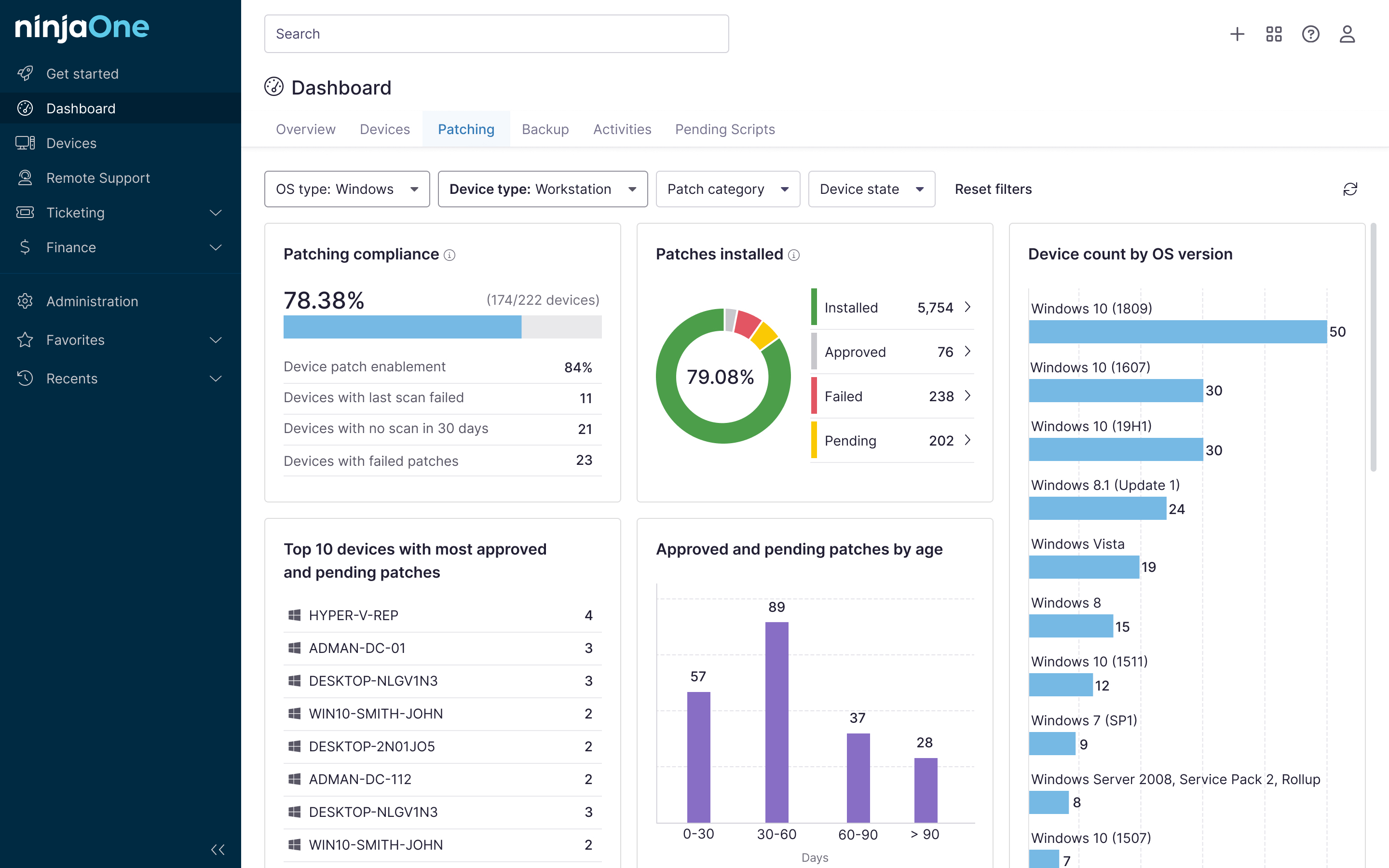
Email management becomes significantly more effective when you understand what is going on. This is where having integrations with an enterprise-ready IT management platform like NinjaOne comes in handy.
A centralized dashboard can provide 360-degree visibility into authentication anomalies. Once anything suspicious occurs, alerts are immediately sent to your support team. This also supports robust reporting for audit readiness and governance reviews.
When email events are visible alongside broader IT telemetry, resolution times decrease, and recurring issues become easier to diagnose.
Why email must align with endpoint and identity governance
While monitoring helps detect issues, access enforcement determines whether they happen in the first place. We recommend integrating your email systems with endpoint governance to ensure that only compliant, managed devices can access corporate communications.
Central endpoint managers provide insight into device posture, encryption status, and configuration compliance. When email access policies use this context, organizations can enforce conditional access based on both user identity and device trust. This alignment prevents email from becoming an isolated entry point within an otherwise governed environment.
Common misconceptions
Enterprise email management is often misunderstood because many people still associate it with a single tool or function. In reality, however, this framework often intersects with identity governance, endpoint security, and user experience.
Let’s look at other misconceptions and the actual truths behind them.
1. Misconception: Email security is only about filtering spam and malicious attachments
Ask a stranger about email security, and the standard answer would (most likely be) somehow related to spam.
And you know what? We get it.
But the truth is that this only represents one layer of protection.
The truth: Enterprise email management also includes authentication controls, encryption standards, access governance, retention policies, and lifecycle management that collectively protect both communication and data.
2. Misconception: Endpoint management tools automatically secure emails.
Even with the best endpoint management tools, email security requires a deeper, more nuanced approach. It is a misconception that once a device is managed, any and all emails coming from (or received by) it are automatically protected.
The truth: While endpoint governance is essential, email security requires integration with identity systems and aligned policy enforcement to ensure secure access.
3. Misconception: Compliance is separate from email operations.
When you hear the terms “HIPAA” or “GDPR,” emails rarely come into your head. And yet, this very misconception can create blind spots in email governance.
The truth: Email frequently contains personally identifiable information, making retention policies, audit logging, legal holds, and DLP controls essential components of enterprise email management.
4. Misconception: Strong security controls always reduce productivity
A surprising (and still rampant) misconception is that strong security controls slow employees down. This only gets exacerbated by poorly designed policies.
The truth: Well-designed enterprise email controls balance usability with protection, improving both security posture and operational efficiency while minimizing risky workarounds.
Developing an excellent enterprise email policy framework
A strong enterprise email management strategy integrates security controls, compliance governance, endpoint context, and operational visibility into a unified framework.
By aligning email policies with endpoint governance, organizations protect communications without sacrificing usability. When email management becomes part of broader IT operations rather than a standalone function, risk posture improves and operational efficiency increases.
Related topics: