Key Points
- Modernization of government IT involves architecture redesign, infrastructure transformation, application modernization, governance changes, and policy alignment.
- These practices help public sector organizations improve their security, resilience, and public services, which typically cannot be achieved with legacy systems alone.
- Modernization efforts improve citizens’ experiences through service speed, dependability, better data sharing, and increased productivity for government employees.
- Challenges in government IT modernization include system adoption, data migration, workforce education/training, and impact on projects with long timelines.
Government IT modernization involves practices that help public sector organizations improve their security, resilience, and public services. It’s an imperative plan of action to replace or enhance legacy systems, strengthen defenses, and improve how technology supports mission-critical work across federal, state, and local agencies.
In this blog, we will help you understand what encompasses government IT modernization techniques, why this matters, and how it improves how technology supports mission-critical work across federal, state, and local agencies.
What government IT modernization means
From the name itself, government IT modernization is a structured strategy that aims to improve legacy or stagnated systems within government IT infrastructure. The process encompasses the following:
- Replacing or refactoring legacy systems: Improvements of old systems by replacing them with modern and scalable platforms
- Strengthening cybersecurity: Enhancement of security and compliance that can prevent more sophisticated attacks
- Introducing automation: Deployment of automation in critical tasks to reduce manual interventions and human errors
- Enhancing reliability: Ensures systems benefit from reduced risks and improved resilience posture
- Enabling seamless digital services delivery: Helps with streamlining and promoting efficient delivery of public services to citizens and businesses.
Why legacy systems drive modernization
Due to factors like budget constraints and issues with adoption, many government agencies still use stagnated systems that may not be able to adapt to today’s security threat prevention practices and digital service expectations. These legacy technologies often:
- Lack modern cybersecurity capabilities
- Require scarce expertise to maintain
- Impede innovation and adaptability
- Increase operational risk and cost
These limitations make modernization urgent, not optional.
Security and regulatory drivers
Cybersecurity challenges, such as the increasing sophistication of cyber threats against government systems and the evolving compliance policies, drive IT administrators of government agencies to enforce modernization. Legacy systems compound these challenges with their lack of modern controls like MFA, real-time monitoring, and zero-trust frameworks.
That’s what the continuous IT improvements are there for: to help meet regulatory requirements, enable better threat detection, and reduce the attack surface. Modernizing government IT infrastructure is a core component of national and organizational security strategy.
Budget and resource constraints
Government agencies would often face budget deliberations and scrutiny that impact undertakings, such as acquiring components in modernizing IT infrastructures. This directly affects government IT modernization efforts. However, inefficiencies due to outdated systems may cost more, especially when vulnerability risks are at play. In this case, government organizations are encouraged, mandated, or incentivized to modernize within tight financial limitations.
Impact on public services
Modernizing IT environments significantly improves the experiences of citizens through the advantages of modern ways in which government agencies deliver services. The key benefits include:
- Speed: Faster and more intuitive digital experiences
- Dependability: Increased reliability and uptime
- Better data sharing: More streamlined and secure data sharing practices across agencies
- Increased productivity: Reduced backlogs and manual processing
Anything that enhances citizens’ experiences can add to their satisfaction and trust. Public service transformation through IT modernization can also narrow the gap between public and private sector service experiences.
Operational resilience and continuity
The risks of disruptions will always be there. This warrants operational resilience for government organizations for uninterrupted service delivery to citizens. Modern IT systems support resilience and continuity through the following:
- Redundancy: Government agencies should have a backup system in case of cyberattacks, natural disasters, or system outages.
- Real-time monitoring: SIEM, SOC operations, EDR/XDR, continuous diagnostics and mitigation (CDM) programs (federal) can help alert IT administrators if a component of a system is failing or going over/under a set threshold.
- Robust disaster recovery capabilities: Service continuity also needs a reliable disaster recovery platform in case of data loss or compromise.
Legacy systems typically lack these features. Government IT modernization improves continuity planning and recovery capability by building fault tolerance and proactive response mechanisms into the IT environment.
Challenges and risk considerations
Government IT modernization is complex and involves more than upgrading technology. Agencies must consider:
- System adoption: Integration with existing mission-critical systems may be a challenge for some who use distinct legacy technologies
- Data migration: Movement of critical data, even within the organization, may pose security risks. This might also affect continuity planning, so data migration strategies should be in place.
- Education and training: The workforce needs to be trained for the changes, which involve upskilling or reskilling.
- Long project timelines: Planned projects with phased execution will be highly impacted by shifting priorities, budget fluctuations, and the rapid pace of technological evolution.
These challenges can be mitigated through proper planning pre-modernization.
Common misconceptions
Modernization is often misunderstood. Let’s clear up three common fallacies:
Modernization means moving everything to the cloud
This is not always the case. While cloud adoption is common, modernization can include hybrid and on-premises improvements to better fit mission needs. This is true especially for organizations that still use old systems that cannot be easily migrated. This also applies to government agencies that handle highly-protected data that needs localized control.
Modernization is purely a technology project
It’s much more than technology or even a cosmetic project. As described, government IT modernization involves moving parts such as changing processes, culture, and workforce skills to support new ways of working.
Modernization can happen quickly
This is not true for most public sector transformations. Many modernization efforts typically happen incrementally, taking several months or even years. Phased milestones are also utilized to reduce risk and maintain service continuity.
NinjaOne integration
NinjaOne can support government IT modernization. The platform has achieved FedRAMP authorization at the Moderate Impact Level, with Joint Authorization Board Provisional Authorization to Operate (JAB P-ATO) authorization pathway, allowing federal agencies to adopt the platform with confidence in its security and compliance posture. Additionally, it can:
- Provide visibility across legacy and modern systems
- Automate operations for repetitive and critical tasks
- Enhances security monitoring through robust RMM capabilities
Quick-Start Guide
NinjaOne does offer capabilities that support Government IT Modernization, and here’s how:
- Modernization is a Strategic Necessity
Modernizing IT infrastructure is no longer optional—it’s essential for security, efficiency, and compliance, especially in government sectors where outdated systems pose risks. - NinjaOne’s Role in Modernization
NinjaOne provides tools and features that align with government IT modernization goals, such as:- Centralized Management: Streamlines IT operations across devices and systems.
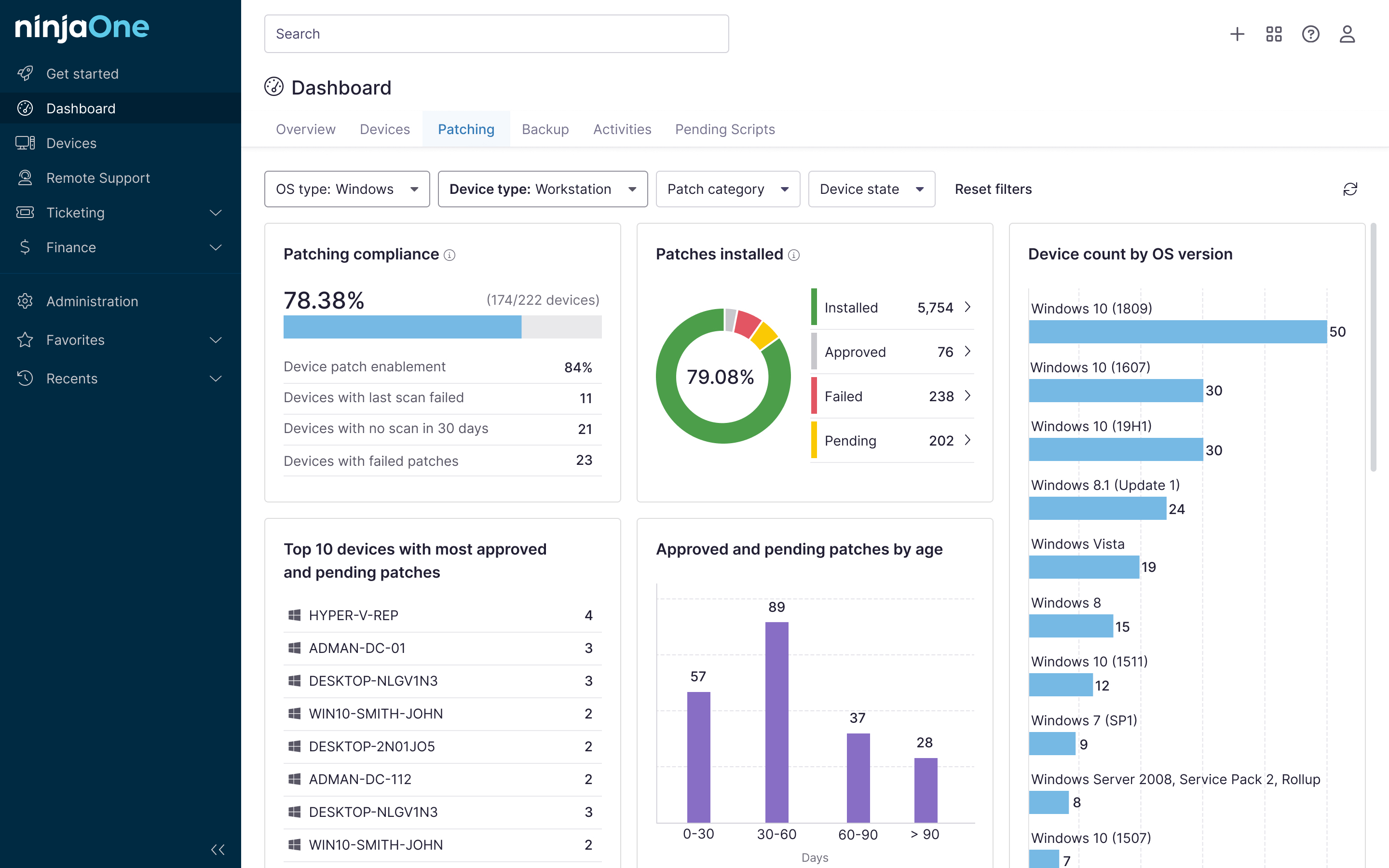
- Automated Patching & Updates: Ensures systems remain secure and up-to-date.
- Compliance & Reporting: Helps meet regulatory requirements with robust audit trails and reporting.
- Scalable Solutions: Supports large-scale deployments typical in government environments.
- Relevant Features
- Vulnerability Management: Identifies and remediates security gaps.
- Cloud Integration: Facilitates migration and management of cloud-based resources.
- PSA Integrations: Connects with platforms like Autotask, ConnectWise, and HaloPSA for enhanced service delivery.
NinjaOne equips organizations—including government agencies—with the tools needed to modernize their IT infrastructure strategically and efficiently.
The significance of modernizing government IT
Cyber threats are getting more sophisticated by the day, and it’s only logical to upgrade old technologies, especially if they’re used in government service delivery. Modernization of government IT infrastructures helps public sector agencies boost service quality, improve efficiency, and build public trust.
Key takeaways:
- Government IT modernization is driven as much by risk reduction and mission continuity as by technology advancement.
- Legacy systems increase long-term cost and exposure even when they appear stable in the short term.
- Successful modernization depends on governance, process change, and workforce readiness, not just new platforms.
- Incremental modernization reduces disruption while building resilience and public trust over time.
By updating legacy systems and adopting more agile, secure, and resilient technologies, it can improve mechanisms that run the government IT environment and enhance citizens’ experiences.
Related topics: