Key Points
- Automation reduces manual errors and speeds up critical steps like access revocation and device handling.
- Auditable workflows with logging and validation make every offboarding repeatable and compliance-ready.
- A structured offboarding framework goes beyond checklists to cover security, compliance, and accountability end-to-end.
Offboarding is as important as any juncture in the journey between MSPs and clients or end users. An IT offboarding checklist can help ensure a smooth and professional process, but is it enough to satisfy all stakeholders?
This guide discusses a more nuanced approach to building an offboarding framework and how RMMs can strengthen security, compliance, and efficiency.
For a walkthrough of these steps, watch the IT offboarding framework video.
Get to know the offboarding lifecycle
The processes may vary, but the following core stages are crucial to any offboarding.
Offboarding stage | How it works |
| Initiation | The offboarding begins when HR, a PSA workflow, or a service request notifies IT of a departure. |
| Access revocation | In this step, user accounts, MFA tokens, and permissions are deactivated across systems to prevent unauthorized access. |
| Device recovery and sanitization | Company-owned devices are collected, wiped, and prepared for repurposing or secure disposal. Example: A laptop is returned, reimaged using Microsoft Intune or an equally capable software, and logged back into the asset inventory. |
| Knowledge handoff and archiving | Critical knowledge, project data, and communications are transferred and stored securely. Example: Archiving an Exchange mailbox, moving project notes to Confluence, and recording a walkthrough video. |
| License reallocation and monitoring | Freed-up licenses are reassigned or released to avoid waste and ensure compliance. |
| Audit and closure | Final checks confirm that all tasks are completed, and audit logs are stored for compliance. |
Some of these steps are usually only tagged as completed upon an audit or approval. For example, PSA tickets can only be closed after a manager validates device collection, access revocation, and documentation handoff.
That said, there are also processes that are best automated once conditions are met. For that, a PSA or an RMM like NinjaOne can be assigned to automate many offboarding tasks. You can download this end-user offboarding checklist to get a general idea.
For more about access termination, archiving, and auditing, check out these expanded insights for each stage and how an RMM platform offers solutions to some of the most pressing IT offboarding challenges.
Automate access termination and validation
Deactivation was traditionally done manually, which was prone to human error, especially at scale. Here are some common challenges and a way to fix them:
Common challenges:
- Missed MFA or shared account removal
- Unmarked tools or software (shadow IT)
- Accounts are spread across multiple systems
Access termination is the most urgent part of offboarding. Automation ensures speed, accuracy, and security. If so, it’s a win-win-win.
For Azure environments, PowerShell or AzureAD scripts can disable user accounts, archive data, and revoke MFA.
Here is a common script for renouncing user access:
PowerShell Example – Disable User Access:
Set-AzureADUser -ObjectId [email protected] -AccountEnabled $false
Verification Check:
Get-AzureADUser -ObjectId [email protected] | Select AccountEnabled
For non-Azure environments, you may proceed using Active Directory, Google Workspace, or third-party RMM APIs. For NinjaOne, you can check out these scripts for user access and management.
An RMM also makes the offboarding lifecycle auditable, which is essential for compliance and conflict resolution. Watch this video on how to improve IT onboarding and offboarding for end-users.
Capture knowledge and operational memory
Outgoing employees often carry unique client knowledge with them. MSPs might risk service disruption without a structured handoff and archiving process.
Common challenges:
- Staff rush or resist knowledge transfer
- Documentation is incomplete or outdated
- Information is scattered across inboxes, drives, and other platforms
Automation also addresses many gaps during this stage of offboarding. For instance, user management tools and software can automate archiving inboxes, shared folders, and project notes. An RMM also brings centralized storage for retrieved assets and offboarding modules.
On the practical side, a 30-minute knowledge transfer session is often more valuable than the traditional documentation checklist. The NinjaOne Remote® feature can help with these sessions aside from facilitating knowledge transfers.
Enforce governance with ticketing and audit logs
Auditing requires a consolidated effort from IT and the tools they use. The RMM may help ensure every step is traceable, repeatable, and auditable, but MSPs and clients are equally responsible for closing tickets and validating closure checklists.
Common challenges:
- Missing devices or file storage credibility
- Lack of accountability for untracked actions
- Gaps are discovered only during audits or client escalations
One way to enforce visibility and control over this stage is to create offboarding workflows in PSA tools or RMMs. Each step must have audit trails for traceability and validation. These logs should also help fill in reports for further auditing and client escalations. Audit logging is a core feature of NinjaOne.
Additional RMM benefits for auditable IT offboarding
A resilient offboarding framework goes beyond user access and management. An MSP can add value to the service by integrating compliance, reporting, and visibility into the process.
Integrate with compliance and QBR processes
Transparency is crucial to IT compliance. As a result, IT environments are often reliant on endpoint visibility and user management. MSPs, in particular, use RMMs to provide scalable governance over the client’s network and assets.
In some cases, clients only hear about offboarding when issues occur. But MSPs with a thorough grasp of SOC 2, ISO 27001, and HIPAA compliance standards are wise to track and provide remediation summaries regularly.
These frameworks also promote immediate action, including swift revocation of access rights. But it doesn’t end there since repeatability (i.e., offboarding happens the same way every time, with evidence) is also expected. Again, this falls into the realm of automation, which any capable RMM can deliver on demand and at scale.
Visual tracking and risk reporting
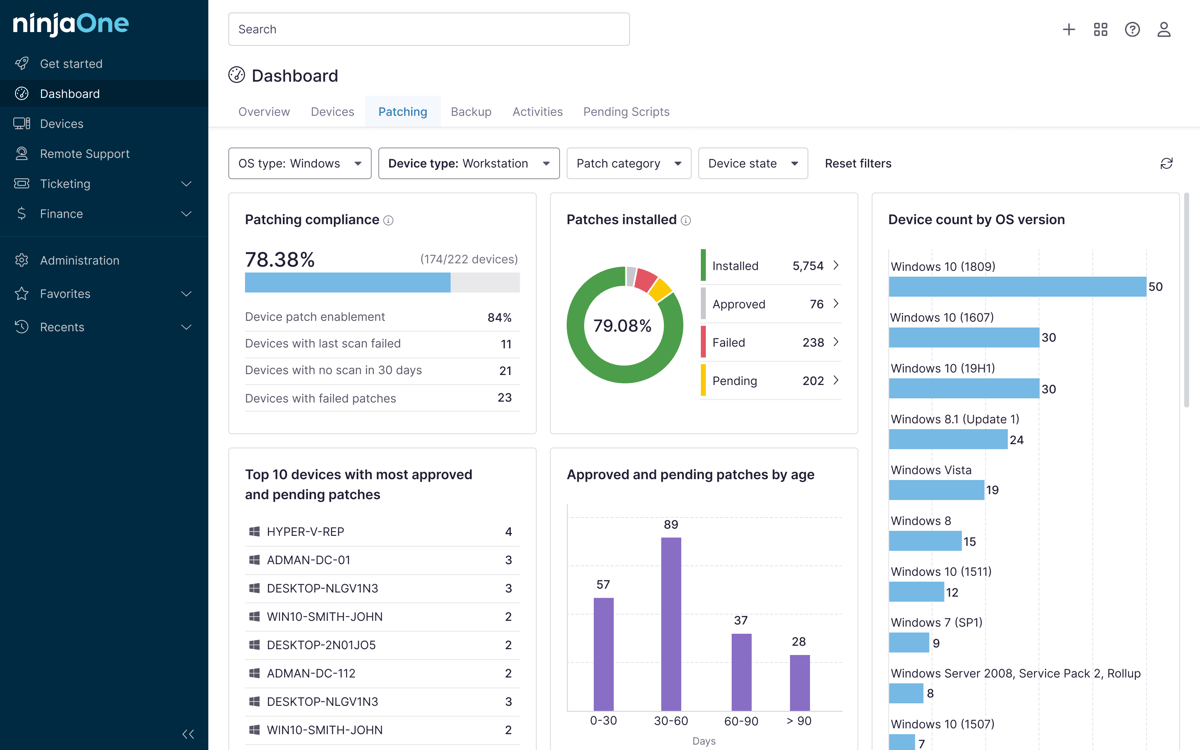
The NinjaOne unified IT management dashboard combines endpoint management, endpoint security, remote access, user management, and IT reporting (*and more) in a single platform.
IT administrators benefit greatly from this setup since they can rely on automation for repeatable tasks, while maintaining clear visibility over actionable events and interactions. Likewise, it helps offboarding workflows become consistently auditable and risk-averse.
Auditable and compliant offboarding workflows with RMM
Ensuring compliance alignment is integrated into your offboarding framework not only protects client data but also helps with reduced cost and overall efficiency. When auditable and transparent, offboarding can become a competitive advantage in IT services.
Here are some NinjaOne integrations to improve your offboarding workflow:
- Use custom scripts to deactivate users, remove agents, or validate actions
- Tag offboarded devices for pending wipe or repurposing
- Generate compliance logs via scripting and attach to PSA tickets
- Monitor endpoint activity to catch delayed decommissions or asset ghosting
MSPs need an offboarding framework, not just a checklist. Auditability, automation, and documentation are key to scalable execution, whether it’s onboarding or offboarding users.
Related topics:
- How to Improve End User Management in 2026
- Endpoint Visibility: What It Is & How to Achieve It
- [Video] Improving Your Onboarding and Offboarding Process for New Users
Quick-Start Guide
NinjaOne’s Offboarding Framework Capabilities
Key Security and Audit Features:
- Vulnerability Management
- Comprehensive vulnerability scanning and tracking
- Centralized dashboard for vulnerability reporting
- Integration with multiple security tools (Tenable, Qualys, Rapid7)
- Automated vulnerability import and remediation
- Identity and Access Management
- SCIM (System for Cross-domain Identity Management)
- Supports Service Principal Authentication
- User account deactivation and role management
- Group and permission synchronization
- Device Management
- Remote device monitoring
- Asset tracking and inventory management
- Device health and compliance tracking
- Remote device wiping capabilities
Offboarding Workflow Recommendations:
- User Account Deactivation
- Use SCIM to automatically disable user accounts
- Track and revoke access across multiple systems
- Maintain audit logs of account status changes
- Device Management
- Use remote wipe scripts
- Remove devices from management
- Capture device inventory and configuration before removal
- Compliance and Auditing
- Maintain detailed logs of offboarding actions
- Track device and user status changes
- Generate reports for compliance documentation
Additional Security Considerations:
- Integrate with security tools like SentinelOne
- Use vulnerability importers to track potential security risks
- Implement least-privilege access principles