

Key Points
- Mapping MSP services to CMMC controls helps government contractors achieve audit readiness and clarify responsibility ownership across IT and security operations.
- MSPs can support CMMC Level 2 compliance by aligning services such as endpoint management and vulnerability management with NIST 800-171 and FedRAMP requirements.
- Centralized compliance mapping, continuous monitoring, and measurable audit evidence improve operational consistency and help MSPs scale secure managed services for regulated industries.
Mapping managed service provider (MSP) services to Cybersecurity Maturity Model Certification (CMMC) controls supports audit readiness and strengthens client relationships. By being able to effectively and demonstrably provide a broad range of CMMC-compliant IT services, MSPs can turn what is often seen as a compliance burden into an opportunity to expand or solidify their business in the government contractor space.
This guide explains how you can map the IT services you provide to the relevant CMMC requirements that they support, including NIST 800-171, FedRAMP, and how ownership and clarity enable compliance and streamline auditing.
Service-to-control mapping is central to the success of CMMC compliance
CMMC compliance requirements are based on the data that an organization handles, categorized into Federal Contract Information (FCI) and Controlled Unclassified Information (CUI).
Mapping MSP services to CMMC controls helps ensure that compliance requirements are directly supported by operational activities. This means that responsibilities are clear with defined boundaries that close gaps, controls are fully and consistently implemented, and that the resulting documentation supports validation and auditing.
Why service-to-control mapping is beneficial for MSPs
Organizations that work with sensitive data in either contractor or subcontractor roles rely on MSPs to understand and implement CMMC requirements on their behalf, translating them into operational services. Mapping the services provided, the controls they implement, and how these directly satisfy each requirement makes it clear to clients that they are compliant, enhances compliance itself by closing responsibility gaps, and assists with assessment and auditing.
MSPs that handle data on their US government contractor clients’ behalf may also need to be compliant themselves, and can also benefit by generating repeatable compliance processes that scale across clients – improving the security posture of their customer base and providing opportunities to serve other similar businesses.
Understanding the structure of CMMC controls
CMMC Level 1 requires basic controls and is self-assessed. CMMC Level 2, however, requires more advanced controls and is assessed by an authorized third-party assessment organization (C3PAO). This level is based on NIST 800-171.
To provide compliant IT services, or services that enable your clients’ compliance, you will need to cover NIST 800-171 control families, including:
- Access control
- Configuration management
- Identification and authentication
- Incident response
- System and information integrity
As part of CMMC Level 2 compliance, you may also require FedRAMP authorization if you provide cloud services.
Mapping core MSP services to control families
The specific services you offer, and the nature of your clients’ work with sensitive US government data, will define the CMMC-prescribed controls required.
Mapping can be a simple matrix that matches a control to the technology or product used, for example:
- Identity and access management (IAM) services support identity and authentication controls
- Endpoint management supports configuration and system integrity controls
- Security monitoring supports incident response requirements
- Patch management supports vulnerability and system maintenance controls
In many cases, MSPs that offer these services are themselves compliant, or close to it, through the implementation of security and data protection best practices. Mapping the services you offer with CMMC control requirements clarifies what additional work needs to be done (CMMC requires 80% of the 110 listed control measures be met to be compliant) to achieve compliance.
Define ownership for each control
Ownership and responsibility gaps – either due to incomplete planning or implementation, or due to drift – compromise compliance.
Not all controls are strictly IT-related (such as physical controls), so you must clearly determine:
- Which controls are managed by the MSP
- Which controls remain with the client
- Where responsibilities are shared
- Who, within each organization, takes ownership of the ongoing effectiveness each specific control
Clearly defined roles are critical to ensuring coverage. You do not want to not discover during an audit that key measures were not taken simply because the responsible team member thought it was someone else’s job.
Aligning IT services with NIST 800-171 requirements
CMMC Level 2 is based on NIST 800-171, and MSP services should be mapped accordingly.
As with all legally mandated and enforced standards and frameworks, when it comes to final planning and implementation, you must refer to the most recently officially published resources to ensure that you are completely covered.
What about FedRAMP and CMMC?
FedRAMP does not apply to all organizations that must meet CMMC Level 2 compliance. However, if you provide cloud services (or services that relate to them, for example using shared infrastructure) that handle sensitive data, you will need additional FedRAMP authorization to obtain CMMC Level 2. Due to this, many MSPs will need to seek FedRAMP or use FedRAMP authorized remote monitoring and management (RMM) tools.
As with broader CMMC requirements, if FedRAMP is required, the controls implemented to meet it should also be mapped to MSP services and assigned clear ownership.
Ensuring configuration and control consistency across IT environments
To ensure gapless coverage and ready validation, service-to-control mapping should be consistent across systems. Compliance platforms provide insights into this, while automated IT management tools provide the mechanism for enforcement.
Regularly reviewing standardized configurations and repeatable processes ensures documentation is up-to-date, and provides audit-ready evidence of compliance.
Measurable outcomes are required to prove CMMC compliance
Proof of compliance requires evidence, so outcomes must be measurable. Aligning services with requirements helps you identify the right historical information and metrics to collect to prove ongoing compliance. This evidence may be in the form of training material, policies, vendor documentation, and information collected from your IT infrastructure monitoring.
How service mapping improves MSP service delivery
While audit outcomes are the primary goal, you can also see improvements to operational effectiveness across your client base through thorough documentation of your services, how they align with compliance frameworks (not limited to just CMMC), and how they can be streamlined and made efficient through overlapping requirements.
Compliance planning, documentation, and review eliminate gaps in service coverage, encourage standardization, and lead to improved scalability. Meanwhile, these benefits can be shared with clients (even those who do not require compliance), demonstrating a commitment to a strong security posture.
Supporting audit validation through comprehensive service mapping
With measurable outcomes defined and hard data to back their effectiveness, compliance auditing is simplified.
You will have, ready and on hand in the event of an unexpected audit:
- Clear evidence of how controls are implemented
- Easier validation by assessors
- Reduced ambiguity in responsibility
- Improved documentation alignment
This proof is useful for internal purposes as well: your clients will rely on you to manage many aspects of compliance, and evidence of this is valuable for presentation during client check-ins.
Compliance mapping must be centrally documented
CMMC auditing does not assess the current compliance state of an organization – it requires proof that you have been continuously compliant.
Accurate documentation centralized in a documentation platform is the ideal repository for this. Additionally, maintaining clients’ documentation and compliance data can be offered as a managed service, providing an additional income stream or value-add for MSPs, and establishing a vital single source of truth for compliance status.
CMMC compliance as a market opportunity for MSPs
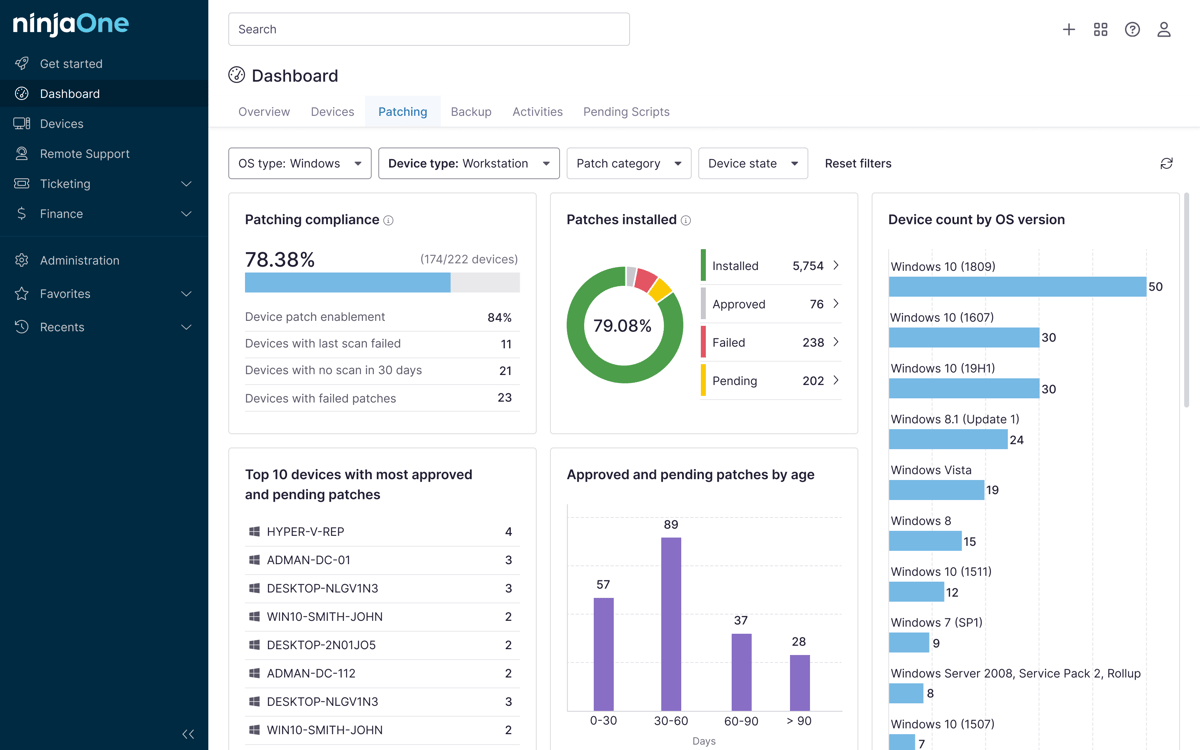
CMMC compliance cannot be granted by a single platform, but it is the application of the right tools to implement the controls required to secure data. NinjaOne provides a FedRAMP-authorized MSP platform that gives you the tools to implement over 90% of CMMC controls, with supporting tools to help you ensure that you get it right – continuously, with documented evidence.
Unifying RMM, mobile device management (MDM), vulnerability and patch management, documentation, and endpoint security with a suite of IT tools, NinjaOne helps you reduce compliance risk while improving support outcomes. By granting oversight with robust security controls and monitoring, you can keep client infrastructure in alignment with business goals and ensure CMMC controls meet compliance objectives.