

Key Points
- MSPs don’t necessarily need CMMC certification, but they’re still in scope, especially if they access or manage systems containing CUI and FCI.
- The most relevant CMMC requirement for MSPs centers on Level 2, which maps to the 110 controls in NIST SP 800-171 Rev. 2.
- Certain keywords, such as “DoD Contract,” “DFARS,” “CUI/FCI,” and “audit-ready,” mentioned on a discovery call indicate a CMMC opportunity.
- CMMC scope is limited to systems that process, store, or transmit CUI/FCI. Understanding this boundary upfront helps MSPs prevent over-scoping and reduce cost.
- FedRAMP-Authorized tooling has become a must in CMMC-regulated environments. MSPs must verify that their RMM, patching, and management platforms meet FedRAMP standards.
The Cybersecurity Maturity Model Certification (CMMC) doesn’t have to turn every discovery call into a compliance deep dive. For managed service providers (MSPs), the goal is to recognize when a prospect is in the CMMC space, qualify quickly, and guide the next step with confidence.
CMMC is a cybersecurity framework created by the U.S. Department of Defense (DoD) to help protect sensitive data across the defense supply chain. It’s designed to safeguard Federal Contract Information (FCI) and Controlled Unclassified Information (CUI) handled by DoD contractors and suppliers.
CMMC requirements are beginning to appear in DoD contracts and are expected to phase in over several years as DFARS rulemaking and contract adoption continue. Many defense contractors are already preparing for assessments as these requirements expand. MSPs that access or manage systems containing FCI or CUI often inherit contractual and security control responsibilities related to those environments — even if the MSP is not itself required to obtain CMMC certification.
Understand CMMC faster with our comprehensive MSP-focused guide.
The 30-second overview for MSPs
Most MSPs are not required to pursue CMMC certification themselves. Instead, they typically must demonstrate that the services and technologies they provide support the contractor’s ability to meet required CMMC controls. Although the MSP may not be required to achieve CMMC certification, the tools and services they provide will likely fall under the scope of the clients’ assessments and audits. As a result, the MSP’s security posture can directly affect the client’s audit outcome.
- If a prospect mentions DoD, subcontractor relationships, NIST SP 800-171, CUI/FCI, FedRAMP, or government cloud environment requirements, it’s usually a strong signal that CMMC-related compliance discussions are likely to follow.
- You don’t need to be a compliance expert to qualify a CMMC opportunity. Focus on scope, responsibilities, and evidence.
- Many MSP conversations in this space center on CMMC Level 2, which aligns with NIST SP 800-171 requirements for protecting CUI.
- The fastest way to build credibility is to ask better questions and be clear about what you can (and can’t) prove.
Start with the cues
If you hear any of the keywords below, pause your standard MSP discovery flow and move into CMMC qualification:
- DoD/defense contract
- Prime contractor/subcontractor
- NIST SP 800-171
- DFARS (Defense Federal Acquisition Regulation Supplement)
- CUI / FCI
- Audit, assessment, “we need proof”
- FedRAMP
- ITAR (International Traffic in Arms Regulations)
These terms usually mean the prospect is feeling pressure to demonstrate control alignment and produce evidence, not just “improve security.”
When those keywords show up, the next step isn’t a full compliance consult; it’s a quick scoping conversation to confirm whether CUI/FCI is in play.
Use this qualification flow
MSPs can often determine whether a CMMC opportunity exists quickly by getting clarity on three things: what’s in scope, what you’re responsible for, and what proof will be expected (and by when).
1) Confirm contract and data reality
Ask:
- Are you a prime contractor or subcontractor for the DoD, or do you support one?
- Do you handle CUI, FCI, or both?
- Which systems, users, or teams touch that data?
What you’re looking for: a clear link between DoD-related work and the environments you manage.
2) Clarify scope
Ask:
- Which systems are actually in scope for CUI/FCI (systems that process, store, or transmit that data)?
- Is that data segmented to specific users/devices, or spread across the environment?
Why this matters: scoping mistakes create unnecessary cost, complexity, and risk. Scope is typically limited to systems that process, store, or transmit CUI/FCI, not automatically the entire environment.
3) Validate the readiness “pressure point”
Ask:
- Are CMMC clauses showing up in your new or renewed contracts yet?
- Do you have an upcoming assessment, contract renewal, or prime/vendor review?
- Are you aligning with NIST SP 800-171, or just starting?
What you’re looking for: a timeline that turns “interesting” into “urgent.”
Align your MSP service offerings to meet clients’ CMMC compliance needs.
See how NinjaOne strengthens security and simplifies compliance.
Next steps: Set up the scoping call (gather responsibilities + evidence)
After the customer confirms they handle CUI or FCI, move to a short scoping call to document what you’ll manage for the in-scope environment, and what evidence the customer or prime will expect you to provide. MSPs may inherit security and evidence obligations when they access, administer, or host systems containing FCI or CUI, so this step prevents scope creep and last-minute audit scramble.
- Confirm which services you’ll deliver for in-scope systems (patching, monitoring, configuration, reporting).
- Confirm what equivalent controls mean for the systems you manage, and what proof is required (reports, audit trails, logs). Equivalent controls typically mean demonstrating technical and operational safeguards that support the contractor’s required CMMC control outcomes.
- Confirm whether the customer requires tooling to run in a FedRAMP-Authorized environment.
Common gotchas to catch early
These misunderstandings stall deals or derail implementation:
- “CMMC applies to everything we do.”
- CMMC scope is tied to systems handling CUI/FCI, not necessarily every IT asset.
- “The contractor gets certified, so the MSP isn’t involved.”
- If you access or manage in-scope systems, you’re part of the security control story.
- “Our MSP must be certified.”
- Often the contractor is the certified entity, but MSPs may still need to demonstrate equivalent security controls for the systems they manage.
How to position the next step
Keep it consultative and concrete:
- Lead with business impact: eligibility to support DoD-related work, customer trust, and audit readiness.
- Avoid getting lost in acronyms: focus on scope, controls, and evidence.
- Be explicit about boundaries: what your team can automate and prove versus what requires customer policies and procedures.
A strong next step is a short scoping call focused on:
- Identifying in-scope environments and workflows tied to CUI/FCI
- Confirming whether CMMC Level 2 alignment (NIST SP 800-171) is the target
- Outlining what evidence the customer or prime will expect from the MSP
- Clarify which compliance responsibilities belong to the MSP versus those that remain with the contractor or compliance advisor.
How NinjaOne can help MSPs support CMMC readiness
MSPs supporting contractors that handle CUI frequently need to support environments aligned to CMMC Level 2 (NIST SP 800-171), while maintaining visibility, automation, and control across every managed customer environment. Many legacy IT management tools were not designed to help MSPs consistently demonstrate compliance evidence across multiple customer environments.
NinjaOne helps MSPs operationalize, automate, and demonstrate technical controls that support CMMC readiness, allowing MSPs to help defense clients maintain contract eligibility without becoming compliance auditors themselves.
NinjaOne is the only FedRAMP-Authorized, multi-tenant MSP platform built for speed and simplicity.
- FedRAMP-Authorized foundation: Helps MSPs operationalize and demonstrate controls aligned to NIST SP 800-171 / CMMC Level 2 expectations.
- Built for MSPs: True multi-tenancy, automated patching, and consolidated visibility across customer environments.
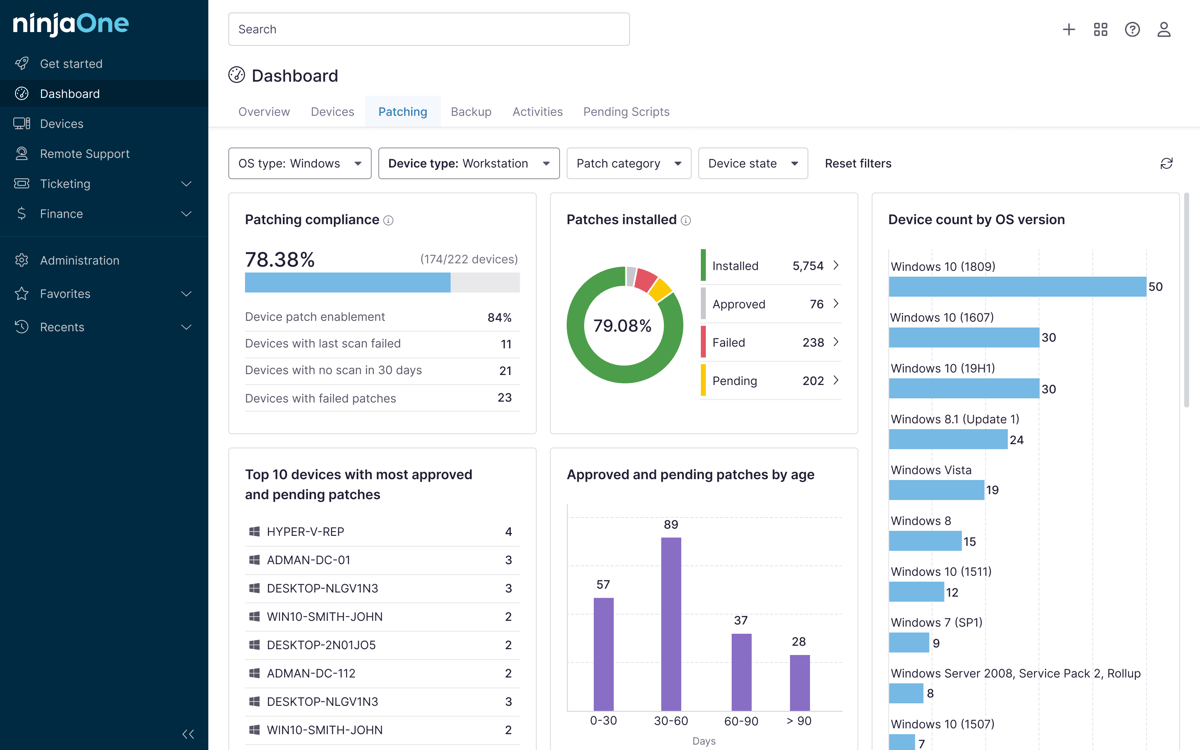
- Automation-driven: Policy-based patching, remediation, and audit reporting mapped to key CMMC Level 2 / NIST SP 800-171 controls.
- Secure by design: Role-based access control (RBAC), multi-factor authentication (MFA), encryption, and comprehensive audit logging for administrative actions.
- Rapid deployment: Typical deployments can be completed in weeks, depending on environment complexity and onboarding requirements. In fact, 92% of NinjaOne MSPs are fully operational in 30 days.