Key Points
- Vulnerability management combines assessment (scanning) with remediation (patching and configuration). Many vendors specialize in one; pick the best solution based on your gap.
- Top vulnerability management tools in 2026: 1. NinjaOne, 2. Sprinto, 3. Automox, 4. Orca Security, 5. Tenable Nessus, 6. Saner CVEM, 7. Qualys VMDR, 8. InsightVM, 9. VulScan, 10. Arctic Wolf.
- The best vulnerability management tool features automation (quiet, scheduled), real-time reporting/alerts, risk-based prioritization, and continuous detection with full asset visibility (“single pane of glass”).
- NinjaOne stands out because it offers unified endpoint visibility across Windows/macOS/Linux, zero-touch patching and scripting for fast remediation, and strong usability; user reviews also cite a rapid path to high patch compliance.
Searching for the best vulnerability management tools in the market today? You’ve come to the right place. We’ve done all the research, compiled data from leading review sites (such as G2 and Capterra), and created this comprehensive guide on what to look for when selecting the best software vulnerability management tools for your business.
For a quick visual overview, watch our video guide: Best Vulnerability Management Tools for IT Professionals
Best vulnerability management tools at a glance
Rank | Vendor | Software type | Features | Trial information |
| 1 | NinjaOne | Unified IT operations with vulnerability management | Zero-touch patching, real-time monitoring, automation, cross-OS support | 14-day free trial |
| 2 | Sprinto | Compliance and vulnerability management | Automated remediation, policy enforcement, risk prioritization | 14-day free trial |
| 3 | Automox | Cloud-native patching and vulnerability management | Vulnerability sync, automated cross-platform patching, config management | 15-day free trial |
| 4 | Orca Security | Cloud-native application protection platform (CNAPP) | Endpoint and cloud workload scanning, risk-based remediation, automation | Demo or trial available |
| 5 | Tenable Nessus | Cloud-based vulnerability management | Asset discovery, automated risk prioritization, real-time scanning and reporting | 7-day free trial |
| 6 | Saner CVEM | Endpoint security and vulnerability management | Continuous scanning, patch deployment, compliance checks (PCI, HIPAA, NIST) | Free trial available |
| 7 | Qualys VMDR | Cloud-based vulnerability management and patching | Asset detection, continuous monitoring, prioritized remediation | 30-day free trial |
| 8 | InsightVM | Cloud and on-prem vulnerability management | Agent/agentless scans, live dashboards, policy assessments, integrations | 30-day free trial |
| 9 | VulScan | Vulnerability management scanner | Internal scans, multi-tenant management, noise reduction for alerts | Demo request only |
| 10 | Arctic Wolf | Managed vulnerability management service | Continuous scanning, concierge-led risk management, automated remediation | Demo request only |
What are vulnerability management tools?
Vulnerability management is the process of identifying, assessing, remediating, and managing cybersecurity vulnerabilities in your IT network. It’s a critical part of any strong IT environment, especially because unresolved security vulnerabilities can expose your organization to data breaches and other cyber threats.
The best vulnerability management tools reduce the attack surface of your IT network, improve your organization’s security posture, help you meet regulatory compliance requirements, and minimize business risks. As you can see, vulnerability management plays a critical role in your business’s success. In fact, it can be argued that every successful business has some form of internal vulnerability management tool.
4 key features of top vulnerability management tools
1. Automation
Your vulnerability management solution should work silently in the background with automated scans and alerting systems in place. Keep in mind that while the main goal of vulnerability management is to reduce perceived weaknesses and flaws in your IT network, your tool shouldn’t disrupt your end users. This is best achieved with IT automation that reduces manual intervention and frees your IT technicians to perform high-value tasks.
2. Reporting and alerts
Reporting for your vulnerability management should be robust, effective, and performed in real time. The last part is extremely important: your reporting tool should be able to generate accurate reports based on the latest data. This allows you and your IT team to perform the most appropriate actions to resolve issues.
3. Prioritize issues
Great vulnerability management solutions can prioritize issues based on severity. This optimizes the performance of your IT team as every technician knows exactly what their workload is and which issue to resolve first. If possible, look for a vendor known for its fast first-response times.
4. Vulnerability detection
Vulnerability management relies on a proactive IT approach. This means resolving detected issues and continuously scanning your IT network to discover any weaknesses or vulnerabilities. By actively searching for vulnerabilities, your organization can stay ahead of emerging risks, adapt its defenses accordingly, and maintain its competitive advantage.
What tools combine vulnerability scanning and management?
When it comes to understanding what a vulnerability management tool does, it’s one thing to scan vulnerabilities, and it’s another to combine such detection with remediation. This distinction is crucial to consider as some businesses may prefer a solution that offers both features to better close the gap between merely finding a vulnerability and fixing it.
The solutions covered in this article that combine vulnerability scanning and management are:
- NinjaOne, providing unified scanning-equivalent monitoring with zero-touch patching in one console
- Saner CVEM, offering continuous scanning with native patch deployment
- Automox, pairing detection with automated cross-platform patching
- Qualys VMDR, delivering detection and prioritized remediation in one platform
- Arctic Wolf, featuring continuous scanning with automated remediation workflows
That said, the depth of remediation varies by vendor; Arctic Wolf’s remediation, for example, runs through a concierge security team rather than self-serve automation. So it’s worth reading each tool’s full entry below to see how “combined scanning and remediation” plays out in practice.
How to use this guide on the best vulnerability management tools
When using this guide, it’s important to remember that vulnerability management, as a category, essentially comprises two functions:
- Vulnerability assessment, which includes scanning devices and endpoints for any potential technical flaws
- Vulnerability remediation, which involves patch and non-patch strategies to maintain the health of your IT network
Many companies specialize in one or the other function of vulnerability management. They may only perform continuous and regular scanning or implement automated patch management software to update business applications on an endpoint device.
Deciding which vendor is most suitable for you depends on what you need your vulnerability management tool for. Ideally, find software that enables you to proactively address weaknesses, strengthen your current IT defenses, and reduce your risk of cyberattacks.
Explore NinjaOne Endpoint Management
Unify visibility and control across all devices to reduce complexity, improve efficiency, and strengthen security all from a single console.
Learn more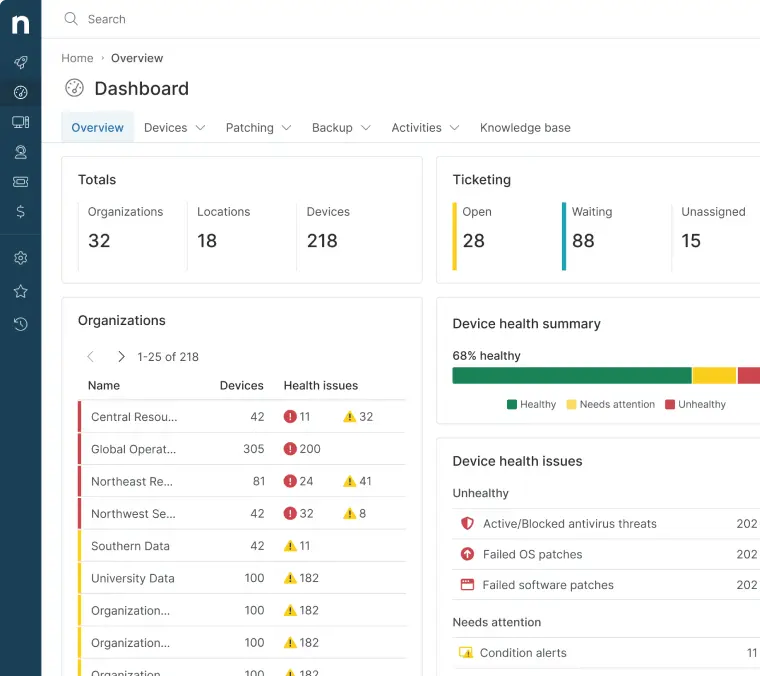
10 best vulnerability management tools for IT professionals
All G2 and Capterra ratings data as of September 2026.
1. NinjaOne
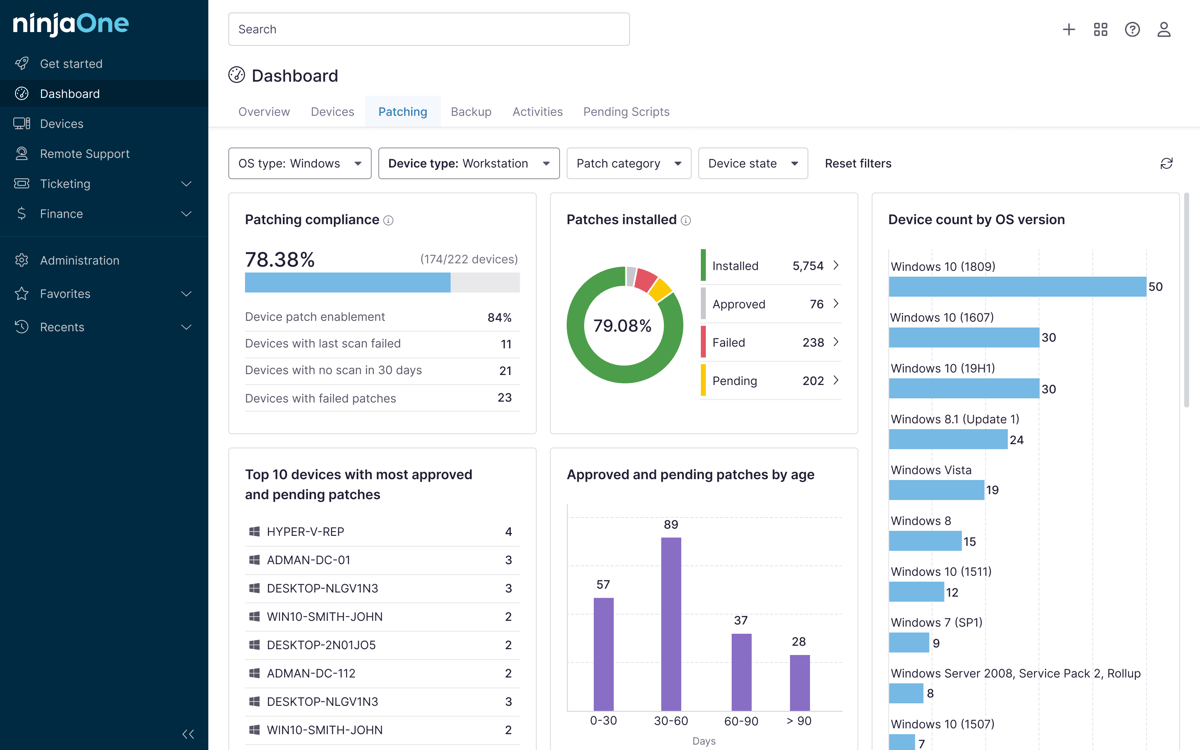
NinjaOne is a unified IT operations platform with a vulnerability management and mitigation capability that minimizes your exposure to security weaknesses through real-time monitoring, alerting, and robust automation. It allows you to quickly identify and resolve endpoint patching and configuration issues in all your Windows, macOS, and Linux devices from a single pane of glass.
NinjaOne believes in proactive device monitoring and supports IT teams with up-to-date zero-touch patching and scripting capabilities. Built by a team with a combined experience of over a century in IT management, NinjaOne’s vulnerability management helps you gain 360-degree visibility into your entire IT estate from a single, intuitive console that is easy to deploy, learn, and master.
Take control of vulnerability management before attackers find the gaps first.
Start your free trial of NinjaOne Vulnerability Management or watch a free demo.
Best for
NinjaOne works best for IT teams and MSPs that need unified management, patching, and risk-based vulnerability prioritization across Windows, macOS, and Linux devices from a single console.
Strengths of NinjaOne
1. Scan-free/zero endpoint impact architecture
NinjaOne utilizes a server-side correlation architecture that prevents disruption to end users. This means that scanning happens server-side, eliminating agent performance spikes or slowdowns on endpoints while they’re being assessed. It also gets rid of scan scheduling overhead, which means IT teams don’t need to plan, manage, or wait for scan cycles. This promotes faster vulnerability surfacing and remediation, keeping vulnerability data updated rather than only accurate immediately after a scan.
2. Autonomous patch management
NinjaOne Patch Management reduces vulnerability exposure by ensuring that all endpoints are consistently updated with the latest security patches for operating systems and software. IT teams can also perform third-party patching to ensure that all potential attack surfaces remain up to date with the latest security patches. NinjaOne automates patching to reduce delays and ensure consistency at scale, enabling organizations to remediate known vulnerabilities faster, reduce attack surfaces, and maintain compliance with security and regulatory requirements.
3. Intelligent vulnerability assessment
Using NinjaOne makes it easier for IT teams to prioritize addressing the most critical vulnerabilities first. NinjaOne leverages risk-based policies and automated patch deployment to identify, analyze, and rank vulnerabilities based on severity, exploitability, and business impact. NinjaOne Patch Intelligence AI further enhances this by analyzing vendor advisories, deployment signals, and real-world patch telemetry to determine patch health. This allows risky CVEs to be paused automatically while stable updates proceed. IT professionals can leverage this AI-driven assessment to make more informed patch deployment decisions that reduce system downtime and ensure patch stability.
4. Vulnerability-to-patch mapping
NinjaOne eases the complexities of preventing threats by automatically connecting detected vulnerabilities to specific patches that remediate them. This completely removes the process of manually cross-referencing patches to vulnerabilities, accelerating remediation decisions. Moreover, vulnerability-to-patch mapping significantly reduces the time between exposure and resolution, minimizing the exposure window that attackers could exploit.
5. Offline exposure awareness
As part of maintaining exposure awareness, NinjaOne is capable of remembering the last known software state of the managed device when it’s offline. It can then match newly disclosed vulnerabilities to the device’s last known state even while the device is still offline. This means that once the device reconnects, remediation can proceed immediately without waiting for a fresh scan to run first.
6. World-class customer service
NinjaOne’s team of knowledgeable technical experts is dedicated to helping IT teams and MSPs succeed with highly responsive assistance. With an average CSAT score of 98%, NinjaOne stands apart from competitors for its support team’s quick response times. Consistently rated #1 in customer support, NinjaOne’s support helps organizations resolve issues quickly and reduce downtime.
What users say
Michael Moore, Carahsoft’s chief information officer, was challenged with meeting the technological needs of the company’s hypergrowth. Burdened with multiple redundant and inefficient tools, Moore was looking for an all-around tool that could help him maintain Carahsoft’s security posture.
“NinjaOne helps us bolster our security profile by keeping our machines up to date on the latest patches. NinjaOne also enables us to push out security configurations easily and remediate endpoints more efficiently. It’s incredibly intuitive for our team to use,” said Moore. “We leverage NinjaOne to help us in our security posture, and we’re able to successfully achieve complete adherence to the strictest public sector compliance frameworks.”
Read more NinjaOne customer stories or check out NinjaOne reviews.
NinjaOne reviews on G2
| Category | NinjaOne Rating |
| Overall | 4.7 out of 5 (5,037) |
| Has the product been a good partner in doing business? | 9.4 |
| Quality of Support | 9.1 |
| Ease of Admin | 9.1 |
| Ease of Use | 9.1 |
NinjaOne reviews on Capterra
| Category | NinjaOne Rating |
| Overall | 4.7 out of 5 (298) |
| Ease of Use | 4.7 |
| Customer Service | 4.7 |
| Features | 4.5 |
| Value for Money | 4.6 |
Proactively resolve critical vulnerabilities with NinjaOne’s vulnerability management tools.
2. Sprinto
Sprinto is a compliance management software that enables organizations to implement strict security controls and maintain compliance with regulatory standards. This platform offers vulnerability management through features like real-time alerts and automated remediation workflows. It also offers built-in compliance templates and reporting for frameworks such as SOC 2, ISO 27001, NIST CSF 2.0, GDPR, and HIPAA, among others.
Users can also utilize Sprinto’s Vulnerability Management add-on module to expand the solution to include capabilities such as risk-based vulnerability prioritization. Sprinto relies on integrating with third-party vulnerability scanning tools, such as Qualys or AWS Inspector, to augment its monitoring and flag vulnerabilities for remediation. This module also ensures that IT environments are regularly scanned and detected risks are resolved via automated workflows.
Best for
Sprinto is a suitable solution for cloud-first organizations in tightly regulated industries that must adhere to multiple security frameworks.
Features
- Alerting: Automated alerts inform users of potential risks and provide actionable next steps.
- Automation: Sprinto allows technicians to automate vulnerability management processes for greater efficiency and security.
- Reporting: The platform’s built-in compliance reporting allows users to meet HIPAA, SOX, and PCI DSS compliance standards.
Shortcomings
- Integration: Reviewers have often encountered integration issues, such as unclear error messages, while using Sprinto.
- Limited customization: According to reviews on G2, Sprinto users would appreciate more customization and reporting flexibility.
- Guidance: Sprinto users report that guidance can be clearer when it comes to the platform’s onboarding documentation.
Sprinto reviews on G2
| Category | Sprinto Rating |
| Overall | 4.7 out of 5 (1,685) |
| Has the product been a good partner in doing business? | 9.5 |
| Quality of Support | 9.4 |
| Ease of Admin | 9.3 |
| Ease of Use | 9.2 |
Sprinto reviews on Capterra
| Category | Sprinto Rating |
| Overall | 4.7 out of 5 (86) |
| Ease of Use | 4.8 |
| Customer Service | 4.7 |
| Features | 4.7 |
| Value for Money | 4.7 |
3. Automox
Automox offers an end-to-end vulnerability detection solution that allows you to identify and report various cyber vulnerabilities. Vulnerability Sync brings two critical functions (vulnerability detection and remediation) together in a single dashboard. It uses detection data from CrowdStrike, Tenable, and Qualys that can be easily uploaded into the Automox system. Automox utilizes cross-platform automation and policy-based configuration to patch, configure, manage, and control Windows, macOS, and Linux systems alongside ingested scan data.
See how Automox compares with NinjaOne or read a more in-depth review of Automox alternatives.
Best for
Automox benefits organizations that deploy a variety of operating systems and third-party applications.
Features
- Patch management: IT professionals can automate their patching processes with Automox.
- Cross-platform support: Automox lets users remediate Windows, Linux, and macOS vulnerabilities.
- Automated remediation: The platform detects, organizes, and presents critical vulnerabilities so that users can quickly resolve them.
Shortcomings
- Updates: According to G2 reviews, Automox often encounter update issues (e.g., driver updates) that can affect productivity.
- Slow performance: Automox can be slow to respond, especially when reconnecting with devices.
- Access issues: G2 reviews say users can experience access issues, such as difficulty in viewing logs, necessitating extensive documentation search.
Automox reviews on G2
| Category | Automox Rating |
| Overall | 4.5 out of 5 (324) |
| Has the product been a good partner in doing business? | 9.0 |
| Quality of Support | 8.8 |
| Ease of Admin | 8.8 |
| Ease of Use | 8.9 |
Automox reviews on Capterra
| Category | Automox Rating |
| Overall | 4.7 out of 5 (153) |
| Ease of Use | 4.8 |
| Customer Service | 4.7 |
| Features | 4.5 |
| Value for Money | 4.6 |
4. Orca Security
Orca Security delivers cloud-native vulnerability management that provides full-stack visibility across AWS, Azure, Google Cloud, and Kubernetes environments without agents. The platform scans workloads, containers, and configurations at the cloud infrastructure level, eliminating blind spots while avoiding performance impacts on production systems. Orca Security combines vulnerability detection, misconfiguration management, malware scanning, and compliance monitoring into one solution tailored for cloud-first organizations.
Best for
Orca Security is best suited for businesses that rely on cloud services and wish to secure their cloud systems and data.
Features
- Cloud vulnerability management: The platform continuously identifies and prioritizes vulnerabilities across workloads, containers, and VMs in cloud environments.
- Risk-based prioritization: Orca Security contextualizes vulnerability data to highlight the most critical risks first.
- Focus on compliance: The platform ensures continuous compliance reporting for frameworks like PCI, HIPAA, NIST, and CIS.
Shortcomings
- Security: Some users of the platform cite challenges in the detection of vulnerabilities, impacting troubleshooting.
- False positives: Other reviews pointed out the disadvantages of experiencing frequent false positives while using the platform.
- Dashboard: Some Orca Security users said that the UI can feel overwhelming, making it difficult to quickly find the information needed for troubleshooting.
Orca Security reviews on G2
| Category | Orca Security |
| Overall | 4.7 out of 5 (313) |
| Has the product been a good partner in doing business? | 9.47 |
| Quality of Support | 9.1 |
| Ease of Admin | 9.0 |
| Ease of Use | 9.2 |
Orca Security reviews on Capterra
| Category | Orca Security |
| Overall | 4.8 out of 5 (60) |
| Ease of Use | 4.7 |
| Customer Service | 4.8 |
| Features | 4.7 |
| Value for Money | 4.6 |
5. Tenable Nessus
Tenable Nessus is a vulnerability assessment platform that helps organizations identify, assess, and prioritize security weaknesses across their IT assets through comprehensive vulnerability scanning and analysis.
Best for
Tenable Nessus suits cybersecurity professionals and IT teams, especially those in technology and software development.
Features
- Asset detection: Tenable Nessus offers continuous asset discovery and assesses these assets for vulnerabilities.
- Threat intelligence: The solution automates prioritization to remediate the most critical vulnerabilities first.
- Automation: Tenable Nessus automates vulnerability assessment and management processes for efficiency.
Shortcomings
- Complex interface: The platform has a steep learning curve and can be better suited for more experienced IT professionals.
- Vulnerability scanning: Tenable Nessus’s real-time scanning could be further improved, according to reviews.
- Limited features: Reviews say that the platform’s features are limited, such as those for host capacity and the testing of mobile apps.
Tenable Nessus reviews on G2
| Category | Tenable Nessus Rating |
| Overall | 4.5 out of 5 (309) |
| Has the product been a good partner in doing business? | 8.7 |
| Quality of Support | 8.4 |
| Ease of Admin | 8.9 |
| Ease of Use | 8.9 |
Tenable Nessus reviews on Capterra
| Category | Tenable Nessus Rating |
| Overall | 4.7 out of 5 (94) |
| Ease of Use | 4.6 |
| Customer Service | 4.3 |
| Features | 4.6 |
| Value for Money | 4.5 |
6. Saner CVEM
Saner CVEM, formerly known as SanerNow, is a vulnerability management solution developed by SecPod. It provides various tools to scan, detect, analyze, and remediate vulnerabilities through patch updates. Saner CVEM is also a comprehensive endpoint security platform that enables your IT department to identify vulnerabilities continuously and understand potential risks in your network. Its solution helps you comply with regulatory benchmarks, such as PCI, HIPAA, NIST 800-53, and NIST 800-171.
According to its website, Saner CVEM includes over 100,000 checks and more than 150 native and third-party patches.
Best for
Saner CVEM is recommended for MSPs and internal IT teams with distributed or hybrid workforces.
Features
- Single pane of glass: Saner CVEM offers a unified cyber hygiene platform.
- Patch management: Users can deploy OS and third-party application updates and patches with Saner CVEM.
- Vulnerability management workflows: Users can also reduce attack surfaces with the solution.
Shortcomings
- Integrations: Users of Saner CVEM would appreciate more streamlined integrations while using the platform.
- Slow performance: Users say that Saner CVEM is prone to slow performance, especially during setup, impacting overall usability.
- Cloud integration: Reviews state that the platform’s limited cloud integration necessitates workarounds and even custom scripting.
Saner CVEM reviews on G2
| Category | Saner CVEM Rating |
| Overall | 4.5 out of 5 (76) |
| Has the product been a good partner in doing business? | 9.1 |
| Quality of Support | 9.2 |
| Ease of Admin | 9.0 |
| Ease of Use | 8.6 |
Saner CVEM reviews on Capterra
| Category | Saner CVEM Rating |
| Overall | 4.5 out of 5 (29) |
| Ease of Use | 4.4 |
| Customer Service | 4.6 |
| Features | 4.6 |
| Value for Money | 4.5 |
7. Qualys VMDR
Qualys VMDR helps you measure, communicate, and eliminate security risks in your hybrid IT, OT, and IoT environments. Its vulnerability management software helps you measure known and unknown risks, prioritize vulnerabilities, and patch devices from anywhere. Qualys also continuously detects critical vulnerabilities and misconfigurations across mobile devices, operating systems, and applications in real time.
Best for
Qualys works best for large enterprises with diverse devices and organizations that must adhere to regulatory standards.
Features
- Asset detection: The solution allows users to identify assets automatically.
- Real-time monitoring: Qualys detects critical misconfigurations and software vulnerabilities.
- Prioritized remediation: Qualys automates quantifying critical vulnerabilities and remediation.
Shortcomings
- Complex features: G2 users have stated that it can be difficult to get past the feature complexity of the Qualys platform.
- Reporting: Reviews say that generating reports is time-consuming and could be further improved.
- User-friendliness: According to reviews, the platform’s interface is complex and challenging to navigate.
Qualys VMDR reviews on G2
| Category | Qualys VMDR Rating |
| Overall | 4.4 out of 5 (168) |
| Has the product been a good partner in doing business? | 8.5 |
| Quality of Support | 8.1 |
| Ease of Admin | 8.5 |
| Ease of Use | 8.6 |
Qualys VMDR reviews on Capterra
| Category | Qualys VMDR Rating |
| Overall | 4.0 out of 5 (33) |
| Ease of Use | 4.0 |
| Customer Service | 4.0 |
| Features | 4.2 |
| Value for Money | 3.9 |
8. InsightVM (Nexpose)
InsightVM by Rapid7 helps you quickly discover and prioritize active vulnerabilities. In addition to providing complete visibility into your IT assets, InsightVM allows you to remediate detected security flaws through a single console proactively. Other features include lightweight endpoint agents, live dashboards, active risk scores, integrated threat feeds, and policy assessments.
InsightVM integrates with over 40 business applications, including InsightIDR, Splunk, and ServiceNow.
Best for
InsightVM is recommended for medium to large businesses with hybrid setups that include on-premises, cloud, and virtualized infrastructure.
Features
- Real-time scanning: InsightVM offers agent and agentless scanning for vulnerabilities.
- Remediation reports: Users can generate customizable reports to ensure IT compliance.
- Asset tagging: IT professionals can categorize IT assets based on their criticality and risk for prioritized remediations.
Shortcomings
- Resource-heavy: Users have said that InsightVM struggles with heavy memory consumption.
- Performance: G2 reviews state that InsightVM users often experience performance issues, especially when running scans.
- Complex setup: Reviews say InsightVM requires a lot of time and resources for the initial setup.
InsightVM (Nexpose) reviews on G2
| Category | InsightVM (Nexpose) Rating |
| Overall | 4.4 out of 5 (80) |
| Has the product been a good partner in doing business? | 9.3 |
| Quality of Support | 8.0 |
| Ease of Admin | 9.0 |
| Ease of Use | 8.8 |
InsightVM (Nexpose) reviews on Capterra
| Category | InsightVM (Nexpose) Rating |
| Overall | 4.3 out of 5 (18) |
| Ease of Use | 3.8 |
| Customer Service | 3.7 |
| Features | 4.3 |
| Value for Money | 3.9 |
9. VulScan
VulScan offers complete and automated vulnerability scanning. It lets your IT department detect and prioritize weaknesses that hackers could exploit, giving you peace of mind as you run your business. It’s also a product of RapidFire Tools, a Kaseya company.
VulScan can manage multiple network environments at scale so you can manage unlimited networks of any size anytime. It markets itself as a vulnerability-scanning solution that works inside and outside the networks you manage.
Best for
VulScan works best for MSPs who need to track and remediate vulnerabilities across multiple client environments.
Features
- Internal vulnerability management: VulScan automates internal vulnerability scans for networks and Windows devices.
- Multi-tenant management: The vulnerability management platform helps users monitor and manage multiple networks from a single dashboard.
- Vulnerability noise management: IT professionals can set criteria that automate removing repeated alerts and false positives.
Shortcomings
- Complex interface: G2 reviews of VulScan say that its interface is rather difficult to navigate, impacting the productivity of its users.
- Initial setup: Reviewers find VulScan’s setup to be complicated as the process requires extensive configuration.
- Reporting: Users say that the reporting function is limited, with generated reports lacking necessary details for insight and troubleshooting.
VulScan reviews on G2
| Category | VulScan Rating |
| Overall | 4.1 out of 5 (121) |
| Has the product been a good partner in doing business? | 8.2 |
| Quality of Support | 8.1 |
| Ease of Admin | 7.9 |
| Ease of Use | 8.1 |
VulScan reviews on Capterra
| Category | VulScan Rating |
| Overall | 4.0 out of 5 (9) |
| Ease of Use | 4.1 |
| Customer Service | 4.2 |
| Features | 3.3 |
| Value for Money | 4.2 |
10. Arctic Wolf
Arctic Wolf provides Managed Risk, a concierge-led managed service that discovers, benchmarks, and hardens environment against digital risks through continuous scanning and guided risk remediation. The software helps you manage prioritization and personalized protection by your concierge security team.
Aside from managed detection and response, continuous vulnerability and risk management, and managed security awareness, users can request optional add-ons, such as incident response. Regardless, all packages leverage machine learning and custom detection rules to deliver personalized protection.
Best for
Arctic Wolf works best for small- to medium-sized businesses that need more visibility of their IT environment.
Features
- Device monitoring: The solution provides continuous monitoring of endpoints, networks, and cloud environments.
- Vulnerability scanning: Arctic Wolf scans an organization’s IT assets for possible points of exploitation for cyberattacks.
- Remediation: Automated remediation workflows make it easier to deal with vulnerabilities.
Shortcomings
- Learning curve: Some G2 reviews have stated that there’s a steep learning curve when it comes to familiarizing oneself with Arctic Wolf’s feature set.
- Cybersecurity risks: Usershave often been overwhelmed by the amount of security risks reported by the platform, wishing for improvements in notification.
- Dashboard issues: Reviews mention issues with Arctic Wolf’s dashboard, reporting delays in resolving vulnerabilities.
Arctic Wolf reviews on G2
| Category | Arctic Wolf Rating |
| Overall | 4.7 out of 5 (280) |
| Has the product been a good partner in doing business? | 9.5 |
| Quality of Support | 9.4 |
| Ease of Admin | 9.1 |
| Ease of Use | 9.2 |
Arctic Wolf reviews on Capterra
| Category | Arctic Wolf Rating |
| Overall | 3.0 out of 5 (2) |
| Ease of Use | 3.5 |
| Customer Service | 3.5 |
| Features | 3.0 |
| Value for Money | 2.5 |
Comparison of vulnerability management tools for IT professionals (G2)
Category | NinjaOne | Sprinto | Automox | Orca Security | Tenable Nessus | Saner CVEM | Qualys VMDR | InsightVM | VulScan | Arctic Wolf |
| Overall | 4.7 out of 5 (5,037) | 4.7 out of 5 (1,685) | 4.5 out of 5 (324) | 4.7 out of 5 (313) | 4.5 out of 5 (309) | 4.5 out of 5 (76) | 4.4 out of 5 (168) | 4.4 out of 5 (80) | 4.1 out of 5 (121) | 4.7 out of 5 (280) |
| Has the product been a good partner in doing business? | 9.4 | 9.5 | 9.0 | 9.4 | 8.7 | 9.1 | 8.5 | 9.3 | 8.2 | 9.5 |
| Quality of Support | 9.1 | 9.4 | 8.8 | 9.1 | 8.4 | 9.2 | 8.1 | 8.0 | 8.1 | 9.4 |
| Ease of Admin | 9.1 | 9.3 | 8.8 | 9.0 | 8.9 | 9.0 | 8.5 | 9.0 | 7.9 | 9.1 |
| Ease of Use | 9.1 | 9.2 | 8.9 | 9.2 | 8.9 | 8.6 | 8.6 | 8.8 | 8.1 | 9.2 |
Comparison of vulnerability management tools for IT professionals (Capterra)
| Category | NinjaOne | Sprinto | Automox | Orca Security | Tenable Nessus | Saner CVEM | Qualys VMDR | InsightVM | VulScan | Arctic Wolf |
| Overall | 4.7 out of 5 (298) | 4.6 out of 5 (86) | 4.7 out of 5 (153) | 4.8 out of 5 (60) | 4.7 out of 5 (94) | 4.5 out of 5 (29) | 4.0 out of 5 (33) | 4.3 out of 5 (18) | 4.0 out of 5 (9) | 3.0 out of 5 (2) |
| Ease of Use | 4.7 | 4.8 | 4.8 | 4.7 | 4.6 | 4.4 | 4.0 | 3.8 | 4.1 | 3.5 |
| Customer Service | 4.7 | 4.7 | 4.7 | 4.8 | 4.3 | 4.6 | 4.0 | 3.7 | 4.2 | 3.5 |
| Features | 4.5 | 4.7 | 4.5 | 4.7 | 4.6 | 4.6 | 4.2 | 4.3 | 3.3 | 3.0 |
| Value for Money | 4.6 | 4.7 | 4.6 | 4.6 | 4.5 | 4.5 | 3.9 | 3.9 | 4.2 | 2.5 |
Final scores of the best vulnerability management tools of 2026
| Rank | Tool | Final score | Summary |
| 1 | NinjaOne | 9.37 | NinjaOne unifies endpoint management, patching, and risk-based vulnerability prioritization in one console. |
| 2 | Sprinto | 9.01 | Sprinto layers compliance-focused remediation workflows on top of third-party vulnerability scanners. |
| 3 | Automox | 8.48 | Automox pairs cross-platform patching with vulnerability detection synced from CrowdStrike, Tenable, and Qualys. |
| 4 | Orca Security | 8.45 | Orca Security delivers agentless, cloud-native scanning across AWS, Azure, GCP, and Kubernetes with risk-based remediation. |
| 5 | Tenable Nessus | 8.19 | Tenable Nessus provides AI-powered exposure management with continuous asset discovery and prioritization. |
| 6 | Saner CVEM | 7.74 | Saner CVEM combines continuous scanning with native patch deployment in a single endpoint security platform. |
| 7 | Qualys VMDR | 7.34 | Qualys VMDR delivers cloud-based detection and prioritized remediation across hybrid IT, OT, and IoT environments. |
| 8 | InsightVM | 7.10 | InsightVM offers agent and agentless scanning with live dashboards and customizable remediation reporting. |
| 9 | VulScan | 6.80 | VulScan provides multi-level internal vulnerability scanning built for MSPs managing multiple networks. |
| 10 | Arctic Wolf | 6.53 | Arctic Wolf offers a concierge-led managed risk service with continuous scanning and guided remediation. |
Final Score = sum of all available converted metrics divided by the number of available metrics. Missing metrics are excluded rather than assigned a zero. Review volume is log-scaled separately for G2 and Capterra.
Our best vulnerability management software comparison and ranking methodology
This review and ranking of the best vulnerability management software in 2026 is based on a transparent, structured methodology. The process includes:
- Data Sources: Aggregated ratings and review counts from G2 and Capterra as of September 2026.
- Final Score is the average of up to ten metrics, each converted to a 0–10 scale:
- G2: Good partner in doing business
- G2: Quality of support
- G2: Ease of admin
- G2: Ease of use
- Capterra: Ease of use (multiplied by 2 to match G2’s 0 to 10 scale)
- Capterra: Customer service
- Capterra: Features
- Capterra: Value for money
- G2: Review volume, scaled from 0 to 10 across all ranked tools
- Capterra: Review volume, scaled from 0 to 10 across all ranked tools
- Review volume is scaled logarithmically and then mapped so the tool with the fewest reviews scores 0 and the tool with the most scores 10. This keeps a handful of reviews from being treated the same as thousands, without letting review count alone decide the ranking.
- Not every tool publishes all ten metrics. Where a metric doesn’t exist for a tool, that metric is left out of the average entirely rather than counted as zero.
- Data Freshness: All data was collected and last validated on September 23, 2026.
How to evaluate a vulnerability management tool
As more and more companies rely on remote or distributed teams, the risk of cybersecurity events has also increased. Cybercriminals have become more sophisticated in their exploitation tactics and techniques to exploit any weakness in an IT network. Your vulnerability management tools should provide end-to-end endpoint visibility of the entire IT infrastructure in a single pane of glass. This is key: you can’t fix what you can’t see.
Watch a free demo of the #1 Unified IT Management Platform
See how organizations simplify endpoint management, strengthen security and scale IT operations with NinjaOne.
Choosing the best vulnerability management tool
Selecting the right vulnerability management tool is crucial for maintaining robust security and protecting your organization against potential threats. While there’s no “perfect” tool for all businesses, you can choose the right one by carefully considering your needs and environment:
- Are you focusing on network devices, applications, or both?
- Do you need a tool for on-premises systems, cloud-based environments, or both?
- How well does your tool integrate with your existing security infrastructure?
Decide what you want for your vulnerability management tool and your overall IT budget. This keeps you focused on what to look for when speaking with vulnerability management vendors.