Key points
- Top NetApp Competitors in 2026: 1. NinjaOne, 2. Druva Data Security Cloud, 3. Acronis Cyber Protect Cloud, 4. Veeam Data Platform, 5. Commvault Cloud, 6. Rubrik Security Cloud, 7. HYCU, 8. Arcserve UDP, 9. NAKIVO Backup & Replication, 10. Zerto, 11. MSP360 Backup.
- Why IT Pros Look for NetApp Alternatives: Tool sprawl, separate consoles, and complex management drive teams toward unified backup platforms.
- What to Prioritize: Hybrid backup, ransomware protection, fast restore, automation, and integrations with SIEM, email/SMS/Slack, and IT management tools.
- Why NinjaOne Stands Out: Single-pane endpoint + backup management, cloud-native SaaS deployment, proactive alerting, and a unified suite for endpoints, servers, Microsoft 365/Google Workspace, and email archiving.
- How to Choose the Best NetApp Competitor: Match workloads to platform strengths, validate restore speed and reporting, review feedback, and use trials/demos to confirm usability and scalability.
In this guide, we list the top eleven NetApp competitors in 2026 based on customer reviews from leading review sites. We focused on NetApp’s backup solutions as well as evaluated the platforms on their usability, functionality, and integration with other tools. While we’ll primarily refer to NetApp BlueXP Backup and Recovery, we’ll occasionally mention SnapCenter and StorageGRID as well.
It’s worth noting that there is no “best” backup solution for everyone. What would work for your peers may not be suitable for you. That said, it’s important to select a backup tool that improves efficiency and secures business-critical data while reducing tool sprawl. NetApp Backup, while robust, currently doesn’t have a cohesive management system among its products. This may be challenging for smaller IT organizations looking for a single system.
This is where this guide can help. Whether you’re actively looking for alternatives to NetApp or merely shopping around, we included our top choices, rooted from each alternative’s ability to simplify workflow.
Reasons IT pros look for alternatives to NetApp
While NetApp’s backup solutions work well within ONTAP-centric environments (ONTAP being NetApp’s internal operating system), many IT teams find that managing multiple tools across separate interfaces can introduce operational complexity. Organizations with lean IT staff or distributed environments often prefer a unified platform that consolidates endpoint management, backup, SaaS protection, and monitoring into a single console.
Cost structure and scalability also play a role in why IT professionals evaluate alternatives. NetApp solutions are frequently optimized for enterprises already invested in NetApp infrastructure, which may not align with organizations operating in heterogenous or cloud-first environments. As hybrid workforces expand and SaaS adoption increases, many IT leaders prioritize solutions that can protect endpoints, servers, and cloud applications cohesively without requiring multiple add-ons or specialized storage expertise.
1. NinjaOne
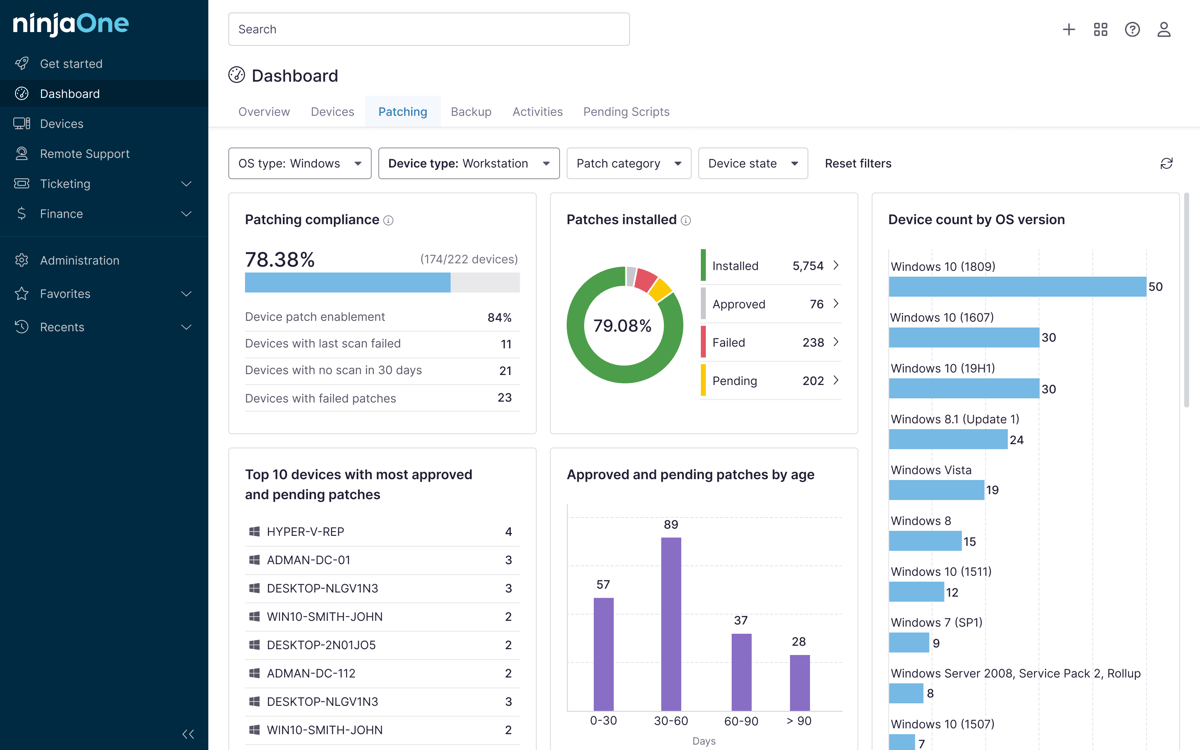
NinjaOne, the automated endpoint management platform, is proven to increase productivity, reduce security risks, and lower IT costs. Trusted by tens of thousands of customers, the cloud-native NinjaOne platform provides single-pane visibility into its services, from endpoint management to patch management and backup.
NinjaOne is the top NetApp alternative
NinjaOne’s cloud-native, agent-based platform delivers seamless coverage across endpoints, servers, and SaaS applications, all from a single pane of glass. With its rapid deployment, user-friendly interface, and proactive alerting integrated into modern communication tools, NinjaOne simplifies administration and enhances resilience for distributed IT ecosystems.
In particular, NinjaOne Backup is our top contender in this list of NetApp alternatives because of its cohesive approach to backup. Rather than needing separate tools, which may introduce blind spots, NinjaOne’s unified backup offering brings together endpoint backup, server backup, SaaS backup, and email archiving (through NinjaOne SaaS Backup and NinjaOne Email Archiver, respectively) into a single, integrated platform.
By centralizing backup, retention, and workflow restoration within the broader NinjaOne endpoint management platforms, IT teams gain full visibility and policy-driven control across their entire data lifecycle.
5 reasons to choose NinjaOne Backup over NetApp
1. Unified endpoint and backup management
NinjaOne Backup is seamlessly integrated with the broader NinjaOne endpoint management platform, providing a centralized console for patch management, remote monitoring and management, and data protection. NinjaOne also offers a separate tool, SaaS Backup, that expands its backup capabilities for M365 and Google Workspace data. Regardless, this cohesive architecture eliminates the need for multiple tools and streamlines workflows for IT teams.
NetApp BlueXP, on the other hand, primarily targets ONTAP storage systems, requiring separate interfaces and tools such as SnapCenter and StorageGRID.
2. Simpler setup
As a cloud-native SaaS solution, NinjaOne can be quickly deployed and used almost immediately with minimal configuration. Specifically, NinjaOne Backup supports cloud-only, local-only, and hybrid backups, allowing IT enterprises to set up the most suitable backup for their specific needs even as they scale.
In contrast, BlueXP Backup and Recovery is deeply tied to the ONTAP infrastructure and often requires additional setup and storage expertise for end-to-end deployment.
3. Proactive alerting
NinjaOne Backup provides real-time monitoring and proactive alerts directly through the main dashboard as well as integrated channels such as email, SMS, and Slack. This ensures timely notification of backup failures, ransomware detection, or policy violations. While BlueXP includes centralized dashboards and alerting for snapshot or job failures, it’s primarily focused on ONTAP-centric events and lacks the broader context of endpoint status or third-party integration channels.
4. Broad platform across devices and SaaS
NinjaOne offers a unified backup suite—including NinjaOne Backup, NinjaOne SaaS Backup, and NinjaOne Email Archiver—that supports diverse environments such as Windows and macOS endpoints, servers, Microsoft 365 data, and remote laptops.
Conversely, you would need separate NetApp backup solutions to support your entire IT architecture.
5. Block-aware backups
A key feature of NinjaOne’s solution is that it is block-aware. This means it can resume a backup or restore a process exactly where it was left off in the event of an interruption. Not only does this minimize downtime and eliminate the need to restart the entire process, but also, it makes backups more reliable and efficient.
In contrast, NetApp BlueXP Backup and Recovery focuses on preserving all ONTAP storage efficiencies rather than on broader endpoint or mixed-platform scenarios.
Strengths of NinjaOne
- Healthily obsessed with customer success: Aside from offering free and unlimited onboarding, training, and support, NinjaOne boasts a market-leading customer satisfaction (CSAT) score of 98.4. In addition, NinjaOne has a 30-minute average support response time, compared to the 12-hour average for competitors.
- Proven results: The numbers speak for themselves—7 of every 10 customers replaced more than four tools with NinjaOne (with 91% replacing 2+ tools), and 95% of NinjaOne customers experienced increased IT efficiency with automation.
- Trusted and secure: NinjaOne is SOC 2 Type II and ISO27001 certified, received a FedRAMP Ready certification, and is built on trusted architecture for high availability, reliability, and redundancy.
- Cloud-native management: NinjaOne is fast to implement, set up, and deploy. It’s a modern, intuitive, easy-to-use product that was built for the next generation of IT.
- High-velocity innovation and momentum: NinjaOne is a platform where power meets simplicity, designed to grow with you and your business. It has a long-term product strategy guided by former MSP leaders, with all its intended updates and features transparently shown in its product roadmap.
Check out this comparison of NetApp vs. NinjaOne.
Customer story
Chris Porosky, CEO of Red Road Networks, was overwhelmed with increasing backup costs from his previous solution—a hurdle that only got more troublesome as his company scaled. With NinjaOne, he was able to increase profitability by 20%–30% while keeping expenses in check with a fully integrated, single-pane backup solution.
“NinjaOne Backup seamlessly integrates with NinjaOne, so it’s really easy to setup and deploy. We can keep an eye on the status of all our endpoint backups and get alerts right in the RMM dashboard so we can resolve backup problems quickly,” Porosky explained. “Not only that, but NinjaOne’s backup policies give us control over what we backup, what we exclude, how much bandwidth we use, and how long we keep data, which helps us balance our data protection needs with storage costs.”
Read more NinjaOne customer stories or check out NinjaOne reviews.
Pricing information
NinjaOne’s IT management software has no forced commitments and no hidden fees. You can request a free quote, schedule a 14-day free trial, or watch a demo.
Reviews
NinjaOne reviews on G2
| Category | NinjaOne Rating |
| Overall | 4.7 out of 5 (3,697) |
| Has the product been a good partner in doing business? | 9.4 |
| Quality of Support | 9.1 |
| Ease of Admin | 9.1 |
| Ease of Use | 9.1 |
NinjaOne reviews on Capterra
| Category | NinjaOne Rating |
| Overall | 4.7 out of 5 (281) |
| Ease of Use | 4.7 |
| Customer Support | 4.7 |
| Functionality | 4.5 |
| Value for Money | 4.6 |
Recover faster and smarter with NinjaOne Backup.
→ Sign up for a 14-day free trial.
2. Druva Data Security Cloud
Druva Data Security Cloud is a cloud-native platform that delivers unified backup, recovery, and data protection across cloud, on-premises, endpoint, and SaaS environments. Its built-in cyber resilience policies that provides immutable backups with AI-driven anomaly detection for rapid ransomware recovery and compliance enforcement.
Features
- Ransomware recovery: Druva quickly identifies unusual or suspicious activities and prevents contamination spread within minutes of ransomware detection.
- Security posture and observability: The platform gains insights into user and data anomalies within one hour of backup. Druva then shares data and alerts with SIEM tools with pre-built integrations or APIs.
- Real-time monitoring: Druva offers 24 × 7 × 365 backup monitoring, where AI-powered telemetry detects anomalous activity in the backup environment.
Shortcomings
- Initial setup: According to G2 users, Druva Data Security Cloud’s first-time setup and configuration may be complex for new users. (Verified G2 Review)
- Role-based controls: Druva users say that the platform’s advanced role-based controls and reporting options can be more flexible. (Verified G2 Review)
- File recovery: Some G2 users have stated that file recovery in Druva Data Security Cloud still needs room for improvement. (Verified G2 Review)
Read this article on the top Druva alternatives or check out NinjaOne vs. Druva.
3. Acronis Cyber Protect Cloud
Acronis Cyber Protect Cloud is a unified, cloud-native platform that consolidates backup, disaster recovery, cybersecurity, endpoint management, and file sync and share under one solution. Designed primarily for MSPs, it brings AI-driven antivirus and ransomware protection together with automated patching and backup in a single agent and console.
Features
- Cyber protection: Acronis leverages its advanced AI-based behavioral detection engine to immediately detect and stop malware, ransomware, and zero-day attacks on client workloads.
- Centralized management: Acronis integrates data protection, cybersecurity, and endpoint management into a single solution with centralized management.
- Backup offerings: Acronis offers full-image and file-level backup and recovery for more than 25 platforms.
Shortcomings
- URL filtering: According to some users, Acronis’s URL filtering capabilities can still be improved. (Verified G2 Review)
- License application: Some G2 users have expressed that it’s rather difficult to tell which licenses are applied in Acronis Cyber Protect Cloud. (Verified G2 Review)
- Logging and reporting: A few users mentioned that the platform would benefit from more advanced built-in logging and reporting capabilities. (Verified G2 Review)
Read this article on Acronis alternatives or compare NinjaOne vs. Acronis.
4. Veeam Data Platform
Veeam Data Platform is a comprehensive and scalable backup and disaster recovery solution built to protect virtual, physical, cloud, and SaaS workloads with enterprise-grade reliability and flexible deployment models. Veeam features deep integration into modern IT ecosystems and advanced automation capabilities and is also favored for its performance in virtualized environments and fast recovery times.
Features
- Broad workload support: Veeam protects virtual machines, physical servers, cloud workloads, and SaaS applications through a unified platform.
- Flexible backup methods: It offers full, incremental, synthetic full, and reverse incremental backups for optimized storage usage and performance.
- Immutable backups: The platform supports hardened repositories and object storage immutability to defend against ransomware attacks.
Shortcomings
- Complex setup: Veeam Data Platform reviews have mentioned that the software’s first-time setup can be complex for new users. (Verified G2 Review)
- Reporting: According to some users, Veeam Data Platform’s reporting feature can be improved with better customization. (Verified G2 Review)
- Manual intervention: Veeam users have mentioned that they still need to manage cloud repositories and tiering policies manually. (Verified G2 Review)
Read this article on Veeam alternatives or compare NinjaOne vs. Veeam.
5. Commvault Cloud
Commvault Cloud is a unified data protection and management platform that provides centralized control over backup, disaster recovery, and data governance across hybrid and multi-cloud environments. With robust automation, data lifecycle management, and extensive integrations, Commvault Cloud helps organizations reduce risk, ensure compliance, and streamline operations.
Features
- Unified data management: The software centralizes backup, archiving, disaster recovery, and compliance in a single platform.
- Threat detection and response: Commvault Cloud integrates AI-driven anomaly detection to identify ransomware and insider threats.
- Granular recovery options: It also enables file-, VM-, database-, and application-level restores with flexible retention policies.
Shortcomings
- Complex interface: Users of Commvault Cloud have said that its interface can be simpler and its menus fewer for easier navigation. (Verified G2 Review)
- Learning curve: Commvault Cloud’s advanced configurations and troubleshooting require deeper product knowledge for new users. (Verified G2 Review)
- Support: According to reviews, Commvault Cloud’s customer support still has much room for improvement. (Verified G2 Review)
Read this article on Commvault Cloud alternatives or compare NinjaOne vs. Commvault Cloud.
6. Rubrik Security Cloud
Rubrik Security Cloud is a data protection platform that integrates security and backup to defend against ransomware, data loss, and operational disruptions. It emphasizes automation, policy-driven backup, and a zero-trust security posture that helps organizations respond swiftly to threats. In addition, Rubrik’s architecture is designed to scale across hybrid cloud environments while delivering fast recovery options.
Features
- Zero-trust data security: Rubrik implements immutability, role-based access, encryption, and multi-factor authentication to reduce attack surfaces.
- Policy-based automation: The platform simplifies backup workloads with SLA-driven policies that schedule and enforce retention rules.
- Cloud and SaaS support: Rubrik protects cloud workloads and SaaS applications, enabling seamless hybrid infrastructure coverage.
Shortcomings
- Advanced configuration: Users have said that because the platform is policy-driven, its advanced configuration options feel less flexible. (Verified G2 Review)
- Dashboard: According to online reviews, Rubrik’s dashboard can use a cleaner appearance for better navigability. (Verified G2 Review)
- Real-time detection: Some users have noticed that Rubrik’s real-time threat detection can yield false positives. (Verified G2 Review)
Read this article on Rubrik alternatives or compare NinjaOne vs. Rubrik.
7. HYCU
HYCU is a data protection platform engineered for hybrid and multi-cloud environments, with particular strength in simplicity and rapid deployment. Emphasizing intuitive management and broad platform coverage, HYCU integrates with cloud ecosystems and provides automated workflows to help streamline backup and restore operations.
Features
- Agentless deployment: HYCU minimizes installation overhead and simplifies backup processes.
- Cloud-native capabilities: It’s designed for hybrid and multi-cloud environments, seamlessly covering cloud resources.
- Streamlined recovery: HYCU offers flexible restore options to reduce downtime across workloads.
Shortcomings
- Immutable backup: According to reviews about HYCU, the platform can be improved with native immutable backup features. (Verified G2 Review)
- Limited scheduling: HYCU users have commented that certain policy-dependent tasks can only be scheduled by day or hour. (Verified G2 Review)
- Alerts and notifications: Some HYCU users said that the software’s alerts and notifications lack meaning information and details. (Verified G2 Review)
Read this article on HYCU alternatives or compare NinjaOne vs. HYCU.
8. Arcserve UDP
Arcserve UDP (short for Unified Data Protection) delivers a suite of backup, replication, deduplication, and high-availability tools in a single solution. It’s designed for businesses seeking integrated data protection across physical, virtual, and cloud environments. Its unified console and bundled capabilities make it appealing for mid-market enterprises that want endpoint and system resilience without managing multiple disparate tools.
Features
- Integrated protection suite: Arcserve UDP combines backup, replication, and high availability with deduplication and recovery orchestration.
- Image-based backup: The solution ensures complete system capture, enabling bare-metal restores when needed.
- Flexible deployment: Arcserve UDP also offers software, appliance, and cloud-based deployment options.
Shortcomings
- Slow backup and recovery: Reviews on Arcserve UDP mention that the platform tends to suffer from slow backup and recovery speeds. (Verified G2 Review)
- Customer support: According to reviews, users have said that Arcserve UDP’s customer support can be faster or more responsive. (Verified G2 Review)
- Slow performance: Users have remarked that the software slows down when dealing with large data sets. (Verified G2 Review)
Compare NinjaOne vs. Arcserve.
9. NAKIVO Backup & Replication
NAKIVO Backup & Replication is a fast-deploying backup solution built for physical, virtual, and cloud environments, providing robust protection for small, mid-size, and enterprise organizations. NAKIVO’s strength lies in its simplicity, automation, and efficient storage usage, making it a popular alternative for teams that need reliable data protection with less overhead.
Features
- Multi-environment support: NAKIVO protects physical servers, VMware, Hyper-V, cloud workloads, and SaaS sources.
- Advanced automation: The tool’s automated backup scheduling and workflow management reduce administrative burden.
- Efficient data handling: Deduplication, compression, and incremental backups optimize storage and speed.
Shortcomings
- Documentation: According to user reviews, NAKIVO’s documentation for some advanced features could be more detailed. (Verified G2 Review)
- Large file restores: Some reviews of the platform mention that large files can take a while to restore. (Verified G2 Review)
- Replication: Some users said that NAKIVO’s real-time replication feature still needs some improvement as it often requires manual restarts. (Verified G2 Review)
10. Zerto
Zerto is a disaster recovery–focused platform that offers continuous data protection (CDP) and near-synchronous replication, reducing recovery point objectives (RPO) and minimizing data loss. Its emphasis on business continuity makes it suitable for organizations that require rapid failover and failback across on-premises and cloud environments.
Features
- Continuous data protection: Zerto provides frequent checkpoints with near-zero data loss potential.
- Hypervisor-based replication: Zerto moves data replication above storage for efficient performance and scalability.
- Multi-cloud support: The software enables disaster recovery across VMware, Hyper-V, and major cloud platforms.
Shortcomings
- Storage size: Zerto users have mentioned that storage size can grow quickly as a result of continuous replication journals. (Verified G2 Review)
- Report generation: According to user reviews, Zerto’s report generation feature (e.g., interface, report adaptability) can be improved. (Verified G2 Review)
- Scalability: Some reviews say that the platform can benefit from improved scalability and installation on newer devices. (Verified G2 Review)
11. MSP360 Backup
MSP360 Backup is a cloud-integrated backup and recovery solution that supports a wide range of workloads—from desktops and servers to databases and SaaS applications—while delivering flexible storage choices and centralized management. MSP360’s cloud-agnostic design lets users choose their storage provider, reducing vendor lock-in and supporting cost-effective data protection strategies.
Features
- Cloud-agnostic backup: The software integrates with over 20 cloud storage providers for flexible storage options.
- Block-level and image backups: MSP360 Backup speeds backups and enables full system or individual file restores.
- Advanced recovery options: MSP360 Backup also restores images to physical or cloud-based virtual machines.
Shortcomings
- Linux backups: Reviews of the software say that it only offers file-level backups for Linux systems, not full system image backups. (Verified G2 Review)
- Error codes: Users of MSP360 Backup have noticed that the platform’s error codes often show incorrect information. (Verified G2 Review)
- Initial setup: A few reviews mentioned that initial setup of MSP360 Backup can feel technical, especially for new users. (Verified G2 Review)
Choosing the best backup solution among NetApp competitors
It’s worth reiterating that no one item in this list of NetApp competitor is a one-size-fits-all solution for organizations of varying sizes, budgets, and IT needs.
What may work exceptionally for one business may not perform as well for another, which is why we recommend doing extensive research—reading aggregated user reviews as well as availing of free trials and demos, where possible—before committing to a backup and recovery software for your organization.