Key points
- The Goal of Tech Stack Optimization: MSP tech stack optimization focuses on reducing software sprawl, lowering costs, and improving efficiency.
- Start With a Full Stack Audit: Inventory all MSP tools across RMM, PSA, BDR, MDR/XDR, SaaS management, documentation, and IAM.
- Identify Overlaps: Map each tool’s primary function and retire or merge overlapping solutions by prioritizing platforms with broader functionality.
- Use Phased Consolidation: Reduce risk by piloting tool migrations, maintaining rollback plans, and securely archiving data.
- Optimize for Security, Compliance, and Scale: A lean MSP tech stack improves security posture, reduces compliance risk, and supports regulatory requirements.
- Maintain Continuous Optimization: Perform quarterly stack reviews, track usage and cost metrics, and use automation.
Managed service providers (MSPs) often accumulate software and tools that continuously expand their technology stack. Although this isn’t uncommon for MSPs, it can lead to
- redundant processes,
- unnecessary complexities, and
- rising costs.
If you want to streamline your team’s workflow, keep reading to learn how to trim and optimize your MSP tech stack while preserving essential functionalities for business growth and client trust.
For a visual breakdown of this topic, watch How to Trim and Optimize Your MSP Technology Stack Without Losing Capability.
How to optimize your MSP tech stack
MSPs need three things to make optimization possible:
- A clear framework
- Defined processes
- Practical tools
Focusing on these three areas should help create a successfully streamlined stack.
💡 Tip: Read Things to look out for before proceeding.
Simplification strategy framework
Before you start on MSP tech stack optimization, you should establish a guidance framework. Your goal is to identify redundancies, categorize tools, and ensure that every solution you use contributes measurable value to your operations. Explore our RMM FAQ for a deeper look at how RMM platforms fit into a streamlined MSP stack.
Key elements of the framework:
- Audit the stack: Start with a comprehensive inventory of all active tools and platforms across categories, including but not limited to the following:
- Map functions and overlaps: Determine each tool’s primary role and see where duplication exists, such as multiple RMMs or overlapping automation systems.
- Categorize tools: Classify systems into these candidates for clarity and rationalization:
- Core
- Supportive
- Obsolete
- Divestment
- Team engagement: Involve frontline technicians and managers and ask for feedback on functionality gaps, workflow friction, and underutilized features.
- Focus on consolidation: Identify opportunities to streamline by prioritizing platforms that offer unified functionality or cross-platform reach.
Streamlining process
After building the framework, create a tactical roadmap that moves in phases to mitigate risk while adapting to a leaner MSP software stack. Here’s a step-by-step process to help you ensure that optimization is always systematic, measurable, and minimally disruptive to your service delivery offerings.
|
Action |
Description |
| 1. Take inventory of all tools. | Document every tool you use across categories, from RMM and PSA to BDR, security, and beyond. |
| 2. Define essential criteria. | Judge tools by usability, integration capability, licensing costs, support quality, and team familiarity. |
| 3. Score and rank tools. | Objectively evaluate each system to highlight any redundancies, overlaps, or low-usage candidates. |
| 4. Plan consolidation pilots. | Test the migration of workflows from divestment tools into selected core platforms. |
| 5. Measure impact. | Track efficiency gains, adoption rates, error reduction, and cost savings. |
| 6. Retire responsibly. | Securely remove access, archive relevant data, notify stakeholders, and document the change. |
Automation for tool usage reporting (example)
Of course, auditing the change is crucial, but doing this manually can take a lot of time and be prone to errors. It’s always good to consider automating this task to create a clear and ongoing view of tool usage, licensing, and redundancy without administrative burden.
| $tools = @(“RMMProduct”, “SecondaryAutomation”, “LegacyBackup”) foreach ($tool in $tools) { $licensed = Test-Path “\\LicensingServer\$tool.license” $lastActive = $(Get-Item “C:\Logs\$tool-activity.log”).LastWriteTime [PSCustomObject]@{ ToolName = $tool Licensed = $licensed LastActive = $lastActive } } |
💡 Note: The tool names (“RMMProduct,” “SecondaryAutomation,” and “LegacyBackup”) are placeholders. Replace them with the actual names of the solutions you want to audit in your environment. Also, the file paths (\\LicensingServer\… and C:\Logs\…) are examples. Update them to match the real locations where your organization stores license files and activity logs.
⚠️ Things to look out for
|
Risks |
Potential Consequences |
Reversals |
| Retiring a tool too early |
|
|
| Data loss during retirement |
|
|
| Security gaps during transition |
|
|
What is tech stack optimization?
Tech stack optimization is the process of refining the various tools, platforms, and systems that MSPs use for their services. It focuses on software consolidation to reduce complexity, cut costs, and enhance efficiency without compromising core capabilities.
This process usually involves the following actions:
- Creating inventories of all tools used across the organization
- Identifying the role of each tool and spotting overlaps or duplications
- Classifying tools as core, supportive, obsolete, or candidates for divestment
- Merging workflows into platforms with broader functionality and tighter integration
- Measuring cost savings and performance improvements post-optimization
Key themes of a lean tech stack for MSPs
MSPs often think that having more tools equates to better services. However, racking up tools without careful consideration can create more issues that can weaken their operations. Trimming down your tech stack shouldn’t force you to sacrifice capability but rather enhance it while simplifying the entire process.
Listed below are key themes for an MSP to consider when adopting a lean tech stack.
“More” isn’t always better
Adding new tools for new challenges may feel like progress, but it often leads to administrative overload. Lean stacks scale stronger because they force MSPs to be intentional with the tools they use. This ensures they prioritize solutions that offer multiple purposes and can scale with the business.
Fewer tools mean less friction
Having fewer tools can help teams focus more on delivering consistent services rather than on training, juggling systems, and watching out for possible errors. This simplifies the process to avoid overlap and confusion.
Alignment drives growth and profitability
MSPs should focus on obtaining tools that align with one another to
- support cross-platform integration,
- accelerate technician onboarding, and
- free up resources for innovation.
Over time, this ensures operational efficiency at a lower cost, allowing for scalable growth and profitability.
Best practices for MSP tool consolidation
The three areas mentioned offer the structure needed for this optimization process. But now you should put effort into building day-to-day habits and guiding principles to ensure long-term success.
Here are some best practices to consider:
Engage frontline technicians early
Your frontline engineers and technicians, who’ll use these tools daily, will often have insights that you might miss. While working, they can easily spot inefficiencies, redundant workflows, and other hidden dependencies.
Creating surveys or holding feedback sessions regarding tool retirements or consolidations ensures smoother adoption while avoiding the risk of overlooking essential functionality.
Set clear consolidation thresholds
If you don’t set rules, it’s easy to justify keeping unnecessary tools “just in case.” Make sure to define thresholds to keep decision-making consistent and objective. For example, you can limit your stack to having only one RMM platform or retire tools with less than 20% active usage.
Prioritize usability and integration
Always try to choose platforms that balance rich features with intuitive usability. These must also integrate seamlessly with your existing systems. You don’t want to replace old tools with new ones that frustrate users or create integration gaps. Focus on ease of adoption and interoperability as much as possible.
Track savings and performance post-cleanup
Optimization is an ongoing investment, so you need proof that these changes deliver results. Document cost reductions, workflow improvements, and technician productivity gains. These metrics should help justify the changes and secure support for future optimization initiatives.
Schedule quarterly reviews
It’s also good practice to conduct quarterly reviews of your stack (in addition to annual deep audits) to confirm the relevance of your current tools, measure performance, and spot any overlaps. This is important because the tech landscape constantly evolves, and tools that made sense before may already be outdated or redundant.
Consider implications on regulation compliance
With increased tool sprawl comes increased compliance risk and audit complexity. Keeping your tech stack lean helps not only mitigate these risks but also ensure that you’re up to date on your compliance with regulatory requirements such as NIS2 and DORA.
Document retired tools and rationale
Finally, maintain a simple log of retired tools, including when and why you removed them. This helps prevent confusion and avoid accidental re-adoption. It’s also a good reference when future teams wonder why a certain tool was abandoned.
NinjaOne platform integration ideas
MSP tech stack optimization or tool consolidation should be an ongoing process for long-term success. To ensure visibility, automation, and proactive alerts, MSPs can use NinjaOne to monitor and manage their technology stack more efficiently.
|
Integration Idea |
How It Helps |
Practical Benefits to MSPs |
| Inventory dashboards | Provides real-time visibility into tool deployment across endpoints |
|
| Lifecycle tagging (active → phasing out → retired) | Tracks each tool’s status during optimization |
|
| License expiration and renewal alerts | Automates renewal reminders and validates usage against licensing |
|
| Inactive system alerts (90+ days) | Flags endpoints or tools with prolonged inactivity |
|
| Cost and usage dashboards | Displays tool costs and usage metrics side-by-side |
|
Sustainable optimization for scalable growth
Optimizing your tech stack is all about ensuring you have a lean and resilient foundation for your service delivery. Focusing on auditing, streamlining, and automating can reduce complexity while strengthening your team’s efficiency.
Consider the mentioned best practices and watch out for common pitfalls to save money, grow your business, and build client trust.
Related topics:
- Building the Right MSP Software Stack: 3 Key Evaluation Criteria to Make Sure You Don’t End Up with the Wrong Tools
- The (Re)Evolving MSP Software Stack: Statistics on What Tools are In and Out
- How to Audit Your MSP Tool Stack for Overlap, Waste, and Underutilization
- An In-Depth Overview of the Cloud Computing Stack (video)
Quick-Start Guide
NinjaOne’s approach to trimming and optimizing your MSP technology stack:
NinjaOne offers several features to help MSPs optimize their technology stack:
- Patch Management Optimization:
- NinjaOne provides intelligent patch management with features like:
- Ring deployment strategy (staggered patch rollouts)
- Patch Intelligence AI for assessing patch risks
- Customizable patch scheduling and approval workflows
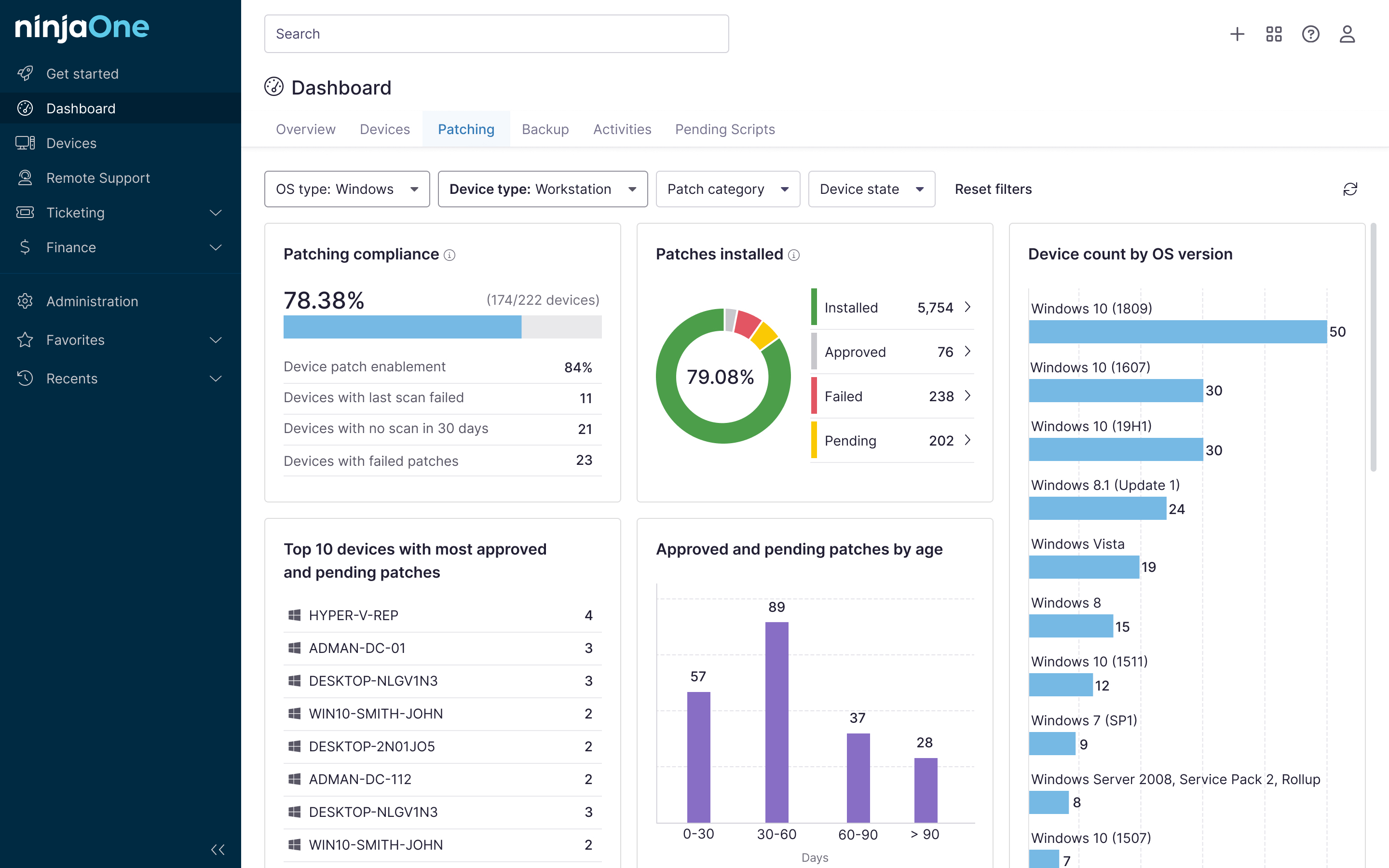
- Detailed patch management dashboards
- NinjaOne provides intelligent patch management with features like:
- Technology Stack Visibility:
- IT Asset Management features allow you to:
- Track and report managed device and software details
- Collect hardware and software inventory
- Create device roles and policies to simplify management
- IT Asset Management features allow you to:
- Efficiency Tools:
- Remote monitoring and management capabilities
- Automated workflows to reduce time-consuming tasks
- Device monitoring and configuration management
- Custom alert creation for critical state changes
- Intelligent Decision Support:
- Patch Intelligence AI provides:
- KB overviews
- Patch purpose and features
- Issues and bugs analysis
- User sentiment and feedback
- Patch Intelligence AI provides:
The platform is designed to help MSPs trim their technology stack without losing capability by providing comprehensive, intelligent management tools that reduce complexity while maintaining robust functionality.