Key Points
- Broadcast Storms Overwhelm Networks: Excessive broadcast traffic can saturate bandwidth and switch CPU, causing latency, packet loss, or outages.
- Switching Loops, the Primary Cause: When switches are connected in multiple ways without proper controls, broadcast traffic can circulate endlessly and multiply rapidly.
- Impact Escalates Fast: Broadcast storms grow exponentially, increasing latency and packet loss until normal network communication breaks down.
- Prevention Relies on Switch Controls: Loop prevention protocols and storm control features can rate-limit broadcast traffic while preserving redundancy.
- Segmentation Reduces Blast Radius: Dividing networks into smaller broadcast domains to contain faults and limit failure blast radius.
If there were weather forecasts in the IT world, one event that would immediately raise alarms would be the news of a broadcast storm. These network problems—much like their namesakes—can take everything down fast, and often without warning.
These events occur when broadcast traffic multiplies uncontrollably until it consumes available bandwidth and overwhelms network devices. What can start as a simple frame meant to help devices discover each other can quickly snowball into a flood of duplicated traffic that brings normal communication to a halt.
In this guide, we answer the question, “How does a broadcast storm happen, and how do you prevent it?” Because broadcast frames are designed to reach every device in a network segment, even a small loop can escalate into a full-blown outage within seconds. It is therefore crucial that IT teams, especially those in highly regulated industries, know how to detect and prevent it before it disrupts operations.
Prerequisites
To get the most out of this guide, you should have a basic understanding of Ethernet networking, how switches operate in a LAN, and how broadcast domains and VLANs work.
You don’t need to be a network engineer, but familiarity with everyday switch behavior will help the concepts click.
What is a broadcast storm? (and why does it escalates so quickly?)
In an Ethernet network, some messages are meant for everyone. These are called broadcast messages, and they’re used for everyday tasks like finding devices or resolving IP addresses. When a switch receives a broadcast, it forwards that message out to all connected devices in the same network segment.
A broadcast storm happens when those same messages keep getting repeated over and over instead of stopping once they’ve done their job. Each time the message comes back, the switch sends it out again, creating more copies every time.
This is why broadcast storms can be dangerous. Unlike regular traffic spikes, broadcast storms don’t level off. They accelerate until network devices can no longer process traffic fast enough, leading to severe latency, packet loss, and often a complete network outage.
How do switching loops cause broadcast storms?
A switching loop occurs when switches are connected in more than one way, and the network doesn’t have a system to control those extra connections. Instead of choosing a single route for traffic, the switches pass messages around in a circle.
This is how it can look like in reality:
- A broadcast message enters a switch and is sent out to all other connections.
- One of those connections leads to another switch, which does the same thing.
- Eventually, the message finds its way back to the original switch through a different cable.
Because the switch doesn’t recognize it as a duplicate, it forwards the message again, and the loop continues.
Each trip around the loop creates more copies of the same message. The longer it runs, the more traffic piles up, quickly overwhelming the network. This is why switching loops is the most common and dangerous cause of broadcast storms.
Why do switching loops need to be actively controlled?
Switching loops are, by their very nature, a common side effect of trying to build reliable networks. Adding extra cables between switches is a standard way to improve uptime, but without something to control those extra connections, the network has no way to know which path traffic should take.
When this happens, switches do precisely what they’re designed to do: Forward traffic as efficiently as possible. Unfortunately, broadcast traffic has no built-in “stop” signal. Once it enters a loop, it keeps circulating and multiplying, which is how a simple wiring or configuration mistake can quickly turn into a broadcast storm.
What are loop prevention protocols?
Loop prevention protocols are built-in safety mechanisms that stop switches from accidentally sending traffic in circles. They allow networks to keep extra cables and backup paths for reliability, while ensuring only one logical path is used at a time. Without these protocols, switching loops would quickly turn normal broadcast traffic into a broadcast storm.
The most common loop prevention protocols used in Ethernet networks include the following:
Spanning Tree Protocol (STP)
Spanning Tree Protocol is the original and most widely supported loop prevention protocol. It works by mapping out how switches are connected and then blocking redundant links that could create loops. If an active link fails, STP can unblock a backup path to restore connectivity, though this process can take several seconds.
Rapid Spanning Tree Protocol (RSTP)
Rapid Spanning Tree Protocol is an improved version of STP that reacts much faster to network changes. It uses smarter detection methods to re-enable backup links quickly when a failure occurs, reducing downtime. For most modern networks, RSTP is preferred because it provides loop protection without lengthy interruptions.
Multiple Spanning Tree Protocol (MSTP)
Multiple Spanning Tree Protocol is designed for larger or more complex networks that use multiple VLANs. Instead of treating the entire network as one tree, MSTP allows different VLAN groups to use different active paths. This improves efficiency while still preventing switching loops and broadcast storms.
How to recognize a broadcast storm early?
Broadcast storms rarely appear out of nowhere. In most cases, the network starts showing signs before everything goes down.
Common warning signs include:
- The entire network is suddenly feeling slow, not just one system.
- Applications are timing out or behaving inconsistently.
- Switches are showing unusually high CPU usage.
- Network links appear busy even when users aren’t doing much.
Because broadcast storms affect whole network segments, the impact is usually widespread. Monitoring tools that track traffic levels and device health can help spot unusual patterns early, making it possible to intervene before a full outage occurs. You can also monitor switches with NinjaOne.
How to design networks to limit the damage?
One of the easiest (and arguably the best) ways to design a network to limit the damage of broadcast storms is through segmentation.
Think of segmentation like putting walls inside a building. Instead of one huge open space where a fire can spread everywhere, you break the space into smaller rooms. In networking, VLANs do exactly that: They divide a network into smaller sections so broadcast traffic stays contained.
When a broadcast storm happens inside one of these sections, it’s trapped there. Devices outside that VLAN aren’t affected, which means fewer users are impacted, and troubleshooting becomes much easier.
Other design choices also play a big role in keeping problems under control:
- Using managed switches with loop prevention enabled. This ensures the network can automatically block paths that would cause traffic to loop endlessly.
- Applying broadcast and multicast limits on access ports. This prevents a single device from flooding the network with excessive traffic.
- Avoiding unmanaged switches in production networks. This reduces the risk of accidental loops, since unmanaged devices usually lack safety features.
- Keeping network layouts documented to avoid accidental loops. This helps prevent mistakes during changes, such as plugging in a cable that creates an unintended loop.
Regardless of which method you or your IT team decides on, the goal is containment. When broadcast storms are confined to a small area, they’re easier to diagnose and far less disruptive.
Additional considerations
While switching loops is the most common cause of broadcast storms, they are not the only one. In real-world networks, a variety of more minor issues can combine to push broadcast traffic out of control. Devices that are misconfigured or malfunctioning can likewise generate far more broadcast traffic than expected. Multicast traffic can also behave similarly and overwhelm the network if it isn’t adequately managed.
In environments with lots of printers, IoT devices, cameras, or other unmanaged hardware, baseline broadcast traffic is often already higher. That leaves less room for mistakes and makes preventive controls even more critical.
Troubleshooting a suspected broadcast storm
When a broadcast storm is happening, the symptoms are usually widespread rather than isolated to one device. Instead of guessing, start by looking for these common signs:
- Sudden network-wide slowness, where multiple users or systems are affected at the same time
- Unusually high broadcast or multicast traffic on switches often indicates excessive duplication.
- Spikes in switch CPU usage, caused by switches spending too much time processing repeated frames
You should also watch for clues that point to a physical or topology-related issue:
- Links showing high utilization with no clear cause, such as heavy usage outside of business hours
- Intermittent outages or flapping connections may indicate a loop being created and broken repeatedly.
- Recent changes to cabling or hardware, including newly added switches or cables, may have created an unintended loop.
These symptoms together strongly suggest a broadcast storm and should prompt an immediate review of switch configurations.
How NinjaOne can help with network loop prevention
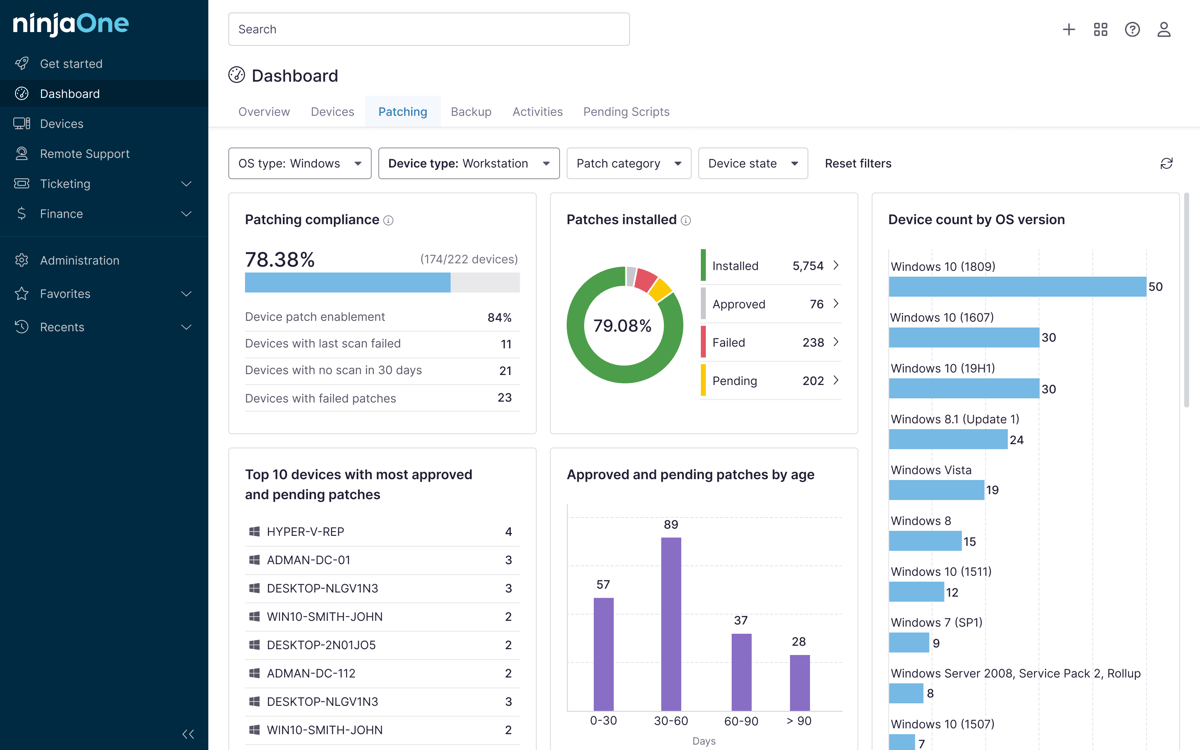
NinjaOne helps IT teams spot and respond to broadcast storms by bringing network activity into a single, centralized view.
- Monitoring abnormal network behavior: NinjaOne’s Network Management System (NMS) provides visibility into traffic patterns, connectivity issues, and device performance, making it easier to detect unusual spikes in broadcast or multicast traffic.
- Centralized visibility across devices: Data from monitored endpoints and network devices is aggregated in a single pane of glass, allowing administrators to quickly identify which systems or network segments are affected instead of troubleshooting blindly.
- Traffic flow analysis: NinjaOne offers support for NetFlow, sFlow, and jFlow, which helps teams understand how traffic moves through the network and where excessive or abnormal traffic is originating.
- Enhanced anomaly detection: SNMP monitoring, syslog collection, and device health checks add context, helping correlate traffic spikes with hardware issues, interface errors, or recent configuration changes.
- Faster response to outages: Real-time alerts and detailed analytics enable teams to investigate and respond before a broadcast storm escalates into a complete network outage.
Quick-Start Guide
NinjaOne can help prevent broadcast storms through several mechanisms:
- Network Monitoring: NinjaOne’s Network Monitoring can continuously monitors network devices and can alert you to unusual traffic patterns that may indicate a broadcast storm.
- Device Health Checks: It performs regular health checks on devices, which can help identify misconfigured or faulty devices that might cause broadcast storms.
- Policy Enforcement: You can create policies to manage device behavior, ensuring that devices adhere to proper network configurations.
NinjaOne’s IT management software has no forced commitments and no hidden fees. You can request a free quote, schedule a 14-day free trial, or watch a demo.
Preventing a switching loop
Switching loops are one of the most common causes of broadcast storms, but they’re also one of the easiest problems to prevent.
Preventing this comes down to a few fundamentals: Designing networks thoughtfully, configuring switches with loop prevention and traffic controls, and keeping an eye on network behavior. When these safeguards are in place, small mistakes are far less likely to turn into major outages.
Related topics: