Key Points
- Choose an MFA enforcement pattern, such as RD Gateway-based MFA, endpoint logon MFA, and cloud Conditional Access for Azure or similar platforms.
- RD Gateway: Enforces MFA before any RDP session reaches the host.
- Endpoint logon: Installs MFA agents on Windows servers or workstations to cover both remote and console access.
- Conditional Access: For Azure Virtual Desktop (AVD) and other brokered services, or hybrid and cloud-based setups.
- Standardize MFA protocols to maintain security and operational flexibility.
Remote Desktop Protocol (RDP) remains one of MSPs’ most effective tools for managing hybrid IT environments. However, it is also frequently targeted by various threat actors. So, implementing multi-factor authentication (MFA) for RDP is essential in keeping a clean slate, maintaining client trust, and reducing stress. After all, there’s a very short list of things that can ruin a Friday faster than an RDP breach.
Best MFA for RDP setups
Before enabling MFA, ensure the environment is fully prepared. Proper planning and communication prevent lockouts, service interruptions, and incomplete coverage across endpoints. For instance, work on these prerequisites:
- Current inventory of RDP exposure and access paths
- Approved MFA provider and factors (TOTP, push, FIDO2, smartcard)
- Certificate management for TLS on gateways and FTPS or HTTPS, where needed
- Change control covering service impact windows and rollback steps
- Central logging for Windows Security events, gateway logs, and MFA provider events
💡 Note: Requirements may vary based on systems, policies, and business needs.
Use cases for RDP
RDP is often used for secure remote administration, server maintenance, and technical support. MSPs rely on RDP to access client systems, while internal IT teams use it to manage infrastructure across multiple locations. Vendors may also use controlled RDP access during deployments or integrations.
Pattern 1: RD Gateway with MFA
For most on-premises environments, using an RD Gateway with MFA offers the best balance of security, control, and manageability. Here’s how:
- Deploy RD Gateway with a TLS certificate and restrict inbound traffic to port 443.
- Integrate MFA at the gateway using an extension or a compatible provider plug-in.
- Enforce Network Level Authentication and switch off RDP exposure to the internet.
- Configure CAP and RAP policies to define who can connect and to which hosts.
- Enable centralized logging for RD Gateway and MFA provider events, forwarding logs to your SIEM for correlation and alerting.
This setup centralizes and secures all RDP access by enforcing MFA at the gateway level.
By verifying user identity before any session connects to internal systems, MSPs gain a single, auditable control point that limits exposure, simplifies compliance, and enhances overall remote access security.
Pattern 2: Endpoint logon MFA (agent-based)
When an RD Gateway is not available or practical, endpoint logon MFA can be set up to provide a direct way to protect RDP sessions at the device level. It’s also an ideal MFA pattern for isolated systems, privileged workstations, or environments that require on-box enforcement without relying on network infrastructure.
- Install a supported MFA logon agent on all target servers and privileged endpoints.
- Configure policies to require MFA for both RDP and console logins, with exclusions only for service accounts that cannot support interactive authentication.
- Validate recovery paths, such as offline codes or hardware tokens, for maintenance or downtime scenarios.
- Enable centralized logging to record MFA successes and failures, and configure alerts for repeated denials or failed attempts.
Endpoint logon MFA extends MFA protection directly to each endpoint, ensuring that access control remains intact even without an RD Gateway.
Pattern 3: Cloud Conditional Access
For organizations using Azure Virtual Desktop (AVD) or other cloud-managed RDP solutions, Conditional Access with MFA provides identity-based control over remote sessions.
- Map RDP scenarios to AVD or another service with Conditional Access support.
- Create Conditional Access policies that require MFA and restrict access to compliant, hybrid-joined, or managed devices.
- Test authentication flows for admins and high-risk accounts; document exceptions and expiry.
- Export and centralize sign-in logs and MFA prompt data into your SIEM for tracking.
This pattern delivers an identity-first security model for RDP, combining user verification with device compliance checks.
Monitoring, evidence, and risk controls
Each implementation should track coverage across all endpoints, documenting the percentage of systems protected by an RD Gateway or endpoint-level MFA, along with users governed by Conditional Access policies.
Event logging
For instance, logs from Windows Security events (IDs 4624 and 4625), RD Gateway connections, and MFA provider results must be collected and analyzed regularly to verify enforcement and detect anomalies.
Accurate and regular documentation
Meanwhile, every exception should have an assigned owner, a documented justification, start and end dates, and compensating security measures. During regular reporting, summarize MFA prompts, failed sign-ins, blocked attempts, and any unprotected endpoints.
Risk controls
Finally, to maintain operational safety, organizations should preserve a monitored break-glass process that grants limited, time-bound emergency access. Offline access methods must be available for maintenance and tested quarterly to confirm reliability.
In addition, consider including a rollback plan for every deployment in case of gateway outages or agent failures. Then, set up preapproved change windows to minimize disruption during recovery.
NinjaOne RDP and MFA integrations
NinjaOne offers extensive support for various MFA configuration options, endpoint management, and IT reporting.
- MFA support: Authenticator App, SMS, hardware-based keys, global administrative idle time logins, and conditional MFA bypass for SSO users.
- Distribute gateway agent prerequisites or endpoint MFA agents, enforce RDP and Network Level Authentication (NLA) settings, and verify TLS certificate compliance.
- Automation: Quarantine endpoints that repeatedly fail MFA checks and trigger credential rotation workflows for suspected compromises.
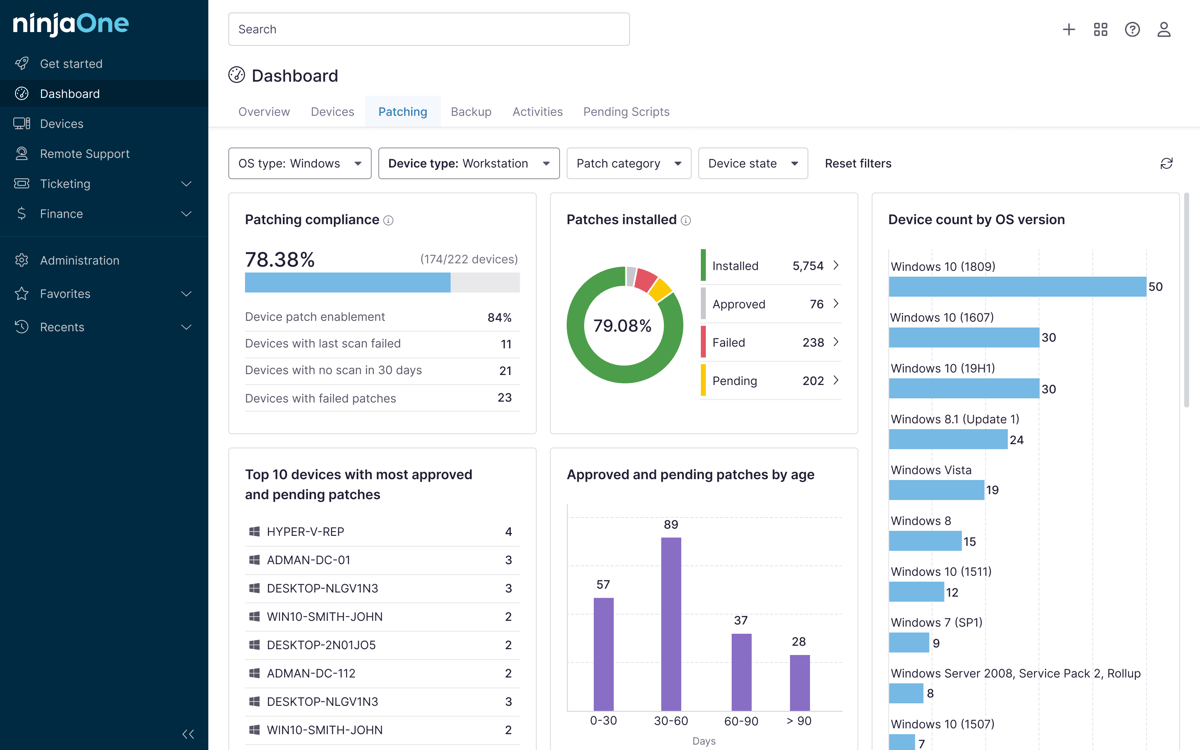
- IT Reporting: Build dashboards summarizing MFA coverage by client, failed RDP attempts, CAP or RAP policy changes, and exceptions nearing expiration.
In addition, NinjaOne Remote® provides unified endpoint control and management for Windows, Mac, and Linux devices. These RDP integrations and MFA support are all available as part of the NinjaOne Platform.
💡 Tip: Check out Remote Access FAQs for more NinjaOne Remote® capabilities.
Quick-Start Guide
You can implement MFA for RDP sessions by configuring your Identity Provider (IdP) and leveraging NinjaOne’s SAML/SSO capabilities. Here’s how:
1. Identity Provider Configuration:
– Set up your IdP (e.g., Azure AD, Okta) to enforce MFA for RDP access. This ensures users authenticate with MFA when attempting to access resources via RDP.
2. NinjaOne SAML/SSO Setup:
– In NinjaOne, navigate to Administration > Accounts > Identity Provider.
– Enable Single Sign-On (SSO) and configure your IdP metadata.
– Enable conditional NinjaOne MFA bypass to ensure MFA is performed only once during login—either at the IdP or NinjaOne, not both. This setting is supported for Azure and Okta.
3. User Login Workflow:
– Users will log in to NinjaOne via SSO. If MFA was performed at the IdP, NinjaOne will skip its own MFA prompt, ensuring a seamless experience while maintaining security.
4. Security Considerations:
– Even with SSO enabled, MFA is still required for high-risk transactions within NinjaOne (e.g., changing policies, editing scripts).
– Ensure your IdP policies enforce MFA for RDP access to maintain a secure remote desktop environment.
Streamlined RDP workflows for MSPs
Enabling MFA for RDP strengthens remote access security against common RDP vulnerabilities. With proper planning, it can also be a catalyst for improving technician workflows and other remote IT sessions. As more client environments go hybrid, MSPs can also take preparations a notch higher by unifying their IT stack, which should further reduce risks when managing remote assets, controlling shared access, and storing credentials.
Related topics: