


Key Points
- Mosyle is a solid Apple MDM option, but its steep learning curve can make implementation harder for technicians.
- NinjaOne ranks first and manages Apple, Android, Windows, macOS, and Linux endpoints, plus virtual machines and servers, from one console, with remote wipe, device locking, automated enrollment, and granular device restrictions.
- Jamf and Iru are strong Apple-focused alternatives. Jamf manages devices through their full lifecycle with automated enrollment, Self-Service apps, and device monitoring, while Iru automates patching and configurations with Auto Apps and Blueprints.
- ManageEngine Mobile Device Manager Plus and Hexnode UEM extend coverage beyond Apple. ManageEngine offers enterprise-grade MDM with remote troubleshooting and app controls, and Hexnode adds multi-OS management with compliance reporting and remote security actions.
This list ranks and reviews the five best Mosyle alternatives, using calculated metrics derived from user reviews and scores. As an Apple MDM solution, Mosyle is a solid choice, but its steep learning curve can make it challenging for technicians to implement.
With hybrid and remote working arrangements becoming the norm, organizations need to adapt to a more mobile workforce. Implementing a mobile device management (MDM) solution would improve your organization’s security posture and streamline complex device management processes.
At a glance
| Tool | Best for | Platform coverage | Free trial | G2 rating (reviews) | Capterra rating (reviews) |
| NinjaOne | MDM consolidation with other IT management tools | Android, Windows, macOS, Linux, Apple | 14-day free trial | 4.7 (5,716) | 4.7 (298) |
| Jamf | Zero-touch deployment and lifecycle Apple device management | Apple | 14-day free trial | 4.7 (2,456) | 4.7 (547) |
| Iru | Apple-centric mobile device fleet management | Apple (primary), Windows and Android (limited) | 14-day free trial | 4.7 (888) | 4.9 (508) |
| ManageEngine Mobile Device Manager Plus | Device, app, and security management | Android, iOS, iPadOS, and tvOS | 30-day free trial | 4.5 (264) | 4.6 (938) |
| Hexnode UEM | MDM support for multi-OS environments | Android, Windows, iOS, macOS, FireOS, and Apple TVs | 14-day free trial | 4.5 (297) | 4.6 (155) |
How we evaluated these Mosyle alternatives
For this review and ranking, NinjaOne utilizes ratings and review counts collected from G2 and Capterra and evaluated based on the average of ten metrics, scaled logarithmically from 0 to 10. You can learn more about the formula we used for our comparative rankings in our methodology section below.
Top 5 Mosyle Alternatives
1. NinjaOne
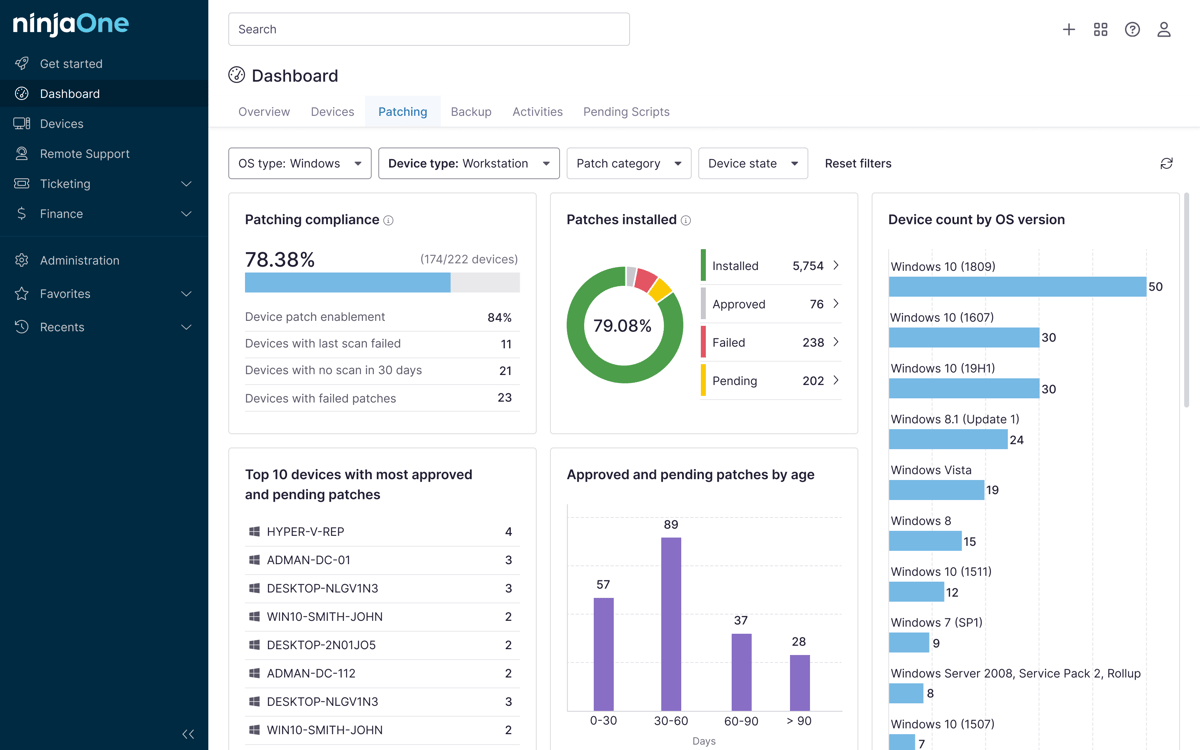
NinjaOne is a unified IT operations platform with MDM that simplifies complex mobile device management operations. With NinjaOne MDM, IT teams can keep track of their Apple mobile devices alongside their Android, Windows, macOS, and Linux endpoints from a single pane of glass. From a single, easy-to-use console, users have access to a full suite of MDM tools, including software deployment and remote control.
5 key points that make NinjaOne an excellent Mosyle alternative
1. Cross-platform compatibility
While Mosyle focuses on servicing Apple devices, NinjaOne offers a more holistic system that encompasses not just Apple systems but also other operating systems, virtual machines, and servers. This makes NinjaOne a great alternative to Mosyle, as organizations can reduce costs by deploying a single solution that covers all their endpoints across a hybrid environment.
Explore Mobile Device Management (MDM)
Manage and secure Android and Apple mobile devices with fast enrollment, policy-based control, and real-time visibility.
Learn more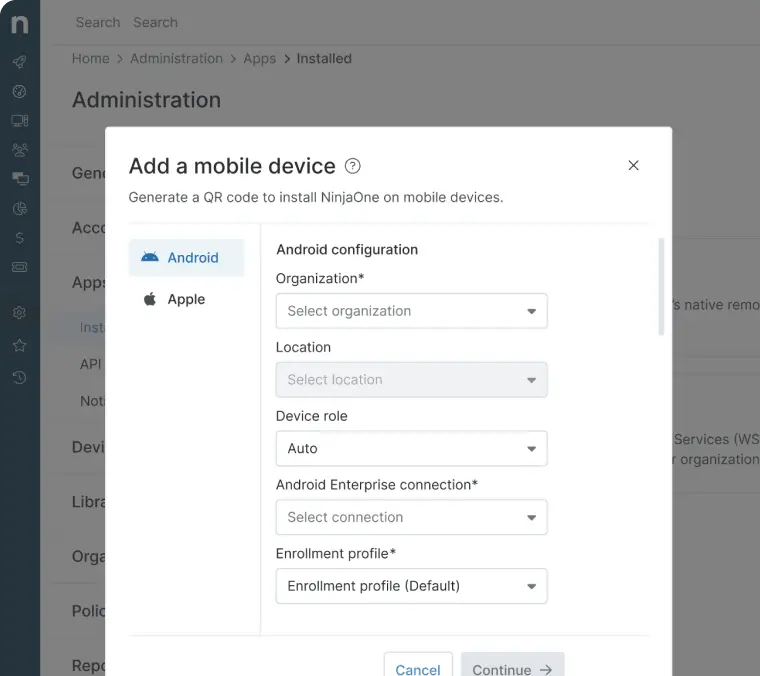
2. Robust security measures
NinjaOne MDM implements several security features. For instance, if a device is lost or stolen, NinjaOne allows technicians to perform remote data wipes and lock devices to prevent unauthorized access to sensitive data. Likewise, NinjaOne also monitors disk encryption status on Windows (BitLocker) and macOS (FileVault) devices from the same console.
3. Compliance management
With NinjaOne, technicians have full control over how mobile devices are used. IT professionals can easily create security policies and deploy these configurations at scale. This ensures that an organization’s mobile fleet is fully compliant with regulatory standards.
4. Automated deployment
NinjaOne MDM simplifies device deployment, making it easier and faster to enroll and get new devices ready for use. With NinjaOne’s robust IT automation tools, users can deploy security policies and install essential applications.
5. Granular device restrictions
See a significant improvement in your business: IT security with granular control over device restrictions. NinjaOne MDM enables IT professionals to restrict the installation of unauthorized applications and even control which functions, such as camera access, employees can access.
Strengths of NinjaOne
- Application management: Technicians can deploy relevant applications and block or uninstall unauthorized ones for security purposes.
- #1 ranked support: With fast response times and an impressive 98% CSAT score, NinjaOne customer service goes above and beyond. Users can quickly get technical assistance and prompt responses.
- User-friendly interface: NinjaOne stands out for its accessibility. Its intuitive interface allows any user, regardless of technical expertise, to navigate the platform, ensuring rapid adoption of the solution.
- BYOD management: Thanks to the platform’s granular control, NinjaOne users can manage only corporate applications without compromising personal privacy and device usage. This allows IT teams to balance BYOD security with corporate security policies.
- Simplified device enrollment: NinjaOne streamlines mobile device enrollment, allowing users to configure multiple devices at once.
Customer story
Paul Jebe, Vice President of IT for Kinex Medical, faced the challenge of maintaining a fleet that included bring-your-own, personal devices. After adopting NinjaOne, Kinex improved its mobile device management, enabling it to expand its fleet. Furthermore, with compliance and security being key criteria in choosing an MDM solution, NinjaOne provides Kinex with security features such as policy implementation and remote control.
“We’re excited to continue growing with NinjaOne by being able to manage our mobile devices from the same pane of glass we use for our other endpoints. Slimming our IT stack even more just brings additional simplicity and efficiency to our lives, so we can better support our company and staff.”
Read more Ninja customer stories or check out NinjaOne G2 reviews.
Pricing information
NinjaOne MDM has no forced commitments and no hidden fees. If you’re ready, request a free quote, sign up for a 14-day free trial, or watch a demo.
Reviews
- 5,038 reviews (at the time of the last update)
- 4.7 / 5 stars
- 298 reviews (at the time of the last update)
- 4.7 / 5 stars
2. Jamf
Jamf is a cloud-native Apple device management software that allows users to manage Apple devices during their entire lifecycle. This solution simplifies device enrollment and allows users to manage device configurations at scale.
Pros
- Application management: Jamf allows users to install applications and deploy updates and patches. Its Self-Service feature allows users to install pre-approved applications as needed.
- Device monitoring: Jamf provides visibility of an organization’s hardware and software, offering insights into device health, security status, and installed applications.
- Device enrollment: Users can automatically enroll Apple devices with pre-configured settings.
Cons
- User interface: Reviews have said that the user interface is challenging to navigate, and some features, such as scripting and smart groups, can be difficult to utilize.
- Software updates: Pushing out updates for macOS can be tricky with Jamf.
- Learning curve: According to G2 reviews, Jamf configurations are complex and require more resources for IT professionals to understand how to use the solution fully.
Reviews
- 2,456 reviews (at the time of the last update)
- 7 / 5 stars
- 547 reviews (at the time of the last update)
- 7 / 5 stars
3. Iru (formerly Kandji)
Iru, formerly known as Kandji, is an endpoint management solution that allows users to track mobile devices and deploy applications, configurations, and security settings to an organization’s mobile fleet. This cloud-based solution focuses on automation to streamline MDM processes. Although largely an Apple-centric device management platform, it has recently expanded support to other operating systems, including Windows and Android.
Pros
- Patch management: Kandji’s Auto Apps system allows users to automate and schedule the deployment of patches.
- Configurations: Kandji utilizes Blueprints that are out-of-the-box configurations, allowing users to deploy applications quickly.
- Compliance management: Users can use configurations to ensure that devices comply with industry regulations and internal policies.
Cons
- Reporting: Iru’s reporting can be lacking for some users. It cannot do aggregated reports and cannot provide some details, such as device traceability.
- Limited support: While Iru has recently expanded support for other operating systems, users note that it still has limitations with non-Apple devices
- Lack of features: Users noted that Iru’s features have limited overall functionality, especially in urgent situations.
Reviews
- 888 reviews (at the time of the last update)
- 7 / 5 stars
- 508 reviews (at the time of the last update)
- 9 / 5 stars
4. ManageEngine Mobile Device Manager Plus
ManageEngine Mobile Device Manager Plus is an MDM platform that lets IT teams oversee smartphones, tablets, and other mobile endpoints running Android, iOS, iPadOS, and tvOS from one central console.
Key capabilities include enterprise-level device management, Wi-Fi and VPN profile configuration, and remote troubleshooting.
Pros
- Enterprise-grade MDM: Built to handle large mobile device fleets, the platform helps organizations protect data and maintain compliance.
- Remote troubleshooting: IT admins can remotely view, control, and manage devices, making it faster and safer to resolve issues without physical access.
- App management: The platform streamlines app distribution and applies app-level restrictions, so only enterprise-approved applications are deployed securely across devices.
Cons
- Mac compatibility: Some reviewers felt that the platform’s compatibility for Mac devices could be stronger.
- User interface: A few users found the interface harder to navigate than it should be and suggested refinements to improve the overall experience.
- Functionality: Users have experienced limited integration within the Apple ecosystem, affecting its functionality and task management.
Reviews
ManageEngine Mobile Device Manager Plus G2 Reviews
- 264 reviews (at the time of the last update)
- 5 / 5 stars
ManageEngine Mobile Device Manager Plus Capterra Reviews
- 938 reviews (at the time of the last update)
- 6 / 5 stars
5. Hexnode UEM
Hexnode UEM is a popular unified endpoint management platform that gives IT teams of all sizes a single console for managing their devices. It also provides MDM support for Android, Windows, iOS, macOS, FireOS, and Apple TV.
Because it is built as a UEM, Hexnode can manage many kinds of endpoints in one place, mobile devices included.
Pros
- Compliance reporting: IT admins can build compliance reports and include key attributes, giving them a clearer view of the entire enterprise device fleet.
- Remote security: If a device is lost or data may be at risk, admins can take action from afar, such as locking the managed device.
- App and content distribution: The platform controls which apps and content get pushed to devices, so only authorized items reach the right endpoints.
Cons
- Device removal: G2 reviewers described the process of removing devices from Hexnode as cumbersome due to an inefficient MFA process.
- Management and reporting features: Users have pointed out that Hexnode UEM’s lacking features, particularly in reporting and device management.
- Limited management features: Users have also highlighted restrictive features in user management and Windows environments.
Reviews
- 297 reviews (at the time of the last update)
- 5 / 5 stars
- 155 reviews (at the time of the last update)
- 6 / 5 stars
Watch a free demo of the #1 Unified IT Management Platform
See how organizations simplify endpoint management, strengthen security and scale IT operations with NinjaOne.
Comparison of the best Mosyle alternatives (G2)
| Category | NinjaOne | Jamf | Iru | ManageEngine Mobile Device Manager Plus | Hexnode UEM |
| Overall | 4.7 out of 5 (5,714) | 4.7 out of 5 (2,456) | 4.7 out of 5 (888) | 4.5 out of 5 (264) | 4.5 out of 5 (297) |
| Has the product been a good partner in doing business? | 9.4 | 9.3 | 9.4 | 8.8 | 9.1 |
| Quality of support | 9.1 | 9.0 | 9.5 | 8.6 | 9.1 |
| Ease of Admin | 9.1 | 8.9 | 9.4 | 8.8 | 9.0 |
| Ease of Use | 9.1 | 8.8 | 9.4 | 8.5 | 8.9 |
Comparison of the best Mosyle alternatives (Capterra)
| Category | NinjaOne | Jamf | Iru | ManageEngine Mobile Device Manager Plus | Hexnode UEM |
| Overall | 4.7 out of 5 (298) | 4.7 out of 5 (547) | 4.9 out of 5 (508) | 4.6 out of 5 (938) | 4.6 out of 5 (155) |
| Ease of Use | 4.7 | 4.4 | 4.9 | 4.4 | 4.5 |
| Customer Service | 4.7 | 4.6 | 4.9 | 4.5 | 4.7 |
| Features | 4.5 | 4.6 | 4.6 | 4.6 | 4.5 |
| Value for Money | 4.6 | 4.4 | 4.6 | 4.6 | 4.5 |
Final scores and summaries of best Mosyle alternatives
| Vendor | Final Score | Summary |
| NinjaOne | 8.73 | NinjaOne MDM helps IT organizations reduce costs and complexity by enabling the management of Android and Apple mobile devices alongside their Windows, macOS, Linux, VMs, and SNMP devices—all within a single platform. |
| Jamf | 8.63 | Jamf is a cloud-native Apple device management software that allows users to manage Apple devices during their entire lifecycle. |
| Iru | 8.62 | Iru is a simple and intuitive tool for Apple mobile devices. It is best suited to organizations whose fleets are primarily Apple devices. |
| ManageEngine Mobile Device Manager Plus | 8.09 | ManageEngine Mobile Device Manager Plus is a reliable and versatile tool that helps IT teams gain better control over their mobile devices. |
| Hexnode UEM | 7.29 | Hexnode UEM is used by mid-market organizations that track and manage many devices across different operating systems. |
Our best Mosyle alternatives comparison and ranking methodology
This review and ranking of the product category in 2026 is based on a transparent, structured methodology. The process includes:
- Data Sources: Aggregated ratings and review counts from G2 and Capterra as of October 2026.
- Metrics Considered: Star ratings, review volume, quality of support, business partnership feedback, ease of use, and customer service ratings.
- Final Score is the average of up to ten metrics, each converted to a 0-10 scale:
- G2: Good partner in doing business
- G2: Quality of support
- G2: Ease of admin
- G2: Ease of use
- Capterra: Ease of use (multiplied by 2 to match G2’s 0 to 10 scale)
- Capterra: Customer service
- Capterra: Features
- Capterra: Value for money
- G2: Review volume, scaled from 0 to 10 across all ranked tools
- Capterra: Review volume, scaled from 0 to 10 across all ranked tools
- Review volume is scaled logarithmically and then mapped so the tool with the fewest reviews scores 0 and the tool with the most scores 10. This keeps a handful of reviews from being treated the same as thousands, without letting review count alone decide the ranking.
- Not every tool publishes all ten metrics. Where a metric doesn’t exist for a tool, that metric is left out of the average entirely rather than counted as zero.
- Data Freshness: All data was collected and last validated on October 30, 2026.
- Process: Products were evaluated for both core and advanced MDM features, customer feedback, recent security incidents, and breadth of integrations, with sources referenced where relevant.
What to look for in a Mosyle alternative
When searching for other MDM alternatives to Mosyle, administrators and IT technicians need to keep an eye on the following characteristics, which include a mix of client requirements and built-in features
Tool consolidation and integration
An ideal MDM solution is built into a centralized platform that includes other IT management tools. Likewise, it should already integrate well with other tools in your existing stack for simple deployment and use.
Security and compliance
Your MDM tool should also comply with standards, especially when managing mobile devices in sectors such as finance and healthcare, which require strict security measures and data privacy.
Intuitive user experience
For quick deployment and use, your MDM tool should have an intuitive UI that avoids the complexities of steep learning curves.
How to choose the best Mosyle alternative
Choosing the best Mosyle alternative is a strategic decision that significantly impacts IT efficiency and your organization’s security posture. By learning about the top MDM solutions that can work as alternatives for Mosyle, you can decide which provider best suits your business needs.
Carefully evaluate your business’s needs and determine what tools you need to address them. Before making a final decision, thoroughly test potential solutions by signing up for free trials to get a hands-on look at what their software offers.