Key Points
- Define Server vs Workstation Roles: Clearly classify endpoints based on their function.
- Implement Device-Specific Management Policies: Separate patching, maintenance, and monitoring protocols for servers and workstations to improve uptime and operational efficiency.
- Optimize Monitoring and Alerts: Track relevant performance metrics for each device type.
- Enforce Security and Compliance Controls: Apply tailored security measures such as MFA, RBAC, encryption, and DLP tools based on the device’s role and risk profile.
- Segment Asset Inventory and Lifecycle Management: Maintain separate asset reports, risk tracking, and lifecycle policies for servers vs workstations.
Servers provide website hosting and various resources that enable end-users to efficiently perform work tasks on individual workstations. While unifying device management streamlines endpoint tracking, defining workstation vs server policies allows you to optimize your assets.
Outline maintenance standards for workstation and server management. This article provides a structured workflow for distinguishing endpoint types across multi-tenant environments.
Workstation vs server management
Security is top-priority, and Remote Monitoring and Management (RMM) platforms typically include device grouping features to streamline workstation vs server handling. Before classifying your endpoints, consider your technical constraints and service goals.
📌Prerequisites:
- Complete inventory of managed endpoints tagged as “Server” or “Workstation”
- Defined patching, backup, and Service Level Agreement (SLA) policies per device role
- RMM or MDM platform supporting device grouping and custom policies
- Network and performance baselines for both device types
- Role-based access control (RBAC) and privileged account management policies
Step 1: Define functional differences and service roles
Client environments can be diverse and involve hundreds of different tools and third-party apps. No two infrastructures are ever truly the same. As such, you should always tailor management workflows to integrate SLAs and avoid generic solutions.
Classify each device type (ie, servers and workstations) to gauge their operational impact and develop monitoring templates that uphold your security posture.
What are servers?
Servers are dedicated physical or virtual machines that host critical services, such as application hosting, sign-in authentication, and database management. Knowing the type of server your clients work with helps streamline resource allocation.
It is a good practice to classify servers based on the workload they handle. For example:
- File servers (e.g., SMB shares)
- Application servers (e.g., IIS, Apache)
- Directory servers (e.g., Active Directory)
- Database servers (e.g., SQL Server, MySQL)
- Virtualization servers (e.g., Hyper-V, VMware ESXi)
What are workstations?
Workstations are physical endpoints configured for various work tasks, ranging from general office tasks to specialized projects such as development, design, or IT support.
Identify workstations by their:
- User role
- Resource usage
- Departmental context
Step 2: Set patching and maintenance cadence
Continuous uptime is essential for servers. Similarly, client workstations rely on frequent performance updates to keep work running smoothly, so operations managers need to establish maintenance protocols to meet both of these needs while minimizing disruption.
To find the most efficient patching schedule, do the following:
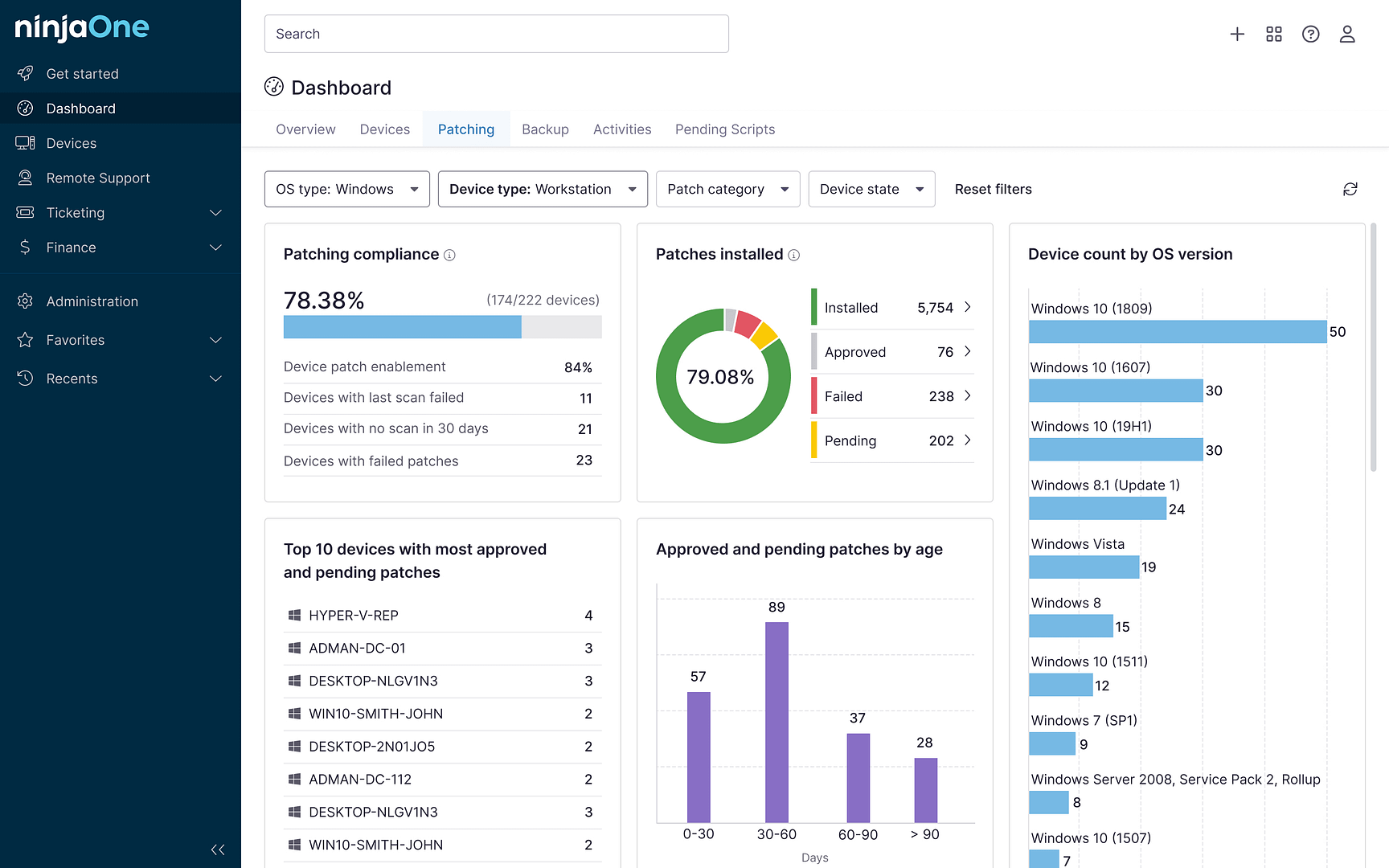
- Centralize endpoint management: RMM tools like NinjaOne provide a birds-eye view of your fleet’s health and security issues.
- Prepare server patching procedures: Follow best practices as you automate pre-patch checks, schedule deployments, and roll back changes.
- Trigger updates during after-hours: Roll out changes in low-risk timeslots for smooth deployments and uninterrupted productivity.
Step 3: Align monitoring and alerting profiles
Tailoring workstation vs server needs means knowing which metrics to prioritize. This ensures that your insights remain relevant, even across different tenants.
Track these performance metrics first for SLA-aligned alerts and effective reports:
Servers
- CPU usage
- Disk I/O
- Service uptime
- Backup status
- Latency
Workstations
- CPU performance
- Memory spikes
- Login success rates
- Disk space
- User-impact alerts
🥷🏻| Enforce continuous monitoring with real-time alerts and centralized data. Read how NinjaOne RMM improves endpoint oversight here.
Step 4: Segment asset inventory and lifecycle management
Differentiating workstation vs server needs involves asset lifecycle tracking, and knowing the optimal time to upgrade or replace client hardware helps maximize usage and supports productivity.
Create separate reports for servers and workstations, list needed components, and incorporate asset fields to align with your client’s budget. IT overseers should also filter endpoints by risk level, and integrate management tools with built-in device tagging and Professional Service Automation (PSA) for cleaner lifecycle reports.
Step 5: Apply security and compliance controls by device type
Security measures should reflect the risk profile of each device type. As such, you’ll need to tailor strict access controls if you want to keep important workstations or key servers safe.
Implement specific compliance controls for each endpoint type:
Servers
- Enforce Multi-Factor Authentication (MFA) for remote access
- Enforce centralized records
- Limit Remote Desktop Protocol (RDP) permissions
- Regularly audit privileged accounts.
Workstations
- Apply encryption standards (e.g., BitLocker, FileVault)
- Block malicious websites with web filtering (e.g., Cisco Umbrella)
- Restrict USB usage with Group Policy, Intune, or other Data Loss Prevention (DLP) tools
Step 6: Automate policy enforcement and reporting
Automating workstation vs server management and monitoring creates time-saving workflows that can scale with your client’s business.
Enhance your workflows with RMM tools like NinjaOne, which grants custom scripts, easy-to-use templates, patch policy enforcement, and auto-generated reports so your team can prioritize uptime and SLA compliance with zero manual effort.
NinjaOne also comes with MDM capabilities and QBR-ready dashboards out of the box, and can be set up within minutes.
How NinjaOne streamlines workstation and server management
Integrating NinjaOne into your technician’s toolkit enhances reporting and simplifies IT monitoring for workstation vs server needs.
| Process | Without NinjaOne | With NinjaOne |
| Define functional differences and service roles. | Manual spreadsheet entry and inconsistent role tagging. | Centralized device role tagging, allowing automated policy assignments. |
| Set patching and maintenance cadence. | Requires script tests and GPO configurations with limited visibility. | Automated patch scheduling based on device type; rollback options, and compliance tracking. |
| Align monitoring and alerting profiles. | Device alerts are assigned per device, with risk of false positives without a unified control panel. | Built-in monitoring templates that can serve as a baseline for servers and workstations. Customizable alert thresholds. |
| Segment asset inventory and lifecycle management. | Separate tracking tools can create a disconnect when tracking workstation vs server needs. | Real-time asset inventory. Lifecycle tags facilitate warranty tracking and alerts. |
| Apply security and compliance controls by device type. | Policies are enforced manually; there is a chance of inconsistent MFA/logging/encryption implementation. | Enforces SLA-compliant security enforcements (e.g., CIS, NIST) by device type. |
| Automate policy enforcement and reporting. | Requires numerous platforms to track manually; risk of compliance drift. | Automation engine generates reports out of endpoint data with QBR-ready dashboards. |
Quick-Start Guide
NinjaOne does have capabilities to differentiate and manage servers vs workstations in MSP environments.
Best Practices
MSPs using NinjaOne typically:
- Create master alerting policies that waterfall to both patching and AV policies
- Use role-based access control for server vs workstation management
- Implement different maintenance windows for servers vs workstations
Key Features for Server/Workstation Management
- Device Roles & Policies
- NinjaOne allows you to create specific device roles (Server, Workstation, etc.)
- You can assign different policies to these roles for targeted management
- Patch Management
- Separate patch policies for servers vs workstations
- Customizable scan/apply schedules appropriate for each device type
- Remote Access & Control
- Granular permissions for server vs workstation access
- Secure remote desktop capabilities for both device types
- Monitoring & Alerts
- Custom alerts based on device type
- Server-specific health monitoring (CPU, memory, disk space, etc.)
- Inventory & Reporting
- Detailed inventory tracking by device type
- Custom reporting dashboards for server vs workstation metrics
Differentiate workstation and server management to maximize your resources
Treating workstation vs server needs separately gives IT firms a strategic advantage; both may share the same management platform, but optimization is a different story. Segment patch policies, prioritize server uptime, and maintain workstation health via centralized dashboards (e.g., NinjaOne) for smoother operations.
Related topics: