
Key Points
- Cyber resilience is the ability to maintain and restore business operations during a cyber incident.
- Cybersecurity reduces attack likelihood, while resilience reduces business impact.
- Compliance frameworks set baselines but do not ensure recovery readiness.
- Resilience requires defined recovery objectives and tested restoration processes.
- Executive ownership and business impact alignment drive effective resilience.
- Continuous testing and adaptation are essential against evolving threats.
Most cybersecurity strategies are centered on prevention with processes that reduce the likelihood of compromise. However, no one can ignore the fact that no control environment is impenetrable, with ransomware, supply chain vulnerabilities, credential abuse, and even operational misconfigurations disrupting well-defended organizations. With that context, the question shouldn’t just be “Can we prevent it?” but more so “How effectively can we endure it?” This is where cyber resilience comes in.
Keep reading to learn what cyber resilience is and how it ensures functionality and recovery in the face of inevitable disruption.
What is cyber resilience?
Cyber resilience is not a tool that can stand alone or a kind of certification to work towards. Rather, it’s the organization’s practical capacity to keep functioning when disruption occurs and become stronger afterward.
This capacity can be demonstrated through an organization’s ability to:
- Withstand operational disruption without systemic failure
- Sustain critical services during adverse conditions
- Restore systems and data in a controlled and timely manner
- Adjust defenses and processes as threats evolve
- Incorporate lessons learned from incidents into future preparedness
Resilience extends beyond technical safeguards, reaching as far into disciplined operational readiness.
How cyber resilience differs from cybersecurity
Cybersecurity and cyber resilience are closely related, but they’re not interchangeable. One concentrates on reducing the chances of compromise, while the other concentrates on controlling damage when compromise occurs inevitably.
Cybersecurity focuses on:
- Preventing unauthorized system and network access
- Identifying and remediating weaknesses that can be exploited
- Detecting and blocking malicious activity before escalation
In contrast, cyber resilience focuses on:
- Minimizing the impact on business operations and finances
- Quickly restoring essential services
- Preserving stakeholder trust during incidents
- Sustaining business operations under stress
Security lowers the likelihood of an incident, while resilience reduces its consequences.
Why compliance alone does not create resilience
Following regulatory security frameworks is important because they provide structure and establish baseline expectations regarding risk management. However, meeting these requirements doesn’t automatically ensure operational strength during disruption.
Most of the time, compliance programs alone are never enough because they:
- Confirm that controls exist, but not whether they perform effectively under stress.
- Emphasize documentation over real-time recovery capability.
- Address known requirements, but not unpredictable and evolving threats.
- Only validate point-in-time alignment instead of continuous preparedness
Resilience requires ongoing validation, testing, and, most importantly, the willingness to adapt as conditions change.
Core components of a resilient organization
Technologies and architectures vary across industries, but organizations that consistently recover well from disruption tend to share a few characteristics. This is because resilience is not accidental; it is built over time through deliberate alignment across teams.
These attributes usually include:
- Executive accountability for cyber and operational risk
- Explicitly defined recovery objectives
- Routine validation of recovery plans and assumptions
- Coordinated response processes across teams
- Clear visibility into how downtime affects the business
Leadership alignment and organizational discipline shape resilience just as much as technical controls.
The role of backup in resilience
Backups are one of the main crutches of a resilience strategy, but they are not sufficient on their own. They are only safety nets that don’t guarantee restoration.
To ensure operational resilience, organizations need other supporting elements, such as:
- Regularly tested restoration procedures under realistic conditions
- Documented escalation workflows during incidents
- Structured communication plans for internal and external stakeholders
- Defined recovery time objectives aligned to business priorities
Ultimately, disciplined execution determines if resilience is achieved.
Adapting to a changing threat landscape
Threat actors and their attack techniques are constantly evolving, so organizations must recognize that past assumptions may no longer hold in the future.
Maintaining resilience in a dynamic environment requires organizations to:
- Reevaluate risk assumptions regularly
- Incorporate learnings from incidents
- Update response and recovery plans as environments change
- Recalibrate operational priorities based on emerging exposures
Simply having static controls will leave organizations vulnerable to evolving threats.
Limitations and scope considerations
Cyber resilience strengthens organizations against disruptions, but it’s not a universal solution to every risk. It’s important to understand its boundaries to set realistic expectations and secure long-term commitment.
Here are some important points to reiterate:
- It doesn’t remove the need for strong preventive security controls.
- It’s not a substitute for regulatory or contractual compliance obligations.
- It requires sustained investment and executive support.
- It needs ongoing measurement, testing, and refinement.
Remember that it’s not a one-time initiative, but a discipline that must be maintained over time.
Common misconceptions
When resilience is equated with prevention or tooling, the concept becomes easily misunderstood. It’s crucial to clarify these misconceptions to manage expectations and prevent blind spots.
| Misconception | Clarification |
| Resilience means zero downtime. | It focuses on minimizing and controlling disruption, not eliminating it entirely. |
| Compliance equals resilience. | Compliance establishes a baseline, but resilience requires operational validation. |
| Backups guarantee resilience. | Recovery success depends on tested restoration and coordinated execution. |
NinjaOne integration
To build a functional cyber resilience strategy, enterprises need consistent visibility, structured processes, and validated recovery workflows. NinjaOne can support these efforts with several capabilities:
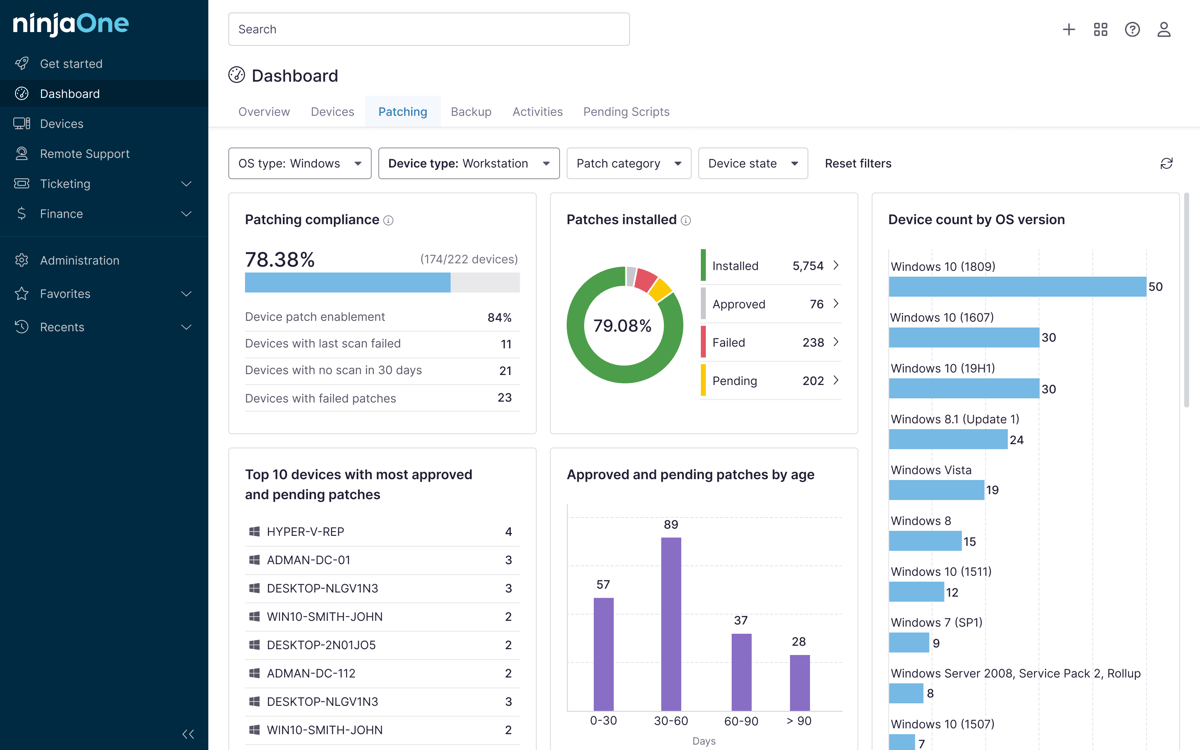
- Centralized visibility that allows teams to monitor endpoint and server health in real time and identify disruptions early.
- Continuous monitoring that enables faster detection and coordinated response to operational anomalies.
- Integrated documentation workflows that standardize procedures and preserve institutional knowledge during incidents.
- Recovery validation tools that help confirm backup integrity and restoration readiness before disruption occurs.
These all strengthen resilience execution while complementing broader governance and risk management strategy.
Operationalizing cyber resilience for business continuity
Disruption is now unavoidable, so despite having prevention and compliance in place, cyber resilience has become necessary in organizations’ evolution regarding managing risks. Mastering this operational capability to sustain operations when controls fail can help businesses preserve trust by managing consequences and maintaining stability in the face of uncertainty.
Related topics: