
Key Points
- A successful PSA implementation for MSPs requires clearly documented service workflows before system configuration begins.
- Undefined processes and weak change management are the primary reasons many MSP PSA implementations fail.
- Phased rollout of core ticketing, time tracking, billing, and reporting reduces operational disruption and improves adoption.
- Early over-customization increases complexity and should be avoided until baseline PSA functionality is stable.
- Strong leadership ownership and cross-team accountability are critical for long-term PSA adoption and optimization.
- Measurable success depends on consistent system usage, accurate reporting, and improved profitability over time.
For managed service providers (MSPs), implementing a Professional Services Automation (PSA) platform is considered a milestone, marking their transition from ad-hoc and manual workflows to a more stable and scalable enterprise business model. However, PSA implementations often fail due to poor planning and misaligned processes, creating friction instead of efficiency. Keep reading to learn how to ensure sustainable success when using an MSP PSA system.
Why MSP PSA implementations fail
PSA deployments usually struggle because of organizational gaps instead of technical limitations. These issues only become visible when the system begins enforcing structure and visibility.
Some of the most common underlying causes of this failure include:
- Service workflows are undocumented or handled inconsistently.
- Legacy processes are recreated without any improvements for efficiency.
- Teams don’t receive the right training and context for the changes.
- Too many customizations are introduced before core PSA functionality is stabilized.
Defining processes before implementation
An MSP PSA software system will reinforce existing operational processes and habits, regardless of whether they are good or bad. So if workflows are not clearly defined yet, configuration decisions will surely become inconsistent.
Before starting system setup, MSPs should ensure they:
- Map out core IT service delivery workflows from intake to resolution.
- Establish consistent ticket handling and escalation procedures.
- Define billing logic and reporting expectations.
Focusing on adoption and change management
Even a well-designed and configured PSA will struggle if the people using it aren’t aligned with the change. Adoption requires consistent user buy-in throughout the transition to ensure impactful improvement.
The following adoption factors can influence success:
- Clearly communicating the purpose and expected impact of the rollout
- Structuring training around the specific roles of technicians and administrative staff
- Setting realistic expectations around a transitional learning curve rather than immediate perfection
Phased implementation reduces risk
Teams often get confused and struggle when organizations try to deploy every feature at once. A better PSA implementation strategy is to phase the rollout to limit disruption and create space for feedback and adjustment. This allows core functions to stabilize before the system becomes more complex.
Effective implementation typically includes:
- Launching core ticket management and time tracking first
- Introducing billing workflows and reporting once usage is consistent
- Slowly layering in automation and third-party integrations over time
Avoiding early over-customization
An extensively tailored PSA during initial deployment often introduces unnecessary risk. Too much complexity early in the implementation process obscures core functionality, ultimately slowing down stabilization.
Premature customization comes with these common risks:
- Increased operational complexity
- Greater difficulty in diagnosing issues when problems arise
- Rigid workflows that are difficult to adjust
Before introducing advanced customization, teams should first focus on validating and adopting baseline capabilities.
Measuring success after go-live
Go-live shouldn’t be the conclusion of the project but the beginning of operational refinement. Teams will only see the real value of implementation after they’ve integrated it into their daily routines. Over time, the return on PSA investment will gradually emerge via measurable improvements.
Here are some indicators of sustained success:
- Consistent system usage across technical and administrative teams
- More accurate reporting that supports financial and operational decisions
- Noticeable reduction in manual effort and corrective rework
Limitations and scope considerations
From everything discussed thus far, organizations should know the following considerations regarding PSA implementation:
- Existing process gaps won’t be resolved unless they are intentionally addressed.
- System configuration must be reviewed and optimized as the business evolves.
- Executive sponsorship and consistent leadership involvement are crucial.
Technology can only create the framework for change. Sustained results will always depend on disciplined execution and engaged leadership.
Common misconceptions
Some PSA implementation assumptions seem reasonable, but actually create avoidable friction during rollout. Clearing up these misconceptions early can help MSPs approach implementation with clearer expectations.
More features mean a better implementation
A feature-rich configuration doesn’t always translate to operational improvement. Most of the time, simplicity drives higher adoption and allows teams to build disciplined habits before having to consider additional functionality.
PSA configuration should mirror old workflows
Recreating legacy processes inside a new system will only preserve inefficiencies. Implementation should be treated as an opportunity to streamline and modernize service delivery.
Go-live means the project is finished
Again, launching the platform marks only the transition into optimization, not completion. Meaningful value emerges through ongoing refinement and measurement well beyond the initial deployment phase.
NinjaOne integration (optional)
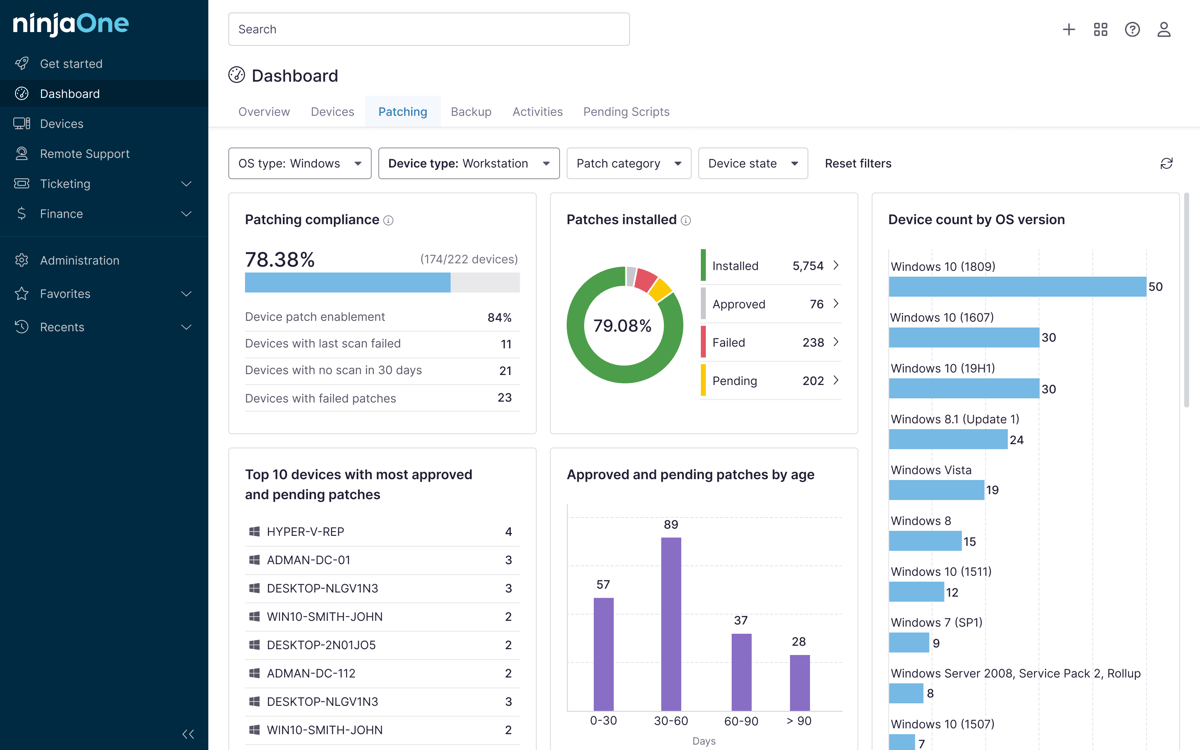
For a smoother PSA adoption, it’s best to have a stable and well-managed endpoint environment. NinjaOne can help by reducing operational noise at the infrastructure level. See exactly how below:
- It reduces alert fatigue and ticket volume by proactively identifying and resolving endpoint issues.
- It provides centralized visibility across managed devices, improving data accuracy within the PSA.
- It enables automation aligned with standardized service workflows, reinforcing consistent execution.
- It offers native integrations with leading PSA platforms, ensuring reliable data synchronization between RMM and PSA systems to streamline service delivery and improve operational efficiency.
By stabilizing day-to-day operations, NinjaOne helps MSPs approach PSA rollout as a structured improvement initiative instead of a reactive adjustment.
Operationalizing PSA for long-term performance
A successful PSA implementation is measured by how effectively it has been embedded into daily operations, so MSPs must treat the process as a structured initiative that takes time and even more commitment. Remember to avoid over-customizing early and focus more on consistent usage and continuous improvement. With these PSA adoption best practices, MSPs can ensure a reliable platform centered on scalable service delivery and stronger financial control.
Related topics: