
Key Points
- Defining Network Visualization: Network visualization uses easy-to-grasp visuals like maps, charts, and dashboards to show network devices, connections, and data flows.
- Types of Visualization: The most common types of network visualization include static and dynamic network maps, performance charts and graphs, and centralized dashboards for real-time monitoring.
- Benefits of Network Visualization: Network visualization improves IT operations by increasing visibility, accelerating troubleshooting, simplifying planning, and making complex network data easier to interpret.
Network visualization, also known as network topology mapping, is the practice of creating visual representations of your network and the entities and processes in it. Typically, these visual representations show network devices, network metrics, and data flows to easily illustrate important data and information.
In this article, we discuss the importance of network visualization and how you can use it to enhance your IT operations.
Improve incident response with real-time network monitoring and management.
Types of network visualization
There are different types of network visualization, the most common being:
Network maps
Network maps are the most popular type of visualization because they allow viewers to see an entire network topology in one place. Most network maps provide details on devices (nodes) and their interconnections (edges), resulting in a logical visual representation.
There are generally two types of network maps:
Static network maps
Static network maps refer to unchanging network maps, typically represented through diagrams. Static maps are ideal when tracking your network topology or understanding a network’s design.
Dynamic network maps
These maps incorporate real-time data into your visuals, allowing viewers to track network changes. Dynamic network maps are usually interactive.
Charts and graphs
Charts and graphs are powerful tools for highlighting trends and comparing data sets. Typically, charts and graphs are used to show metrics and historical data, such as interface utilization, bandwidth, and packet loss. Additionally, this type can also be used to compare data.
Dashboards
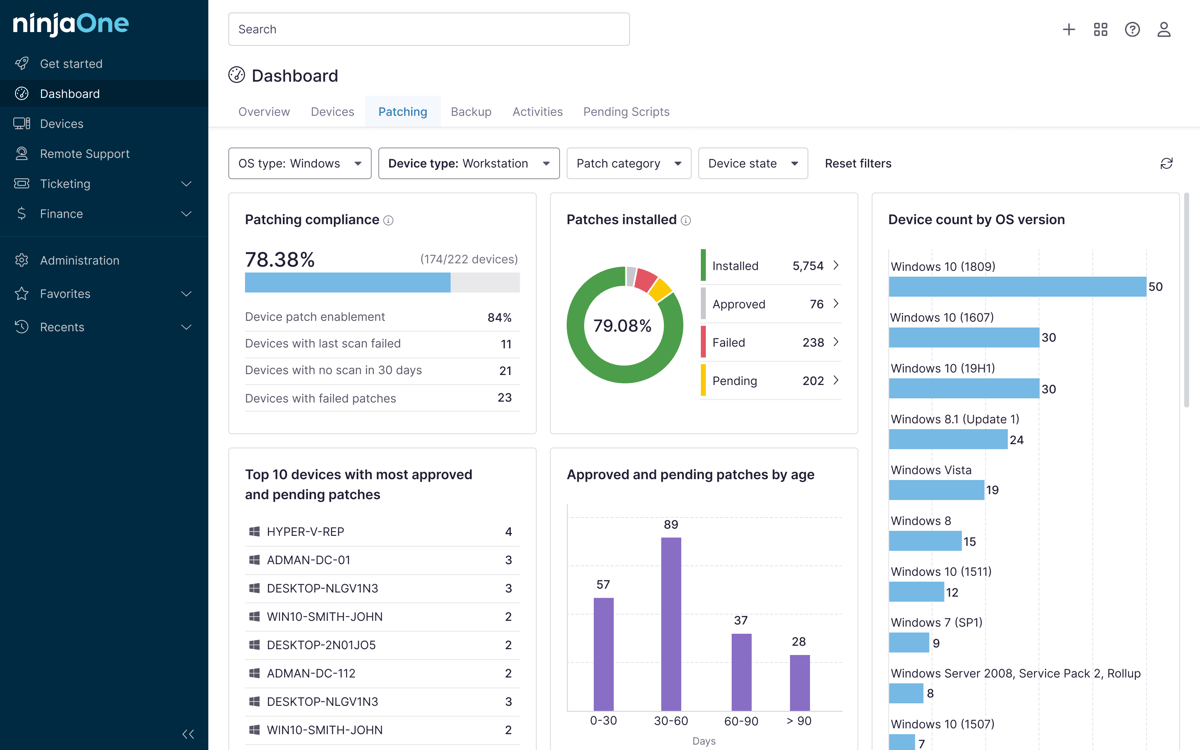
Dashboards are an aggregation of different data in a single pane, allowing IT teams to view and analyze important data quickly. A good dashboard should have the vital information at your fingertips, while remaining intuitive to ensure that users can easily access the data they need. A good example of an information-rich and intuitive dashboard is NinjaOne’s dashboard.
What is the importance of network visualization?
Modern IT operations deal with a lot of data, much of which can be challenging to interpret when viewed in isolation. Network visualization allows IT teams to view data such as device inventories, traffic flows, logs, and performance metrics in a concise and easy-to-understand visual format, allowing them to more easily see trends, structure, relationships, and behaviors in a network.
Benefits of network visualization
There are several benefits of using network visualization in your IT operations, including:
- Enhanced network visibility
- Faster troubleshooting
- Simplified network planning
- Higher staff productivity
- Simplified network representation
- Improved inventory management
When should you have network visualization?
There are some things that become much easier to understand when there’s a visual reference; if you think a concept, point, or analysis would be better understood if it’s shown, then using network visualization items might be the solution.
Some cases where having visuals would enhance one’s understanding include:
- Incident response and impact analysis
- Change planning and validation
- Capacity and dependency assessment
- Communication between technical and non-technical teams
Optimize network performance with real-time visibility and data-driven insights.
Understand your IT environment quickly with comprehensive network visualization
Network visualization transforms raw network data into understanding. By presenting relationships and behavior visually, it enables faster insight, better decisions, and reduced operational risk.
Related topics: