
Key Points
- Use structured templates and a single source of truth (SoT) to eliminate duplicates, keep data consistent, and speed up troubleshooting.
- Automate the flow from discovery to documentation so device lists, diagrams, and configs update as the network changes.
- Assign ownership, review schedules, and triggers to maintain accountability and ensure every page and diagram stays current.
- Apply version control, access restrictions, and secrets management to keep documentation secure, traceable, and compliant.
- Track quality through health reports and scorecards that measure page freshness, coverage, and accuracy across all sites.
Strong network documentation reduces downtime and speeds up troubleshooting. The hard part is keeping it accurate over time. Use clear templates, a single source of truth, and discovery-driven automation. Assign owners with review schedules and apply version control and access rules to track and secure changes.
This guide walks you through network documentation best practices to keep records accurate, actionable, and always up to date.
Standardize your network documentation across all IT environments.
Network documentation best practices: Steps to build and maintain reliable docs
Before you start building and maintaining network documentation, make sure you have the right tools and systems in place.
General prerequisites:
- Discovery and mapping tools that can export inventories, Link Layer Discovery Protocol (LLDP), or Cisco Discovery Protocol (CDP) neighbor data, and diagrams
- A documentation workspace with page templates and version history
- An IP Address Management (IPAM) or network source of truth platform with Application Programming Interface (API) access
- A ticketing system that links changes to documentation and stores artifacts
- Single sign-on (SSO) and role-based access (RBAC) control for documentation and vault access
- Diagram generation is a function of your discovery or mapping tool. Network documentation stores and links the result; it doesn’t generate the diagram itself.
Step 1: Define scope and templates
Begin by deciding what parts of the network you will document and how each piece of information will be formatted using templates. This forms your foundation and keeps every page structured, useful, and easy to update.
Use Cases: Creating a uniform documentation system across multiple locations or teams.
Steps:
- Identify the layers of your network that require documentation. Include:
- Sites
- Racks
- Switches
- Routers
- Firewalls
- Wide Area Network (WAN)
- Wireless systems
- Internet edge
- Critical applications
Extend the scope to include virtual infrastructure and key business applications if they have direct network dependencies.
- Create a standardized page or network documentation template for each asset type. Require fields such as:
- Hostname, role, management IP
- Virtual Local Area Networks (VLANs), trunks, routes
- Simple Network Management Protocol (SNMP) or API details
- Backup path, serial number
- Support contract, dependencies, and owner
- Provide diagram slots for Layer 3 topology maps, Layer 2 VLAN diagrams, and logical service flows.
- Establish naming conventions and formatting standards to maintain consistent entries.
- Build a short field reference document that defines each required field and explains how to fill it.
After this step, you will have structured pages that answer questions quickly, reduce troubleshooting time, and support compliance work.
Step 2: Pick a single source of truth
All authoritative data should reside in a single, controlled system. When information is spread across multiple tools, it drifts and loses accuracy. In this step, you choose a single source of truth (SoT) so every record reflects the live network state.
Use Cases: Reducing manual duplication between monitoring, configuration, and documentation systems.
Steps:
- Choose one platform to act as the authoritative repository for network data. The SoT should store:
- IP addresses
- Subnets
- Device roles
- Interfaces
- Circuits
- VLANs
- Import or synchronize data from your network discovery tools into the SoT.
- Reference the SoT data inside your documentation instead of copying it. Use embedded fields or links that pull values directly from the SoT.
- Use documentation pages for narratives, procedures, and diagrams. Keep structured data in the SoT.
After this step, you will have readable documentation backed by live, authoritative data.
Step 3: Automate the discovery to the doc pipeline
After defining your scope and setting your SoT, automate the flow between discovery tools, monitoring systems, and documentation. Manual updates decay over time. Automation keeps inventories, diagrams, and key fields up to date as the network changes.
Use Cases: Keeping device inventories and topology diagrams synchronized with the live network.
Steps:
- Schedule exports from your discovery or monitoring tools to pull neighbor tables, interface data, and inventories. Run them regularly so diagrams and records stay current.
- Automatically create or update documentation pages when new devices are added. If required fields, such as management IP, owner, or VLAN, are missing, flag them or open tickets for the owners.
- Embed live data blocks from your SoT into documentation pages. Display IP assignments, VLANs, and circuit details directly from the source instead of typing them manually.
After this step, your documentation will align with the live network with minimal manual effort.
Step 4: Assign ownership, SLAs, and triggers
Automation keeps documentation fresh, but it still needs human oversight. Define who maintains what and when updates occur by assigning owners, update intervals, and review triggers.
Use Cases: Updating diagrams after major network changes.
Steps:
- Assign a clear owner to every documentation page, site, or diagram. Each owner is responsible for verifying accuracy within a defined Service Level Agreement (SLA), such as every 30, 60, or 90 days.
- Set triggers that prompt reviews after network changes. Firmware upgrades, VLAN additions, routing updates, or circuit migrations should create a task or notification for the owner. Use your Remote Monitoring Management (RMM), ticketing, or change management system.
- Display a freshness indicator on each documentation page. Use badges or metadata fields showing the last verified date and whether all required fields are complete.
After this step, documentation will have clear ownership, scheduled reviews, and a visible freshness status.
Step 5: Control access and separate secrets
Network documentation often contains sensitive details such as SNMP strings or API keys. If exposed, they can compromise the infrastructure. Apply access control and store secrets separately.
Use Cases: Preventing unauthorized users from viewing device credentials or sensitive configurations.
Steps:
- Enforce SSO and RBAC for all documentation tools. Grant edit rights only to those responsible for maintenance and limit others to read-only access.
- Store passwords, keys, and tokens in a secure vault such as Bitwarden, 1Password Business, or an internal secrets manager. Reference them using links or identifiers instead of pasting them into pages.
- Enable logging and auditing for sensitive documentation. Record who views, edits, or changes permissions on pages like firewall configurations or network diagrams.
Together, these controls strengthen network governance by ensuring access, accountability, and compliance across all documentation systems.
Step 6: Version, link changes, and store evidence
Track every change made to your network and documentation. Versioning, linking to change tickets, and storing evidence create accountability and verifiable history.
Use Cases: Maintaining proof of backup validity and restore testing for compliance and recovery.
Steps:
- Require an approved change ticket for every infrastructure modification. Link each documentation page to the ticket showing what changed, when, and by whom.
- Attach evidence such as diagrams, configuration snippets, and rollback steps. Add key diffs or summaries to the page after the change is completed.
- For all critical devices, maintain verifiable backup evidence, including restore test results that confirm that configuration and state backups can be restored, and reference them in related documentation.
After this step, every change will have a linked context and verifiable recovery data.
Step 7: Report health and improve
The final step is to monitor the accuracy and completeness of documentation through reports, audits, and feedback loops. Your goal is to maintain and continually improve quality, ensuring it remains visible and trending upward.
Use Cases: Tracking documentation freshness for compliance audits.
Steps:
- Publish a monthly or quarterly scorecard showing documentation health. Include:
- Percentage of pages within SLA
- Missing required fields
- Diagram freshness
- New device coverage
- Number of defects or outdated entries corrected
- Review exceptions with owners and assign due dates for remediation.
- Close the loop during quarterly business reviews (QBRs). Use these sessions to confirm updates, address recurring issues, and assign follow-up actions.
- Track trends over time to measure improvement.
After this step, you will have measurable visibility into documentation quality and progress.
Optimize and secure network documentation with version control and access restrictions.
NinjaOne integration
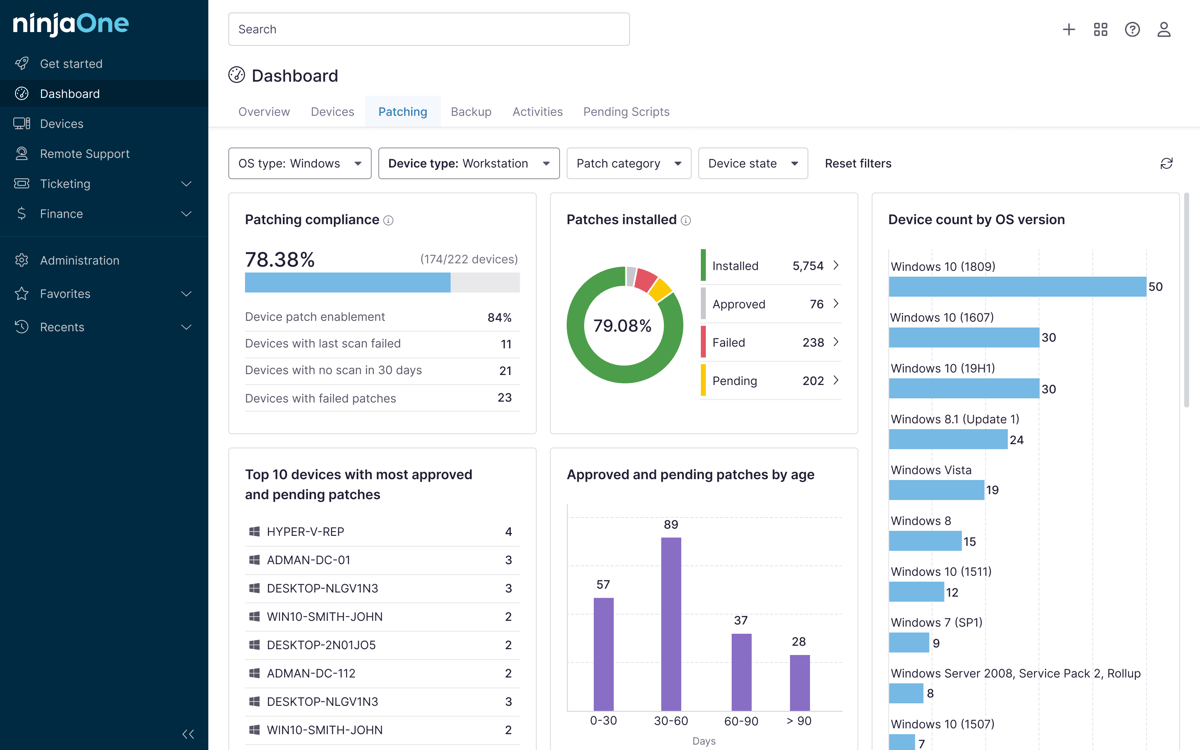
NinjaOne supports automated network documentation through scheduled exports, change detection, and health reporting. These features reduce manual effort and make documentation actionable.
| NinjaOne feature | Function |
| Discovery and inventory | Schedule exports to collect device facts such as IP addresses, roles, interfaces, and circuits. Attach configuration diffs to documentation pages or change tickets for traceability. |
| Automation | Open tickets for stale pages, missing required fields, or new unmanaged devices. Assign tasks to the appropriate owner. |
| Reporting | Generate a monthly documentation scorecard per tenant. Include metrics like freshness, coverage, and open exceptions to track documentation health and improvement. |
Quick-Start Guide
Key Features for Maintaining Current Network Documentation:
- Documentation Fields via Automation, CLI, and API
- NinjaOne Documentation fields can be read from and written to using automation, the CLI component (ninjarmm-cli), and the NinjaOne Public API.
- This keeps device and environment details current without having to retyping them by hand.
- Documentation Management Tool
- NinjaOne includes a dedicated Documentation tool that lets you create, organize, and maintain network documentation.
- You can build a knowledge base with files, folders, and custom wikis tailored to your network.
- Integration with Microsoft Word
- Technicians with the appropriate permissions can edit Microsoft documents directly within NinjaOne Knowledge Base.
- This integration helps maintain documentation consistency and accessibility.
- Public and Shared Links
- The platform allows sharing documents publicly or with specific users via links, ensuring the right people have access to current documentation.
- You can control link expiration and track usage.
- Checklists and Templates
- NinjaOne provides checklist templates to standardize documentation processes.
- These checklists can be assigned to individuals with due dates for completion.
- Automation and CLI Support
- Documentation fields can be read from and written to through CLI, allowing for script automation.
- APIs are available for integration with third-party services to keep documentation updated.
Best Practices for Keeping Documentation Current:
- Establish Ownership: Assign clear responsibility for maintaining different parts of the documentation.
- Use Templates: Create standardized templates for consistency across all network documentation.
- Automate Where Possible: Use the NinjaOne automation features to reduce manual updates.
- Schedule Regular Reviews: Set up recurring tasks to review and update documentation periodically.
- Integrate with Processes: Connect documentation updates to change management and incident response workflows.
NinjaOne provides the tools needed to build and operate network documentation that stays current through a combination of automation, templates, integration capabilities, and structured processes.
Applying network documentation best practices in daily operations
Effective network documentation is supported by a robust system. Build it with clear templates, automation that keeps data up to date, and owners who stay accountable for accuracy. Keep one source of truth for device data, keep pages readable, and tie every update to a verified change. Track quality through reports so you know what’s current and what’s not. When stakeholders can trust what they read, the documentation does its job.
Related topics: