


Key Points
- Categorize Responses: Track security recommendations as accepted, deferred, or declined to improve accountability and support security compliance monitoring.
- Standardize Workflows: Use PSA systems and ticket-based workflows to enforce response timelines and maintain consistent documentation.
- Centralize Response Data: Maintain lightweight, auditable trackers to improve auditability and align client decisions with vulnerability tracking tools.
- Confirm Responses: Capture approvals via secure forms or archived emails to reduce disputes and strengthen compliance evidence.
- Review Regularly: Include open recommendations in QBRs or monthly reviews to highlight risk and drive remediation.
- Watch for Common Risks: Incomplete ticket updates, tracking errors, missed reviews, incorrect automation targeting, and spoofed confirmations can weaken security compliance monitoring.
- Apply Best Practices: Use templates, define ownership, document client justifications, schedule recurring checks with vulnerability tracking tools, visualize compliance, and escalate unresolved items using client relationship management tools.
Centralized client monitoring helps you track which security recommendations are followed, declined, or ignored by business partners. This practice reduces vulnerabilities on both sides and shields your MSP from legal harm if disaster strikes.
This article provides an efficient framework for tracking client responses using cost-effective methods to improve awareness, accountability, and business relations.
How to achieve effective client monitoring
Integrate these components into your client monitoring framework while leveraging scalable platforms that simplify management:
A. Categorize recommendations for action
Start by creating a comprehensive summary of protection strategies (A.K.A. ‘cyber security recommendations’) for current vulnerabilities and group them by client response:
- Accepted – Client accepts and implements your security recommendation.
- Deferred – Client postpones your security recommendation to a pre-defined date.
- Declined – Client rejects or ignores your security recommendation(s).
B. Standardize ticket creation per client
While most ticketing platforms only focus on improving resolution times, other management tools offer features that put a time-based tracker on client responses.
Standardize your approach by utilizing Professional Services Automation (PSA) with tickets to notify both parties when a security recommendation remains unresolved past a timeframe (e.g., 7-14 days without action). Afterwards, update tickets using your list of client actions (e.g., Accepted, Deferred, Declined).
C. Use a lightweight tracker
Store, organize, and maintain client response data with an internal spreadsheet that improves auditability. Make sure to include:
- Client name
- ‘Cyber security recommendation’
- Date delivered
- Response category (e.g., Accepted, Deferred, Declined)
- Follow-up owner
- Justification (if deferred or declined)
- Target implementation date (if accepted)
🥷🏻| Streamline MSP tracking with custom fields and automated alerts.
Learn how to centralize client response logs with NinjaOne’s response templates.
D. Client confirmation methods
Collect and record affirmative client responses with web-based tools like Google Forms, which offer structured note-taking features (e.g., drop-down menus and checklists). As an extra measure, you can also utilize end-to-end encryption for increased security.
However, for smaller clients like SMBs, sending an informal email confirmation will suffice. This is especially true in trusted MSP-client relationships, but note the following best practices:
- Send time-sensitive recommendations via other channels.
- Always encrypt sensitive client data.
- Always log and properly archive emails, for audit purposes.
E. Integrate into QBRs or monthly reviews
Revisit security recommendations and their status during quarterly business reviews (QBRs) to highlight wins, emphasize system protections, and readjust strategies. Visualize your client’s security recommendation uptake rate, and include “open risk items” that can introduce gaps in your security posture.
🎥 Check out the video version here — all five components covered: How to Track Client Responses to Security Recommendations Without Complex Tools.
PowerShell automation example
This technical response validation script format tells you whether a certain hotfix is present on a client machine.
📌 Use Cases: Query for the presence of applied security recommendations; map responses to your spreadsheet tracker; large-scale rollouts.
📌 Prerequisites: Administrator privileges, Windows 10 or Windows 11 operating system.
- Press Win + R, type PowerShell, and press Ctrl + Shift + Enter.
- Run this script:
$client = "<ComputerName>"
$patch = "<WindowsUpdateIdentifier>"
$installed = Get-HotFix -ComputerName $client | Where-Object {$_.HotFixID -eq $patch}
if ($installed) {
Write-Host "$patch is installed on $client (Accepted)"
} else {
Write-Host "$patch is missing on $client (Pending or Declined)"
}
Replace <ComputerName> with the target machine’s name (e.g., CLIENT-MACHINE)
Replace <WindowsUpdateIdentifier> with the specific Windows update you’re looking for (e.g., KB5003637)
⚠️ Things to look out for
| Risks | Potential Consequences | Reversals |
| The ticket was not updated properly. | Remediation could get delayed. | Automate ticket creation and escalation; perform weekly audits on ticket logs. |
| Spreadsheet errors and missing data during client monitoring | Inaccurate client response tracking and open risk | Enforce version control, create backups, and regularly validate your database with your client. |
| Pending security recommendations excluded from QBR | Unresolved security gaps and open risk clients | Include segments for security recommendations and action plans. |
| PowerShell script targets the wrong machine | Missed updates, compliance drift | Use testing environments before rollouts, verify machine names, and use the correct patch IDs. |
| Spoofed email confirmations | Phishing and false compliance | Verify sender domain, archive confirmations, and use encrypted forms. |
Best practices for tracking client responses
As MSP environments mature, client response tracking increasingly feeds into automated escalation and reporting workflows. Documented client decisions now play a critical role in security compliance monitoring, cyber insurance validation, and audit readiness.
Make client monitoring seamless while preserving context with these key points.
Create templates
Enforce structured tracking with pre-built templates that include important fields and emphasize prioritization. These ensure that your documentation stays consistent.
Automated solutions now come with tagging features, which let IT professionals add more fields to custom templates. They can then use these templates to automate data collection enterprise-wide.
Define ownership
Establish contact points to eliminate awkward client follow-ups. Assign stakeholders to specific clients or tasks, and set clear deadlines that align with business needs and contractual obligations.
Document justifications
If a client rejects or postpones one or more security recommendations, accurately document their explanations. Doing so can help absolve your MSP of any liability or insurance claims in the future, especially in heavily-regulated industries like healthcare or finance.
Schedule recurring checks
Deploying regular patch checks to multiple machines via RMM helps validate client compliance. From group policy changes to implementing multi-factor authentication, client monitoring helps maintain system health in an evolving digital landscape.
Make it visual
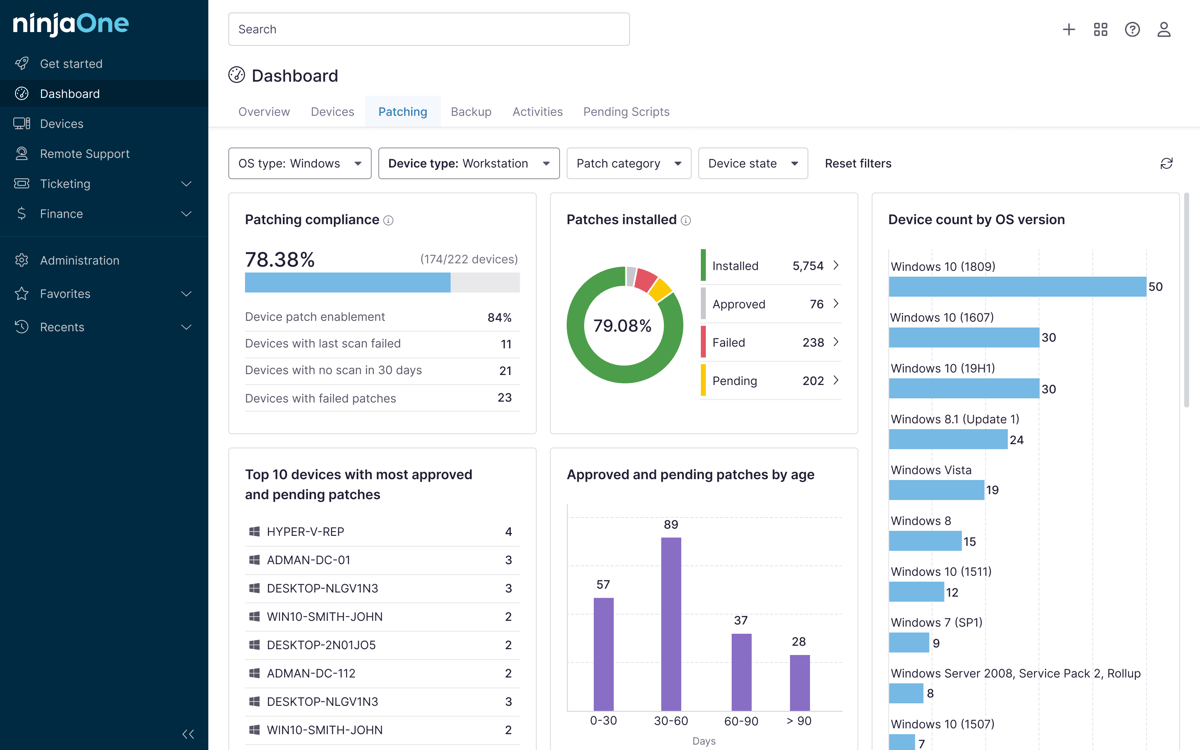
Visualized patch compliance data helps enforce accountability on both ends. RMM tools like NinjaOne offer all-in-one dashboards illustrating open risks, remediation statuses, and compliance scores over time.
Follow up after inaction
Escalation after multiple missed deadlines is optimal to minimize the involved risk. Help your clients dial back in by grouping these long-standing issues by severity and reminding them in quarterly alignment meetings.
How NinjaOne simplifies response tracking and MSP documentation
NinjaOne’s endpoint management empowers IT pros with automated solutions for seamless ticketing, patch compliance, and more.
- Provides customizable templates tailored to client monitoring needs.
- Tags client devices that comply with security recommendations.
- Schedules monthly reports to follow up on open risks.
- Integrates PSA, RMM, and MDM modules to link client responses to tickets.
- Consolidates client responses into a single, unified dashboard.
To learn more about how to incorporate endpoint management into your operations, visit the NinjaOne Endpoint Management FAQ.
Improve client monitoring with goal-oriented security guidance
MSPs provide professional security guidance for clients, but can have safeguards in place in the event that security recommendations are deferred. To optimize client monitoring, leverage PSA ticket trackers, maintain response logs, and establish proper review cadence.
Related topics: