
Key Points
- Remote access infrastructure expands an organization’s attack surface and remains a primary target for credential and port-based attacks.
- Common remote work security risks include weak authentication controls, exposed RDP ports, shared credentials, lack of MFA, and unpatched remote gateway software.
- Endpoint posture drift, delayed patch management, and incomplete vulnerability scanning create blind spots across a distributed environment.
- Remote network monitoring blind spots limit visibility, increasing the risk of undetected lateral movement and external exposure.
- Combining MFA enforcement, device posture validation, endpoint hardening, risk-based patch management, and periodic risk assessments helps create a strong remote workforce security strategy.
Modern distributed environments leverage remote and hybrid work models to maximize productivity regardless of user location. However, as employees and clients connect to corporate networks via insecure connections, such as home networks and free public WiFi, their organization’s attack surface also expands.
Ensuring remote work security requires you to identify structural exposure patterns and address weaknesses that emerge from distributed access models. This helps you secure remote and hybrid processes while continuously identifying and remediating externally exposed weaknesses.
Insecure remote access security risks for enterprise environments
Remote connections don’t share the same level of security that protects enterprise environments, making them a low-hanging fruit for attackers. This makes remote access platforms that are directly exposed to the internet, such as remote desktop protocol (RDP) and virtual desktop infrastructure (VDI), frequent targets of malicious actors.
When remote access tools are misconfigured, attackers can gain persistent access within enterprise systems. Some of the common weaknesses of remote access infrastructures to look for are as follows:
Weak or inconsistent remote work authentication security
Remote access platforms that heavily rely on password-only authentication pose a risk without proper password hygiene practices. Weak authentication controls make remote environments prone to credential stuffing, brute force attacks, and unauthorized logins using stolen credentials.
Exposed remote desktop ports
Open RDP ports can be exploited by attackers to conduct large-scale exploitation across an environment. Attackers typically scan for these ports, and once discovered, they become targets to allow lateral movement within a network.
Shared credentials
Shared remote access accounts hinder accountability across an environment. In this setting, it only takes one compromised credential to take over multiple systems or the whole environment itself.
Lack of multi-factor authentication (MFA)
MFA strengthens access and identity governance by requiring users to submit a second proof of identity, making it harder for automated credential attacks to succeed.
Outdated remote gateway software
Remote gateway software is internet-facing by design, making it a frequent target for exploitation. When security updates or patches are delayed, your gateway’s existing vulnerabilities can be weaponized quickly. By keeping your remote gateway software up to date, you help reduce your organization’s vulnerability window.
Risks of security posture drift on remote work security
While remote endpoints should be included within an organization’s monitoring strategies, maintaining consistent oversight on a large, distributed device fleet can be challenging. Without visibility, administrators are left in the dark regarding device hardening strategies and patch cycles, which can lead to gradual configuration drift.
As security and monitoring controls drift from their intended design, baselines weaken, and vulnerabilities go unnoticed, making it increasingly difficult for IT teams to contain risks.
Unmanaged or poorly hardened endpoints
Over time, personal or lightly-managed devices can deviate from an environment’s defined security standards. When endpoints move away from approved baselines, malware definitions and encryption controls can become outdated.
This type of inconsistency weakens an organization’s oversight and ability to remediate vulnerabilities effectively, creating governance gaps that attackers can exploit to bypass remote access controls.
Patch management in vulnerability remediation
During each patch cycle, software issues and vulnerabilities are publicly disclosed to promote transparency. However, attackers quickly focus on these known vulnerabilities as they offer a path of least resistance.
This makes rapid patch delivery crucial in distributed networks, but achieving it is difficult due to infrequently connected devices and users who delay critical updates. Additionally, incomplete vulnerability scanning and delays in third-party patches can leave known weaknesses unaddressed.
Remote network monitoring blind spots
Remote users operate beyond corporate network boundaries, which limits an organization’s capability to conduct centralized, real-time monitoring for distributed environments. This reduced oversight can leave lateral movement undetected, expose local services, misconfigure port forwarding, and provide incomplete metrics.
Since remote environments operate outside the scope of perimeter-based detection, organizations should assume partial visibility as a baseline. Strengthening endpoint controls and continuous monitoring of remote assets can help offset these blind spots to reduce risk across distributed workflows.
Remote workforce vulnerability management strategy
To effectively reduce remote workforce vulnerabilities, organizations must combine structural safeguards and enforce consistent security configurations across distributed assets.
This section presents strategies that will help transform your remote security program from a reactive model into proactive controls that lower systemic risk.
Strong MFA enforcements
Since attackers frequently rely on credential exploits, MFA prevents compromise by making brute-force attempts and stolen passwords less effective. That said, incorporating MFA controls is highly recommended across all remote access pathways, including virtual private networks (VPNs) and cloud applications.
Device posture validations
Before granting connection, device posture validations should incorporate real-time device health checks, patch status verification, encryption, endpoint protection, and firewall enforcements.
This prevents non-compliant devices from becoming potential entry points within sensitive corporate systems while helping preserve consistent enforcement across an environment.
Consistent endpoint hardening policies
Organizations should standardize baselines, including disk encryption, administrative privileges, active endpoint detection, and firewall policies, across remote endpoints. Through consistent and centralized policy enforcement, you can reduce policy drift risk and ensure endpoints run uniform security controls.
Monitor exposed services and open ports
As organizations shift towards remote work models, their external attack surface also expands through unauthorized remote access tools and open ports. External attack surface management (EASM) helps identify shadow IT deployments and misconfigured port configurations before attackers exploit them.
Timely patch schedules for remote endpoints
Delayed updates expand the vulnerability window of remote systems, as publicly disclosed issues can get weaponized by attackers quickly. Implementing risk-based patch management (RBPM) strategies helps organizations prioritize update delivery on tools and software that can severely impact business continuity.
Conduct regular risk assessments
Remote access architecture, endpoint posture, and external exposure findings should undergo periodic reviews. Including remote infrastructure within risk review cycles ensures that distributed operations align with your organization’s defined risk tolerance and compliance requirements.
Centralize remote work security strategies using NinjaOne
NinjaOne’s Remote Device Management Software enables IT teams to manage and secure remote endpoints from anywhere. This capability is especially valuable for distributed work environments where employees connect to organizational networks remotely.
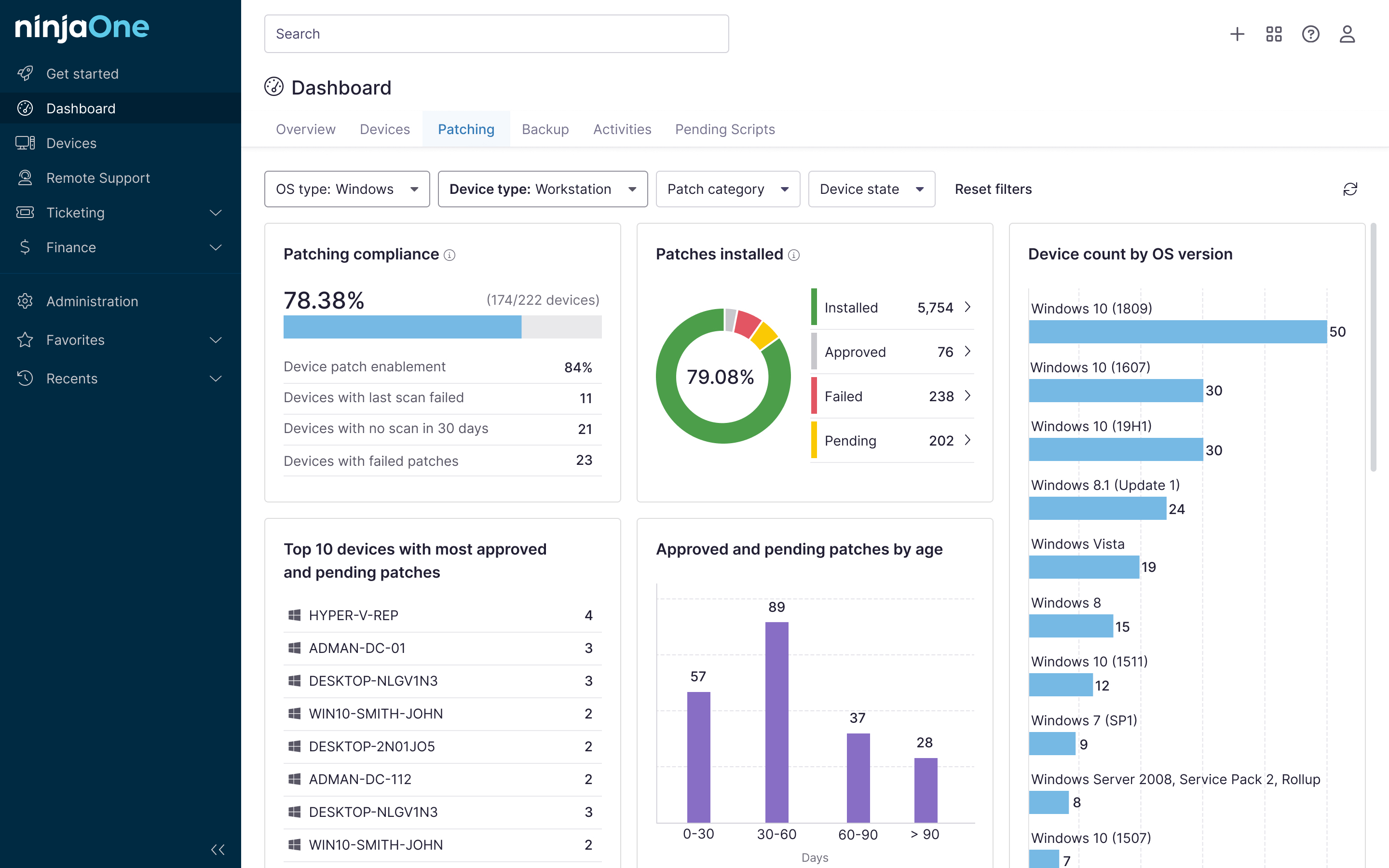
- Real-time device visibility: Provide continuous monitoring of endpoint health, performance, and security status, allowing IT teams to remediate issues quickly.
- Automated patch deployment: Automatically deploy the latest security patches and updates to all endpoints, whether on-site or remote, reducing vulnerability windows.
- Policy-based configuration: Create and enforce policies that align with your organization’s security standards by defining security settings, software installations
- Remote access and control: Gain secure remote access to endpoints for troubleshooting, software deployment, and configuration management.
- Vulnerability tracking: Leverage integrated vulnerability scanners like Qualys and Rapid7 to ingest scan data and display vulnerabilities directly via the NinjaOne console.
- Scalable management: Handle a large number of endpoints across different locations, helping organizations with distributed environments manage their assets effectively.
Identify exposure patterns to mitigate remote access security risk
Distributed environments require a different management approach compared to traditional on-prem infrastructure. By identifying weaknesses in remote access architecture, endpoint configuration, and patch management through continuous monitoring, you can surface vulnerabilities to strengthen your security posture.
Related topics: