


Key Points
- Network continuity focuses on live connectivity, routing behavior, and packet performance, rather than just data recovery and uptime.
- A strong network business continuity plan sets measurable, network-specific recovery objectives for gateways, WAN links, and routing fabric.
- Reliability can be measured through metrics such as latency, jitter, and packet loss across critical paths to surface early warning signs before an outage hits.
- Hybrid and multicloud environments require SD-WAN and SASE integration for policy-driven failover, dynamic path selection, and consistent security.
- Redundancy investments should match actual risk by quantifying the hourly cost of likely failure scenarios, like ISP outages or regional cloud impairments.
- Automation and proactive monitoring prevent outages, with reactive teams experiencing 3.3x more downtime than those using automated observability solutions.
Most business continuity plans treat the network as a supporting character, something that gets restored alongside servers and applications. However, this is an outdated framing. IT and network connectivity issues are now behind a quarter of all service-related outages. And when downtime hits, the financial stakes are significant: Over 90% of mid-size and large enterprises now report that a single hour of downtime costs more than $300,000.
Folding network continuity into a general business continuity network playbook means you’ll miss packet-level risks, misalign recovery targets, and add manual work at exactly the wrong moment.
How network continuity differs from business continuity
Unlike business continuity, which focuses on systems, data recovery, and restoring operations, network continuity is designed to keep connectivity intact during disruptions. It also drills down into routing behavior, packet performance, and dynamic failovers — areas that generic playbooks rarely address with enough specificity.
Here are some of the key differences:
- Network continuity maintains live connectivity, not just server or application availability
- It tracks latency, jitter, and packet loss alongside uptime
- It relies on dedicated failover policies rather than generic redundancy playbooks
Hybrid architectures make these gaps hard to ignore. Your cloud instances might restart after a data center outage, but without proper planning, you may still experience routing black holesblackholes or degraded voice quality.
Remote work adds further complexity. VPN concentrators, SD-WAN edges, and firewall clusters all need to conform to your network continuity plan.
Building a network business continuity plan with measurable objectives
In order to build a strong network business continuity, start by defining your measurable recovery targets. Set network-specific recovery time objectives (RTOs) and recovery point objectives (RPOs) that align with packet-level thresholds, so you can maintain performance under stress.
Defining network-specific RTOs and RPOs
Traditional recovery objectives centercentre on data restoration and app uptime. Network-specific RTOs and RPOs need to cover the components that actually keep people working: routers, WAN links, and gateway appliances.
Here are the recovery targets you need to define for each network segment:
- Gateways: Aim for sub‑60‑second failover in SD‑WAN or firewall clusters
- WAN links: Set an acceptable packet loss threshold, such as 0.1% over 5 minutes
- Routing fabric: Establish route convergence within 30 seconds.
Link these objectives to your broader business continuity network so connectivity failures never slip through the cracks.
Measuring network reliability and continuity performance
Uptime alone doesn’t reflect network reliability and continuity. Latency, jitter, and packet loss across critical paths are the metrics that surface early warning signs before an outage happens. Use a mix of real-time dashboards and historical trend analysis to catch intermittent switch issues and misrouted paths that only appear under load.
Sharing this data on executive dashboards can transform network continuity from a team concern to an organizationalorganisational priority, providing the business case for investment when it’s time to justify headcount or tooling.Adapting network continuity planning for hybrid and cloud architectures
Hybrid and multicloud environments change constantly, so your approach must keep pace. Effective network continuity planning uses SD‑WAN and SASE, balances redundancy with risk, and aligns security and operations before an incident forces the conversation.
Integrating SD-WAN and SASE into network continuity planning
SD‑WAN and Secure Access Service Edge give you a dynamic path selection and consistent security. Building them into your network business continuity plan lets you steer traffic around disruptions without waiting for manual changes.
When you implement SD‑WAN and SASE, focus on:
- Defining policy‑based routing to prioritize critical application flows
- Automating path selection based on real-time performance metrics
- Enforcing consistent security policies across on‑prem and cloud edges
Aligning network continuity planning with these architectures shifts you from vendor escalations to policy‑driven failover, which speeds recovery and reduces human error.
Balancing redundancy cost with network failure risk
More redundancy isn’t always better, but it can be more expensive. The goal is to match your investment to your actual risk profile, which means analyzing before a failure occurs.
Start with the failure modes you’ve already seen, then model the scenarios that would hurt most: a branch ISP outage during quarter close or a regional cloud impairment in your primary region. Quantify what each one costs per hour in lost revenue, productivity, or SLA exposure.
Aligning network continuity with security and operations workflows
Your failover paths run through controls that security and operations both own, which means continuity planning that happens in a silo will create blind spots the moment it’s actually tested. Schedule your continuity tests alongside vulnerability scans so they don’t conflict. Map failover paths to your existing security zones so segmentation remains intact during a reroute.
Strengthening network reliability and continuity through automation
Automation is what separates organisations that respond to outages from those that prevent them. In fact, research shows that organisations with reactive monitoring experience 3.3x more downtime and 2.8x higher lost sales than those using proactive, automated observability.
Implementing proactive monitoring for network health
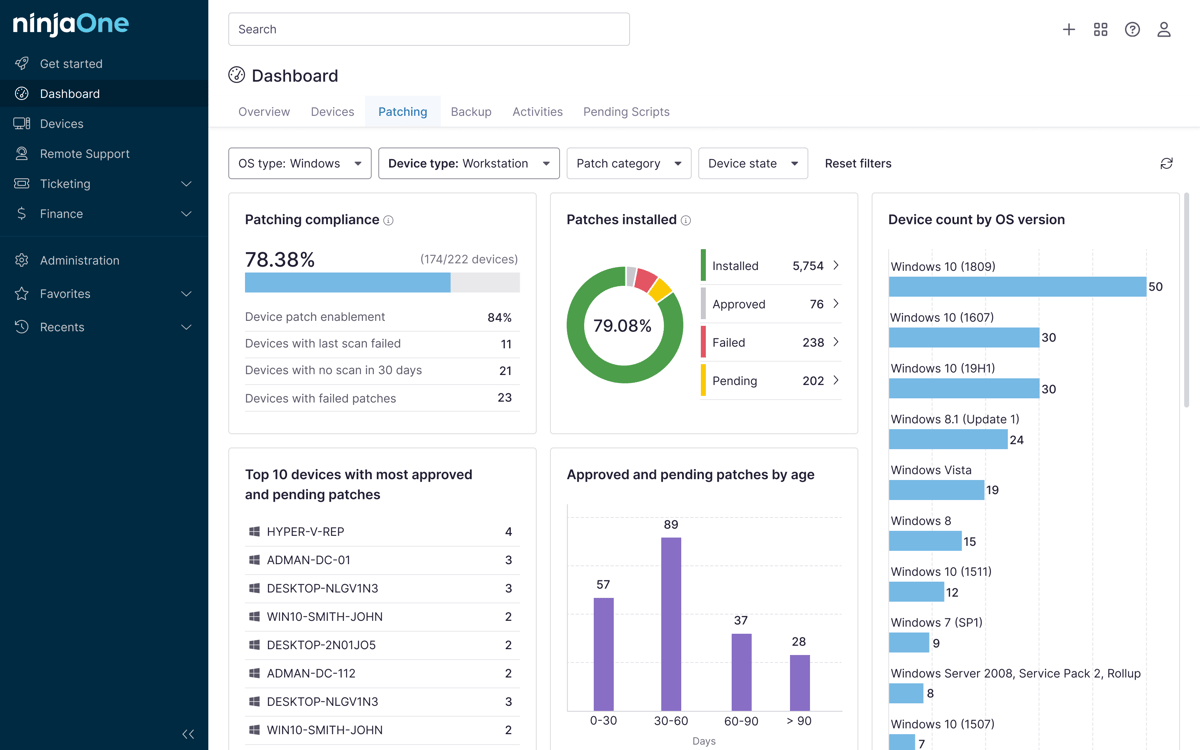
Proactive monitoring combines agents and synthetic transactions to continuously assess health. For example, NinjaOne’s network monitoring gives teams real-time visibility into SNMP devices (firewalls, switches, routers) with threshold-based alerting and automated ticket creation when predefined triggers fire. Synthetic probes simulate critical application flows on a schedule, flagging degradation before users notice it.
The value extends far beyond speed. Knowing a latency spike is building before it degrades voice quality can turn what would have been a major incident into a brief alert and a quick fix.
Automating failover and traffic routing decisions
When a failover happens manually, two things are almost guaranteed: it takes longer than it should, and someone is likely to make a mistake. That’s not a people problem; it’s what happens when you ask engineers to make precise routing decisions under pressure.
Automating path selection and load balancing removes that dependency entirely. Traffic shifts the moment conditions cross a threshold, policies trigger reroutes without waiting for human sign-off, and simulated drills validate that everything behaves as expected before it matters in production.
Integrating network telemetry into operational workflows
Telemetry only helps if every team can act on it in time. Feed network alerts into your ITSM so incidents open with performance context already attached. Correlate connectivity events with endpoint and server logs to speed triage, and present network and application KPIs on shared dashboards. When security, networking, and operations teams are looking at the same data, root cause analysis moves from hours to minutes.
This integrated view accelerates root cause analysis and shortens the time each team takes to prove or disprove their role in an outage.
Preparing for resilient network operations in modern environments
Redundancy alone doesn’t determine how well an organizationorganisation handles an outage. The teams that recover fastest are those that defined their recovery targets before the incident, built visibility into their stack before the alert fired, and automated their response before anyone was under pressure.
A dedicated network business continuity plan is what makes that possible. It gives your infrastructure a structure that generic continuity planning never will: metrics tied to how the network actually behaves, failover policies that don’t wait for human intervention, and telemetry that puts every team on the same page from the moment something goes wrong.
See network continuity in action with NinjaOne
NinjaOne brings endpoint visibility, network monitoring, automated alerting, and helpdesk ticketing into a single platform, so your network business continuity plan has the tooling to match. Start your free NinjaOne trial today!