Key Points
- Translate vulnerabilities into business risk by connecting them to downtime, financial loss, and compliance exposure instead of technical jargon.
- Quantify vulnerability management ROI by comparing remediation costs against the productivity and financial losses caused by unpatched systems.
- Present cybersecurity risks to executives through visual dashboards that track remediation timelines and exposure reduction, rather than raw scan data.
- Prepare a cyber incident communication plan that sets realistic expectations and shows how vulnerability management can limit damage when an incident occurs.
- Frame vulnerability management as a core, ongoing part of the broader cybersecurity strategy rather than a standalone technical project.
IT leaders and managed service providers (MSPs) need an adaptable cyber incident communication plan that executives can understand. With clearly communicated concepts, risks, and benefits, you can ensure that the required resources are made available for your vital security projects and infrastructure, and that expectations are met by measurable outcomes.
This guide explains how IT teams can present business stakeholders with vulnerability management concepts, processes, technologies, and responsibilities with relatable business context. You can then move forward in lockstep with business stakeholders to ensure operational stability, security, and compliance.
Why executives struggle to prioritize vulnerability management
Executives and other business stakeholders will have different priorities than tech leadership. They will be concerned about business outcomes, rather than technical details. As a tech leader in your organization, you need to communicate not necessarily the “how” and/or “why”, but the “what will happen if you don’t” — that is the risk. This is usually oriented around productivity, financial, and compliance outcomes.
Your cybersecurity communication strategy should address business risks directly, and once the impact of effective (or ineffective) vulnerability management on your organization is established, you can provide additional context and technical detail to back up your claims if necessary.
Leading with excessive technical detail, abstract cybersecurity concepts, and unquantified risks may cause non-technical stakeholders to ‘tune out’ before you get to the information that they need to correctly prioritize critical cybersecurity projects.
Translating vulnerabilities into business risk
You must be able to connect vulnerabilities to operational disruption and frame them as real-world threats to business continuity rather than abstract concepts. This means vulnerabilities and exposures must be linked to downtime risk, operational/service disruption (discussed in the context of your business’s unique objectives), customer impact, and regulatory penalties.
Your cybersecurity communication strategy should be reviewed as part of regular vulnerability and patch management governance to keep it in alignment with evolving business goals, threats, and infrastructure.
How to explain vulnerability management ROI
Return on investment (ROI) is measurable, easy to understand, and has direct business outcomes. However, it can be difficult to quantify for cybersecurity and vulnerability management, especially if you don’t have broader access to business data.
You can communicate the potential ROI by presenting scenarios that allow business stakeholders to run some quick math themselves:
- Frame ROI around risk reduction: If ransomware were to disable all workstations in a department, what would the hourly loss of productivity add up to?
- Demonstrate improved operational efficiency: Would the business benefit from users not losing two hours a week to manual patching procedures? How many customers have been impacted because they’ve had to wait for a service representative’s workstation to reboot?
- Connect cybersecurity investments to financial outcomes: Remediation costs more than prevention. Tally the costs of your vulnerability management plan, and compare it directly to the financial loss that would be incurred if an hour, day, or even week of productivity is lost.
Interrupted business isn’t the only cost factor to bear in mind — remediation itself has costs, primarily in engineer time as it’s all hands on deck. If possible, work with your leadership to make sure that you have access to data needed to demonstrate the benefit your work is providing.
Best practices for presenting cybersecurity risk to management
There are four broad steps to vulnerability management: locate and identify, evaluate, monitor and remediate, and confirm.
When explaining these, you must emphasize their relevance in a business context and avoid technical jargon. Raw CVE data, vulnerability scanning outputs, and exploit mechanics will overload even technical stakeholders whose responsibility is not in the details, but prioritizing and assigning resources, and confirming efficacy.
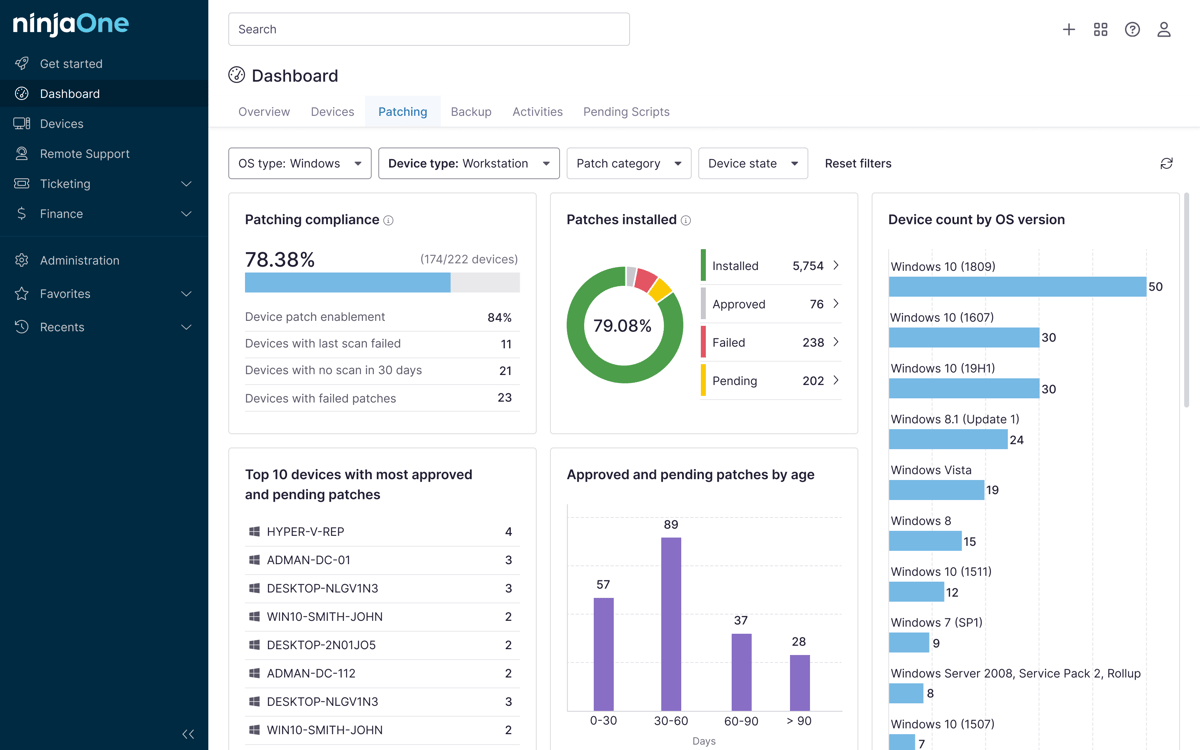
Tailor dashboards for executives. Visualize trends and exposure reduction metrics, highlight still at-risk systems, and show detection and remediation timelines. This will help you explain the impact of ensuring that vulnerability management is sufficiently resourced with staff, tooling, and time.
To justify resources spent on vulnerability, include visual indicators of improvement over time. For example, you could show that critical vulnerabilities are now patched within a certain number of hours rather than days, and how many endpoints are now no longer exploitable due to this. Closing the gap between identification and remediation is one of the most easily communicated metrics for improvement.
You also need a cyber incident communication plan for when something (inevitably) goes wrong
Your cybersecurity communication strategy should explicitly address over/under promising. You can’t undersell the importance of vulnerability management, but at the same time, no cybersecurity apparatus is infallible. If stakeholders are led to believe they have invested in foolproof protections, when an incident does occur they may consider the whole project worthless and not worth continued support.
Your IT team needs an incident response plan. Even when best practices are followed, endpoints are fully patched, and the required security measures are in place, something will eventually go wrong. Zero-days, security-unaware users, and targeted, malicious actors will eventually cause an incident.
A cyber incident communication plan that provides a framework to communicate how all best efforts were taken to protect against this, and why it failed, is helpful here — your team will be under pressure to respond and reassure stakeholders quickly. Demonstrate recovery readiness, how much worse the business impact would have been without vulnerability management and other cybersecurity technologies and processes that are in place.
Communicating vulnerability management as part of a broader cybersecurity initiative
Positioning vulnerability management as a standalone initiative masks its critical nature. You should present it as a core component of the IT infrastructure that allows your business to function. Discuss how effective vulnerability management is part of a broader cybersecurity system, focusing on the same key business outcomes.
Be clear on the benefits that the investment in your IT security team and their tools provides to your organization. Centralized visibility of all assets and cybersecurity metrics helps with this. Effective security should mean there are few incidents — which can lead non-technical leaders to assume that nothing goes wrong, so investing in protections is unnecessary.
Building vulnerability management workflows that collect clear, reportable data automatically
Executive support for cybersecurity investments relies on your team being able to clearly communicate and demonstrate governance maturity and technical competence that result in practical business outcomes. Business resilience, compliance readiness, and improved financial results are the starting point for these discussions, anchoring sometimes technically complex concepts like vulnerability management in terms executives understand and can prioritize.
Coordinated IT operations that use unified, automated toolchains that enable technical workflows and culminate in audit-ready, visual reports and dashboards tailored to both business and technical audiences, remove the legwork of preparing one-off briefs for stakeholder reviews. Your team can then focus on crafting a message that accurately conveys the importance of your security projects based on real outcomes for your business.
Great technicians do not always make great statesmen. Templates can help communicate difficult concepts like technical planning, device risk, and the causes of outages, helping bring structure to collected data and evidence and helping communicate its meaning. Demonstrating dashboards to non-technical stakeholders can also help build trust and understanding — showing, rather than telling.
NinjaOne provides an IT management platform that combines vulnerability and autonomous patch management with remote monitoring and management (RMM), backup, asset management, and endpoint security, with reporting, dashboards, and documentation for maintaining historical data in a report-ready format.