


IT and security have traditionally operated with distinct missions. Security focuses on managing risk, while IT is responsible for maintaining operational efficiency and delivering platforms that support business objectives.
These missions have often been at odds. However, the rapid acceleration of technological change — including AI-driven vulnerability discovery, shorter time-to-exploit windows, agentic AI with system access, and more non-human identities — is compelling organizations to reconsider how they manage IT and security responsibilities.
As coverage gaps grow more precarious and prone to exploit, and the success of one team is increasingly dependent on that of the other. It’s clear that the responsibilities and siloes that were constructed some 30+ years ago to enable modern business no longer measure up to the demands of today.
As expectations for IT and security rise, teams need to unify IT management functions and consolidate existing tool stacks to simplify operations. And as ever-increasing complexity drives up the cost of managing IT stacks, simplicity is at the heart of strong security foundation.
Integrating IT and security through operationalized risk management is the next logical step in advancing modernization efforts.
Smarter IT starts here
Sign up for the NinjaOne Weekly Newsletter and join a thriving community of IT enthusiasts automating the hardest parts of IT together.
The current threat landscape is causing us to rethink the way we manage (and mitigate) risk
AI is expanding and evolving the threat landscape at an unprecedented pace.
The median cost to convert a disclosed common vulnerability and exposure (CVE) is now $2.83 (less than a cup of coffee!), and it takes only 11 minutes for the average known CVE to become a verified, working exploit. The economic barrier that once protected defenders for decades is now gone, and relying on traditional methods and calendars to address new threats is proving unsustainable.
The stakes and associated costs are too high to ignore.
The other side of the same coin
While the rapid evolution of threats garners attention, the same technological advancements are also empowering defenders, particularly in modern patch and vulnerability management.
Organizations can now assess and remediate vulnerabilities faster than ever. And while patch automation is not new, organizations historically haven’t pushed further with it for fear of disruption. That’s starting to change.
AI-driven patch intelligence now identifies which patches are safe to deploy automatically and which require human review. This approach enhances security as release volumes increase, without risking business continuity or employee productivity.
Bridging the gap between IT and security has been talked about for years. But now, it’s finally possible.
Explore NinjaOne Endpoint Management
Unify visibility and control across all devices to reduce complexity, improve efficiency, and strengthen security all from a single console.
Learn more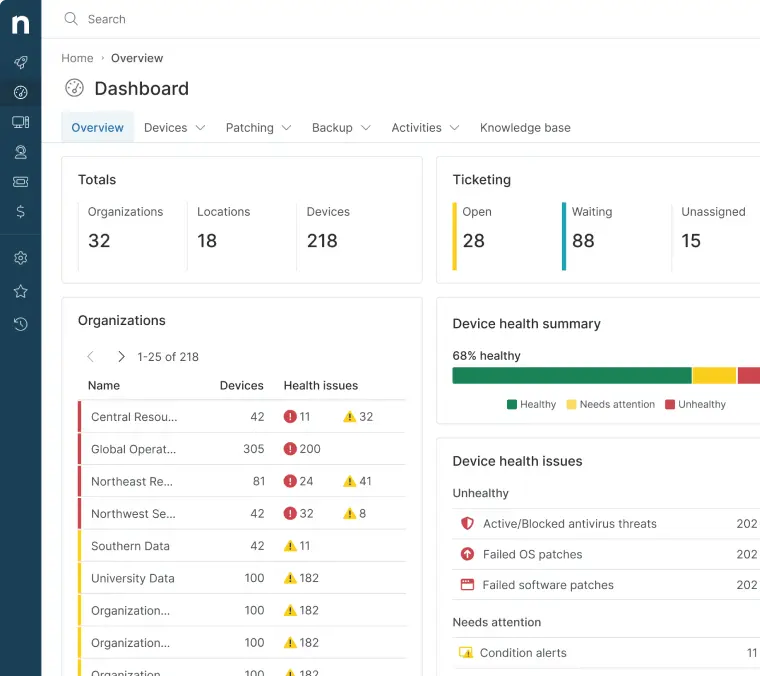
Convergence is already happening
In many areas, convergence is already underway. We’re seeing it in places like patch and vulnerability management, as well as in areas like browser management and shadow AI management. To the ladder point, both IT and security now share responsibility for the risks associated with employees adopting AI tools faster than governance can adapt. The 2026 Verizon Data Breach Incident Report found frequent employee use of AI tools surged from 15% to 45% in a single year, meaning far more sensitive data is now flowing through unapproved platforms than most organizations realize. Bringing AI governance into IT’s control plane lets both teams keep employees productive and secure; rather than one team finger-pointing at the other when unmanaged shadow AI leads to an organizational security lapse down the line.
Backup and recovery tell the same story. As more business data moves to the cloud, SaaS backup is now essential to any unified asset management strategy. Shared visibility into an organization’s backup posture is critical not only for privacy and security, but for operations as well.
We’re at an inflection point
Organizations that accelerate the convergence of IT and security will be best positioned to stay ahead of a threat landscape that keeps widening. Recent research from Gartner is evidence of this shift:
“Rather than treating security and digital workplace enablement as competing objectives, Gartner research demonstrates that leveraging shared telemetry and implementing user-aligned security architectures enables both teams to advance secure behaviors and reduce digital friction in tandem.”
In other words, IT and security are significantly more effective when aligned. Organizations that maintain separation will remain reactive and outdated. While those that embrace convergence and operationalize risk management – enabling IT to fortify foundational security, while freeing up security teams to stay focused on security – will achieve greater growth, clearer ownership, and ultimately be empowered to solve problems more proactively.