
Key Points
- MSPs begin CMMC audit preparation by defining the assessment scope, identifying in-scope systems, and establishing a compliance baseline.
- A complete and accurate System Security Plan documents how security controls are implemented, maintained, and owned across the environment.
- The Plan of Action and Milestones tracks control gaps and remediation progress, showing assessors that compliance is actively managed.
- Structured remediation workflows allow MSPs to close control gaps systematically, validate fixes, and maintain a clear record of all changes.
- Continuous compliance monitoring helps MSPs detect configuration drift and flag deviations from baselines before the formal assessment.
- MSPs support final audit preparation by organizing evidence, coordinating documentation, and ensuring stakeholders are ready for assessor interactions.
Earning a Cybersecurity Maturity Model Certification (CMMC) certification requires organizations to have the right security tools and demonstrate that those controls are properly implemented and consistently maintained. Many defense contractors seek the help of managed service providers (MSPs) to guide them through structured work that must be done before a formal CMMC assessment.
But what do MSPs really do to help these organizations? This article will discuss the crucial role of CMMC audit preparation and the key steps that MSPs take to ensure their clients’ successful certification.
Define audit scope and readiness baseline
Before anything, MSPs and their clients must know exactly what the audit will cover. Not doing so can lead to wasted effort on out-of-scope systems and blind spots on those that actually matter.
MSPs will typically work with clients by asking these scoping questions:
- Which systems, networks, and environments will be assessed?
- Where is controlled unclassified information stored, processed, or transmitted?
- Which responsibilities belong to the MSP and which remain with the client?
- What does the organization’s current compliance posture look like relative to requirements?
Getting the scope right will ensure that all documentation, remediation, and monitoring efforts are directed at systems and controls that assessors will actually examine.
Develop and maintain the System Security Plan
The System Security Plan (SSP) is an important document that assessors will review. It is crucial because the record describes how an organization has structured and implemented its security controls. MSPs play a role in building and maintaining this document to ensure that it holds up under examination.
A complete SSP needs to:
- Show a clear picture of how the environment is structured and where its boundaries begin and end
- Define the specific controls put in place and how they operate daily
- Identify specific parties responsible for each control
- Reflect live system configurations, not an idealized version of them
The role of MSPs here is to ensure that the SSP doesn’t just look good, but accurately represents the controls implemented and maintained day to day.
Build and manage the Plan of Action and Milestones
Aside from the SSP, organizations also need to create a document called Plan of Action and Milestones (POA&M), where they define compliance gaps and commit to fixing them. Although it seems like an admission of failure, a well-structured POA&M will show that an organization understands its current security standing and knows what it needs to improve on.
MSPs manage this document by:
- Pinpointing where the environment falls short of required controls
- Prioritizing high-risk deficiencies and tackling those first
- Keeping individual records of remediation progress until every issue is resolved
- Updating the document as work gets completed, so it always reflects the current status
An actively maintained POA&M matters during an audit because it signals that the organization treats compliance as an ongoing concern.
Implement remediation workflows
After knowing where the gaps are, there needs to be a plan on how to close them. MSPs need structured remediation workflows to ensure fixes are applied deliberately and consistently.
A good workflow should cover these critical steps:
- Surfacing control weaknesses and working through them systematically
- Confirming that each fix actually works
- Applying changes uniformly for consistency
- Keeping a clear record of what was changed, when, and why
A structured remediation process ties up most of the loose ends before an audit and allows organizations to build a stronger overall compliance posture.
Establish compliance monitoring processes
Configurations drift, systems get updated, and previously closed gaps may reopen, so there also needs to be an ongoing monitoring process to ensure that controls stay in place and no issue reaches the audit.
Effective monitoring should include:
- Regularly checking that system configurations remain compliant
- Immediately flagging any deviations from established baselines
- Keeping a live view of remediation efforts
Monitoring gives MSPs the visibility they need to stay ahead of problems by giving them time to fix issues before the assessment.
Prepare compliance reporting and evidence
Assessors need to see clear and organized evidence that backs up claims that controls are implemented properly, and MSPs must ensure this proof is always ready and accessible.
Below are some sources of compliance evidence:
- Status reports that show which controls have been implemented and to what degree
- Historical records that demonstrate the organization has maintained compliance over time
- System-generated logs and outputs that provide objective validation of control activity
- Supporting documentation that maps to specific requirements in the framework
When evidence is well-organized and easy to navigate, assessors can do their jobs faster and with fewer interruptions.
Conduct internal readiness reviews
Before walking into a formal assessment, an organization absolutely needs to do an internal readiness review. This gives MSPs and their clients a chance to find and fix problems while there’s still time to do something about them.
Validation steps of a thorough review should include:
- Checking that all documentation is accurate and consistent with actual system states
- Confirming that every required control is genuinely operational
- Making sure that evidence can be located and produced quickly when an assessor asks for it
- Surfacing any outstanding gaps that still need attention
Conducting this internal review close enough, but not too close, to the assessment date can assure organizations a realistic image of their current standing. It’s also good to note that issues uncovered at this stage cost far less than those uncovered during the formal audit.
Support clients in CMMC assessment preparation
Finally, aside from managing systems and documentation, MSPs can also guide clients in navigating a formal CMMC audit, especially those going through it for the first time. This advisory role offers the most help during final preparation, when clients feel pressured, and there’s little to no room for error.
MSP support through this phase typically involves:
- Helping stakeholders understand what to expect during the assessment and how to engage with the process
- Pulling together organized documentation and evidence
- Walking clients through how assessor interactions typically unfold
- Tying up any remaining remediation tasks that could turn into unwanted findings
This kind of support translates into success because clients who feel informed and well-supported tend to perform better during an audit. They’re not just technically compliant, but also confident and organized under scrutiny.
Quick-Start Guide
NinjaOne Can Help MSPs Prepare Clients for CMMC Audits, NinjaOne offers several key features that directly support CMMC audit preparation:
Security Configuration Management (SCM)
- NinjaOne’s SCM features help ensure systems are properly hardened in accordance with regulatory security and compliance standards—a core CMMC requirement
- Includes automated enforcement of security configurations across Windows, macOS, and Linux endpoints
- Provides benchmark tailoring (no-code) for compliance standards directly in the console
Patch Management & Vulnerability Management
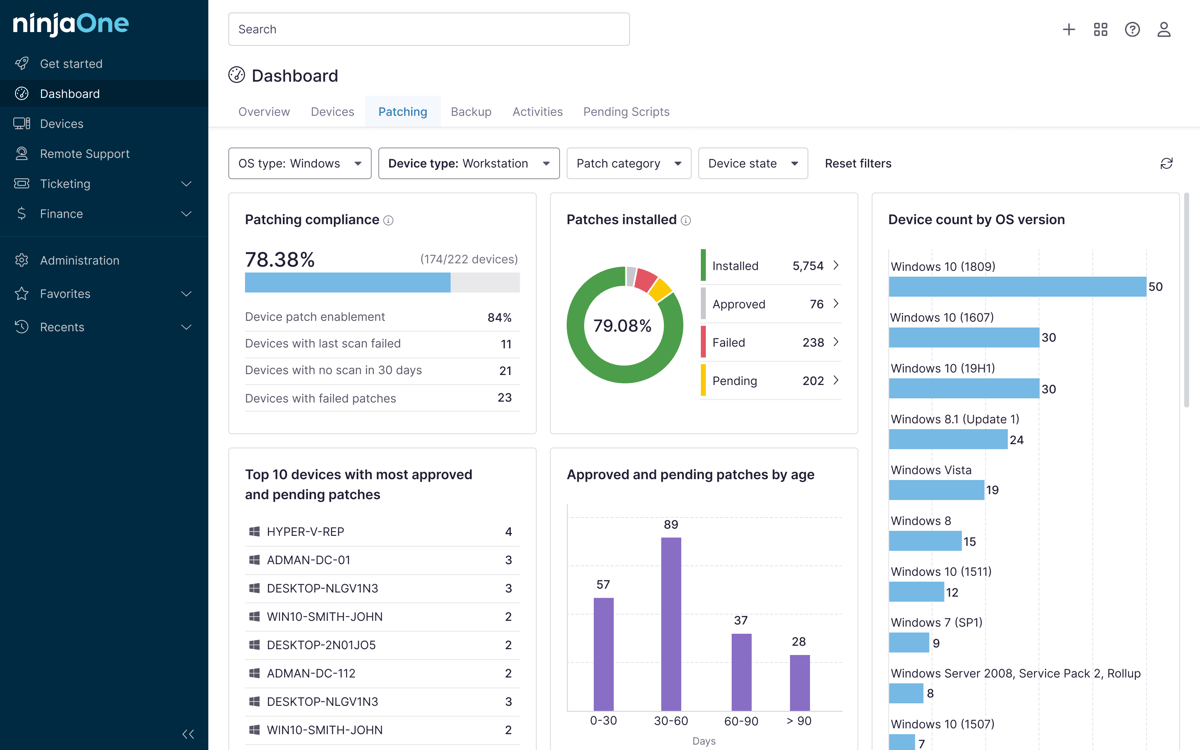
- Automated patch deployment and reporting to keep systems current against known vulnerabilities
- Vulnerability Importer integration to track and remediate identified vulnerabilities
- Critical for CMMC’s emphasis on system updates and vulnerability management
Compliance Reporting & Audit Trails
- Generates comprehensive compliance reports showing device configuration state and adherence to security standards
- Activity retention and export capabilities for audit documentation
- Real-time monitoring of security events and configuration changes
Policy Enforcement & Automation
- Create and enforce policies defining specific security configurations for device groups
- Automated remediation through scripting and automations
- Role-based access controls and least privilege principles
Remote Management & Monitoring
- Secure remote access for troubleshooting and policy enforcement
- Real-time visibility into system health and security posture
- Centralized control across multiple client devices
Building client confidence through CMMC audit readiness and structured preparation
MSPs make a long-term commitment when preparing a client for a CMMC audit, as it requires more than a last-minute review of security controls. It’s crucial to approach this process with structure, from accurate documentation to validating readiness, to give clients the best possible chance of success. Remember, the ultimate goal is to ensure that the organization can demonstrate its compliance clearly and confidently without scrambling to fill in the blanks.
Related topics: