Quarterly stakeholder briefs offer a concise overview of your security performance, challenges, and insights, aligning teams and informing stakeholders without the need for time-consuming business reviews.
This article provides a light and quick MSP quarterly business review template that prioritizes automation, leveraging RMM platforms like NinjaOne to convert raw data into actionable business insights that extend beyond standard reports.
Prefer a visual guide? Watch our video: How MSPs Can Deliver a Lean Quarterly Stakeholder Brief.
How to craft a goal-oriented stakeholder memo
Traditional Quarterly Business Reviews (QBRs) often involve time-consuming preparation and big time commitments. In small or fast-paced environments, this setup isn’t always practical, highlighting the need for a leaner alternative. Here’s how you keep briefs short and sweet:
📌 Prerequisites:
- Access to core metrics (e.g., uptime, patch status, and incidents resolved) from RMM platforms like NinjaOne
- Shared template for consistent reporting (memo, Google Doc, or PDF)
- Defined audience list and delivery method (email, shared folder, portal)
- Cadence commitment (e.g., quarterly by the first Friday of each quarter)
- Optional scripting capability (e.g., PowerShell) for metric extraction
Strategy #1: Clarify purpose and set expectations
Begin by stating what the brief is, how it’s structured, and why it’s important. Keep your messaging concise and to the point as you do the following:
- Summarize recent performance and impactful events.
- Outline any service blockers and list the risks.
- Re-emphasize the current quarter’s objectives.
Example: “This stakeholder memo summarizes your current security posture, operational risks, client feedback, and endpoint management goals. (Note: This is a strategic brief, not a quarterly strategy review.)”
Strategy #2: Use a consistent section-based template
Build your MSP quarterly business review template for consistency and reusability. Establish fixed sections and capture details in bullet points, but remember to tailor sections to your client’s needs. Here are some examples:
| Section | Sample Content |
| Highlights | “89 days since the last minor security breach.” |
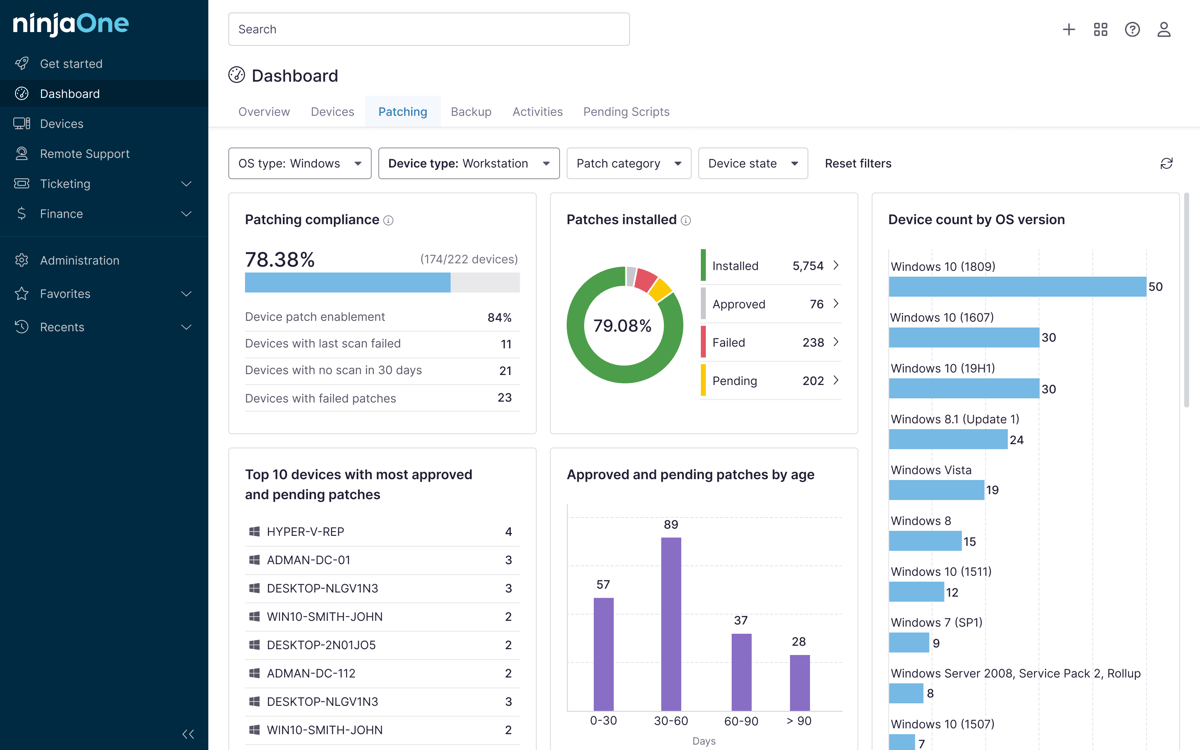
| Risks | “Only reached 79% patch compliance in the current fleet.” |
| Attention required | “Approval still pending for X system upgrades.” |
| Client feedback | “Client expressed interest in expanding the use of NinjaOne dashboards to share key metrics.” |
| Next quarter goals | “Extend backup agent to 25 more endpoints.” |
Strategy #3: Leverage automation for metric extraction
Populate sections automatically with RMM tools to streamline your MSP quarterly business review template briefs. Doing this reduces prep time while minimizing human error.
Use this script to generate relevant metrics and insert them into your memo as a .txt file:
function Get-SystemUptimeStats {
param([string]$Client="ClientA")
$lastBoot = (Get-CimInstance Win32_OperatingSystem).LastBootUpTime
$uptimeSpan = New-TimeSpan -Start $lastBoot -End (Get-Date)
$windowDays = 90
$uptimePct = [math]::Min(100,[math]::Round(($uptimeSpan.TotalDays/$windowDays)*100,2))
$patchesApplied = (Get-HotFix | Where-Object { $_.InstalledOn -ge (Get-Date).AddDays(-$windowDays) } | Measure-Object).Count
[pscustomobject]@{ Client=$Client; Uptime=$uptimePct; PatchesApplied=$patchesApplied }
}
$stats = Get-SystemUptimeStats -Client "ClientA"
$body = @"
Highlights:
Uptime: $($stats.Uptime)%
Patches Applied: $($stats.PatchesApplied)
Risks:
[Your notes here]
Plans:
[Your plans here]
"@
New-Item -ItemType Directory -Path "C:\Reports" -Force | Out-Null
$path = "C:\Reports\QBrief_$($stats.Client)_$(Get-Date -Format yyyy-MM-dd_HH-mm).txt"
$body | Set-Content -Path $path -Encoding UTF8
Strategy #4: Deliver it light and fast
Stakeholder briefs work best when they are lightweight. To avoid confusion, limit your MSP’s updates to 1-2 pages (or a single email thread), avoid lengthy slideshows, and name files consistently.
Afterwards, deliver client reports via email, Microsoft Teams, Slack, or through a point of contact (POC) for transparency.
Strategy #5: Clarify it’s not a QBR
QBRs, or quarterly business reviews, include comprehensive reports on cybersecurity metrics and how they impact your client’s business. Smaller clients like small-to-medium businesses (SMB) typically don’t warrant these, so clarify that your brief seeks to offer the same amount of value (actionable insights and visibility) while reducing time spent.
Example: “This stakeholder report is a quick systems update. Let us know if you want a deep dive or a full roadmap review.”
Strategy #6: Ask for simple feedback
As an MSP, it’s best practice to request feedback for quarterly business reports. This helps refine your process for the rest of your customer base, improve relations with non-IT counterparts, and bolster your reputation as an industry leader.
Close your lean stakeholder memo by asking for your client’s thoughts and opinions.
Example: “Was this report helpful? Would you like to pivot to new goals for the next quarter? Don’t hesitate to let us know.”
MSP Quarterly Business Review Template — Summary for Lean Stakeholder Briefs
Here are the key points to optimizing agile stakeholder reports for small clients:
| Component | Purpose and value | Example |
| Purpose clarification | Clarifies the lean report’s purpose and how it differs from QBRs. | “Unlike QBRs, this lean report focuses on concise system insights and clear actions towards operational improvement.” |
| Fixed template format | Ensures consistency and fast memo generation. |
|
| Use of automation | Speeds up data extraction and reduces human effort. | NinjaOne RMM |
| Short-form delivery | Helps keep your client’s attention, lessens clutter, and drives conversations. | “100% endpoint patch compliance achieved in May.” |
| Framing and labeling | Positively positions your system’s status. | “Attention required” instead of “Delayed goals” |
| Feedback request | Fosters improvement for MSP processes. | “Was this report helpful?” |
Automation touchpoint example
While automation workflows can be created using PowerShell, you can easily replace time-consuming setups and scripting woes with NinjaOne’s user-friendly reporting tools, simplifying the process.
Through NinjaOne, report-makers can view patch compliance across endpoints, pending updates, success rates, and performance metrics—all of which are exportable through the platform’s centralized dashboard. This keeps things simple for clients while removing API-related worries.
NinjaOne also lets you generate hardware inventory reports that show usage trends and aging assets to elevate QBRs.
Leverage NinjaOne’s remote access platform and uptime reports to automatically populate your MSP quarterly business review template for you. And tailor reports by grouping devices, date ranges, patch types, and more.
How NinjaOne integration enhances stakeholder memo creation
NinjaOne’s cloud-native support empowers MSPs with simplified features that let you extract data and populate custom templates through one unified dashboard. It also streamlines the process by:
- Generate snapshot reports for uptime, patch compliance, and agent status.
- Exporting client-level KPIs for device use trends and hotfix success rates.
- Scheduling report exports that you can use to auto-fill memo templates efficiently.
- Connect briefings to incident resolution metrics (e.g., resolution and response times) to track service improvements over time.
Quick-Start Guide
NinjaOne offers several reporting features that can help MSPs compile comprehensive stakeholder reports:
1. Reporting Capabilities:
NinjaOne has a robust Reporting Resource Catalogue
Reports can be:
- Shared globally or with specific technician roles
- Customized by adding or removing sections
- Downloaded as PDFs
- Scheduled and emailed automatically
2. Key Reporting Areas for Stakeholder Briefs:
- Vulnerability Management Reports
- Device Health Summaries
- Patch Management Status
- Organization-wide Performance Metrics
3. Customization Options:
You can create summary reports with widgets like:
- Overall health metrics
- Patch coverage
- Top device types
- Antivirus protection status
- Device OS distribution
Streamline your MSP quarterly business review template
Lightweight visibility reports that are strategically templated can conveniently align teams without committing to a full QBR, especially for smaller clients. The right tools for the job should provide custom report templates, extract endpoint data, and automate emails to offer the best ROI.
Related topics: