
Key points
- Attackers are exploiting vulnerabilities in 5 days or fewer, while the average organization takes 200+ days to patch.
- As MSP clients multiply, scheduled vulnerability scans and manual exports into different patching tools produce stale data and cause remediation delays.
- NinjaOne surfaces a continuously updated, cross-client action queue, where CVE severity, KEV status, affected organizations, and available remediations appear in one view.
- NinjaOne’s Patch Intelligence AI analyzes real-world patch stability signals to automate safe updates and pause risky ones before they reach any client environment.
- The full remediation lifecycle, from detection to patching, runs inside NinjaOne’s unified console with no exports, tickets, or tool switching required.
A LinkedIn follower recently shared a pain point every growing MSP knows: “Speed definitely matters, especially as exposure windows get shorter… but prioritization becomes the real bottleneck. Without clarity on what to address first, faster remediation doesn’t always translate into lower risk.”
What our follower is describing is real. The window between vulnerability disclosure and active exploitation is shrinking as attackers move faster and AI accelerates both discovery and exploit development. Most organizations still rely on delayed detection and manual remediation workflows, which extends the time to fix what attackers have already found. Without clear prioritization and a direct path to remediation, the gap between exploitation and resolution keeps widening.
This is the real issue of vulnerability management for MSPs today, and it’s one most tools are not built to resolve.
The “patch everything” problem
Most MSPs start with the right instinct: patch everything, as fast as possible. However, as your client base grows from five to 50, that approach is no longer feasible due to time and resource constraints.
Vulnerability scans are resource-intensive, so most teams schedule them after hours or less frequently than their environment actually requires. By the time a scan completes, a report is reviewed, and findings are exported into a separate patching tool, the data is out of date. For a growing MSP, that lag has implications across every client environment simultaneously. It places clients in vulnerable positions while vulnerabilities sit unpatched and undetected.
These practices are concerning considering that the volume of vulnerabilities keeps growing. Verizon’s 2025 Data Breach Report showed a 275 percent increase in vulnerabilities since 2024. Concurrently, attacker speed is accelerating, and traditional scan-based models fall further behind. The result is an average time that exceeds 200 days to patch a vulnerability while attackers often exploit vulnerabilities in five days or fewer. That’s a massive exposure window for your clients.
Where traditional scanners break down
Scan-based vulnerability management creates three compounding problems for MSPs:
- Alert fatigue from constantly reacting to Common Vulnerabilities and Exposures (CVE) alerts across dozens of client environments
- Prioritization challenges due to delayed, contextual intelligence that makes it difficult to determine urgency
- Cross-client remediation delays when vulnerability detection and patch deployment live in separate tools
Point-in-time scan reports can also create a compliance problem. When auditors ask for evidence of continuous vulnerability management, a monthly scan report is a weak answer.
From prioritization to remediation in one workflow
NinjaOne surfaces a ranked, cross-client action queue where severity, Known Exploited Vulnerabilities Catalogue (KEV) status, affected organizations, and available remediations appear together in a single view, continuously updated as software changes across your client base.
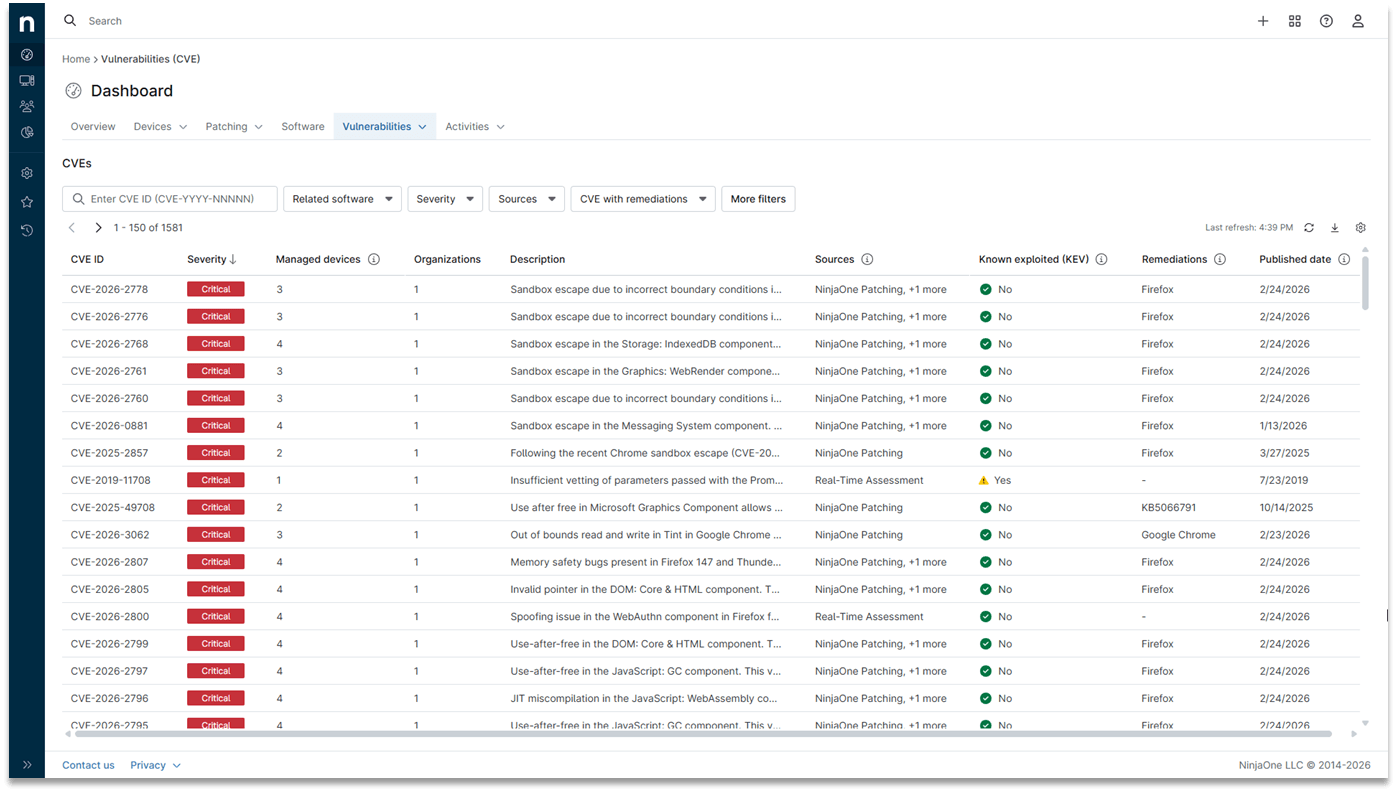
For MSPs using separate detection and patching tools, vulnerability data often lives in disconnected environments. NinjaOne consolidates that view automatically.
Severity and KEV together drive risk-based vulnerability prioritization. Severity highlights potential impact, while KEV identifies which vulnerabilities are actively exploited and should be addressed first.
From that view, remediation is streamlined, allowing teams to initiate patching immediately with the relevant context already in place. NinjaOne connects real-time vulnerability detection directly to Autonomous Patch Management, so the patch that resolves a flagged CVE is already mapped to the affected endpoints. For urgent findings, “Apply Now” pushes the patch immediately, while “Approve” adds the update to the next scheduled patch workflow.
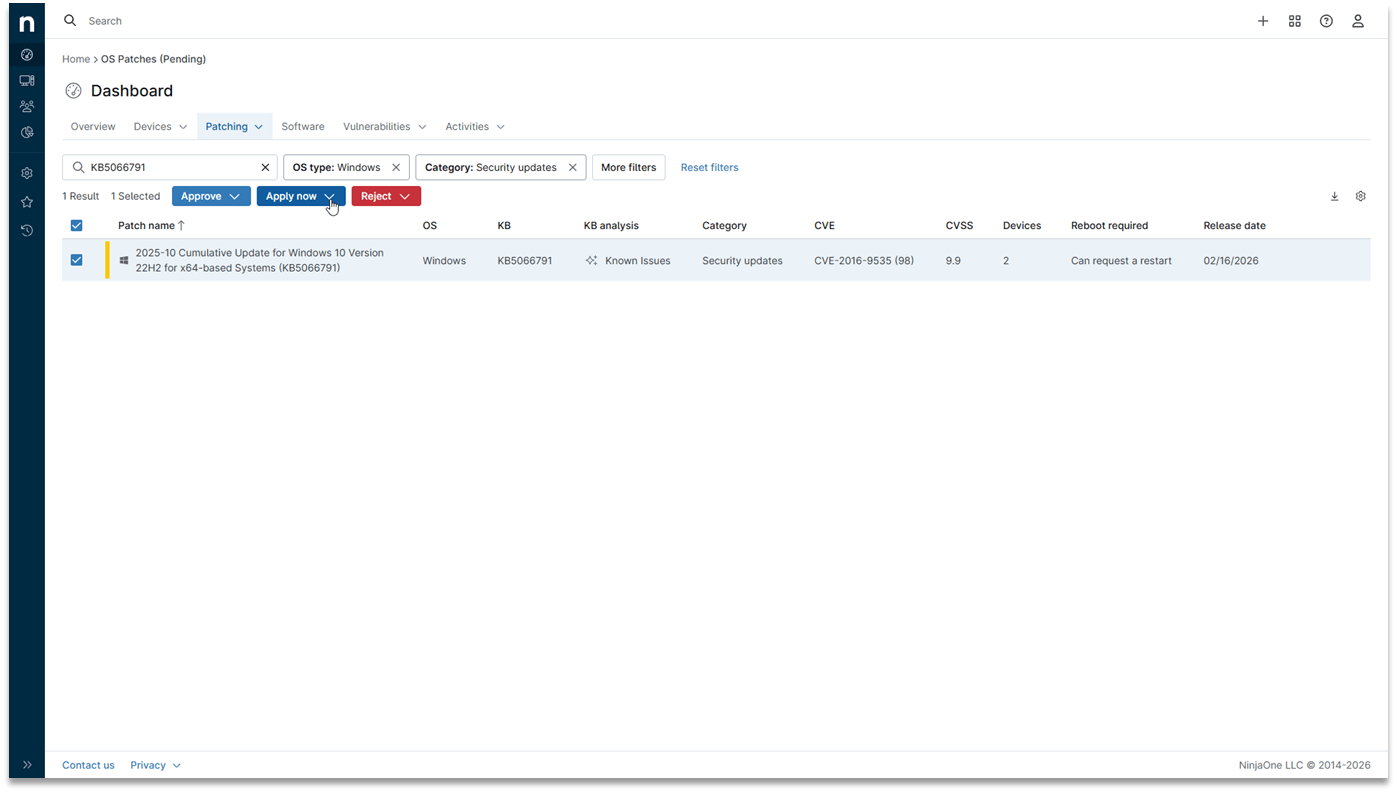
Patch Intelligence AI informs remediation decisions by analyzing real-world patch performance and stability signals. Stable updates are automated, and risky ones are paused before they reach any client environment. You can maintain security urgency without sacrificing operational stability.
The full lifecycle from detection to remediation runs inside one console, with no exports, tickets, or tool switching required. Every action taken in that workflow is automatically captured, building a continuous compliance record without any additional effort from your team.
Turning risk-based prioritization into a service advantage
By connecting detection, prioritization, and remediation in a unified workflow, exposure windows can shrink from weeks to minutes for many common vulnerabilities, while every action is captured automatically as audit-ready evidence.
That combination creates a premium security offering. The MSP who can show a client which vulnerabilities were detected, how they were prioritized, and when they were remediated has something a monthly scan report can’t provide: continuous, verifiable proof that their environment was protected at the speed threats move.
Our LinkedIn follower was right: speed alone doesn’t solve the problem, but speed plus prioritization plus automated remediation in one platform does. That’s what closing the exposure gap looks like.