
Key Points
- Differentiate Android TV from mobile Android: Android TV is built for large displays and remote controls, requiring distinct apps and management methods.
- Understand content delivery models: Content can be pushed, streamed, or stored offline, with caching and bandwidth planning critical for performance.
- Implement kiosk and lockdown features: Restricted profiles and MDM kiosk mode secure public devices and prevent unauthorized use.
- Prioritize network and security controls: Stable connectivity, firewalls, and segregation protect devices from tampering and misuse.
- Leverage MDM for centralized management: Platforms like NinjaOne enable remote monitoring, diagnostics, patching, and streamlined content deployment.
Android TV content delivery relies on several features to run apps and display multimedia content, and also locks down devices for use in public environments. Use cases for this include billboards, digital signage, information points, and self-service devices. Android single app mode, commonly known as “kiosk mode”, and remote device locking are available on Android TV devices for this purpose. This functionality can be further extended with mobile device management (MDM) for full remote management, control, and delivery of remote content.
This guide explains the process of remote content delivery on Android TV devices, with examples that you can adapt to your own use case.
Android TV as a distinct platform for content delivery
Android TV differs significantly from the Android operating system commonly found on phones and tablets. It is intended as the built-in OS for smart TVs, as well as for streaming devices (HDMI ‘sticks’ and set-top boxes). Many low-cost devices that are suitable for public use cases ship with Android TV out-of-the-box, making it a sensible choice.
To serve its intended purpose, Android TV has a user interface that’s built for display on big-screen devices like TVs, and optimized for input using remote controls, rather than pocketable touch screens. Media playback is emphasized, with additional settings focused on using TVs as a display. Apps are affected by this: Android TV apps are usually distinct from their mobile equivalents to account for the difference in display and input configurations.
These differences also impact the choice of tools and methods for effective remote management of public devices and delivering content to them.
Android TV content delivery vs. app management
Android mobile app management (MAM) can be provided as a standalone product or as part of an MDM platform. MAM generally focuses on delivering and configuring business productivity apps to BYOD devices, without broader device management that employees may not feel comfortable enrolling their devices in. This makes it less suited for public-facing devices as it cannot be used to lock them down remotely, providing less overall control and security.
Content delivery is usually agnostic of the actual app that powers Android TV digital signage or kiosks, and usually falls into one of these categories:
- Content pushed from a central platform and cached locally
- Streamed content
- Offline content on the device that is manually updated
These may be uploaded, delivered, and displayed in a dedicated app (for example, a for-purpose digital signage platform), or delivered using physical storage or over the network and then played back using a separate application.
Lockdown and kiosk-style deployment models
The simplest way to provide rudimentary security for mobile Android devices in publicly accessible locations is to use the App pinning feature. However, this is not available in Android TV. Instead, you can set up a restricted profile and set it to only be able to access the intended app. You can then set a PIN that can be used to exit the restricted profile. Exiting a restricted profile without a PIN will require a factory reset of the device.
While this is suitable for basic use cases like small shops, and where devices aren’t connected to any internal IT infrastructure, it is not suitable where security is a concern. It’s important that public-facing devices are isolated on your network, and that you are able to remotely lock and wipe missing devices to prevent their misuse.
Many MDM platforms support kiosk features for Android TV, allowing you to automatically configure devices and lock them to a single app. Remote control can also be leveraged to manage devices and deploy new content.
Custom Android TV variants are also available that are restricted by default for public installations.
Network and performance considerations for Android content delivery
When planning your public IT infrastructure, connectivity is a significant concern. If you are intending to remotely deliver content to Android TV devices, you will need to ensure you do not waste bandwidth. Stable connectivity and caching can reduce the need to reload content, while for some use cases, preloading content for offline use makes the most sense (for example, the digital signage for a food truck that relies on cellular data).
If streaming content, ensure there is sufficient bandwidth for the resolution your display device requires.
Security and tamper resistance for public Android devices
Unattended devices suffer additional security risks. You should ensure their physical security and that your MDM tool supports the following restrictions to make kiosks and signage secure:
- Restricting access to system settings and menus
- Preventing unauthorized application installation
- Applying hardened configuration profiles
Network-level restrictions, including firewalls and segregation, should also be implemented to make sure devices cannot become an attack vector. You will also need to account for how staff will interact with devices: it may be necessary for them to reboot or restart devices, or be able to load refreshed content locally.
Remotely managing, securing, and delivering content to Android TV devices from a single tool
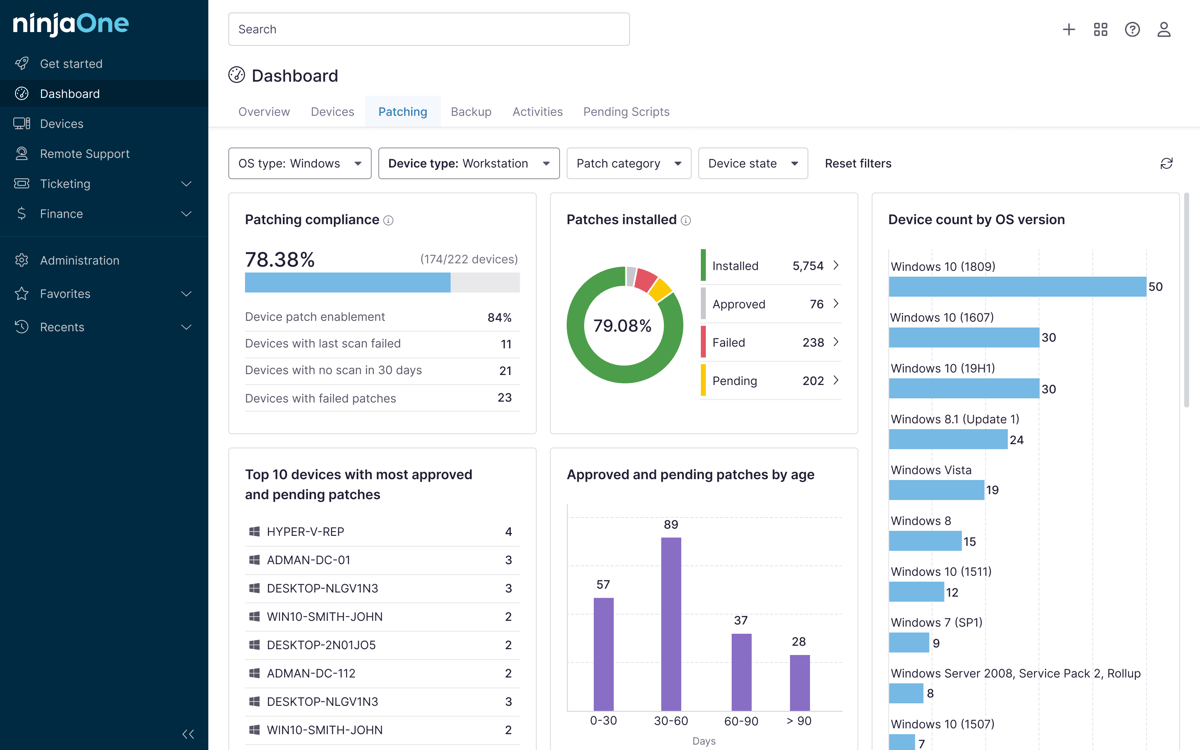
Digital signage and public kiosks present unique IT challenges. Android TV device management should include both operational management and monitoring, including health monitoring, uptime checks, and automated recovery after crashes or reboots. Centralized log collection, remote diagnostics, and patch management are also a necessity to prevent connected Android TV devices from becoming a cybersecurity oversight.
NinjaOne provides a comprehensive MDM platform that covers all of this, with single-app and multi-app kiosk mode for Android devices of any form-factor – streamlining the setup, maintenance, security, and content deployment for public Android TV installations.