Key points
- What IT Reporting Tools Do: Collect, analyze, and visualize IT infrastructure data into actionable reports and dashboards.
- Key IT Reporting Features: Data accuracy, real-time reporting, historical reporting, automation, customizable dashboards, and intuitive user interfaces.
- Top IT Reporting Tools for 2026: 1. NinjaOne, 2. SolarWinds Service Desk, 3. ManageEngine ServiceDesk Plus, 4. SysAid, 5. Atera, 6. IT Glue, 7. Progress WhatsUp Gold, 8. Auvik, 9. Paessler PRTG, 10. Datadog.
- Best All-in-One IT Reporting Platform: NinjaOne ranks #1 for unified endpoint management, customizable report templates, and compliance-ready insights.
- IT Reporting by Use Case: ITSM-focused tools prioritize ticketing and service delivery metrics, while network and infrastructure tools emphasize monitoring and alerts.
IT teams know how much data they need to examine server performance, network health, and user activity—it’s a constant stream. However, it can get overwhelming if you’re bombarded with information, and it may be difficult to separate the signal from the noise. This may cause a workflow that isn’t streamlined or problems ranging from delayed responses to missed IT issues, which can disrupt critical business processes.
This is why having one of the best IT reporting tools is necessary. When following best practices on IT reporting, these tools can transform that constant stream into actionable insights, enabling you to identify and address potential problems before they escalate. Additionally, employing an IT tool with comprehensive reporting features can grant you clear visibility into your IT infrastructure, improving IT workflows.
Top 10 IT reporting tools at a glance
| IT reporting solution | Key features | Trial information |
| NinjaOne | Unified endpoint management, report builder and templates, automation, compliance reporting | Free 14-day trial |
| SolarWinds Service Desk | IT automation, asset inventory, and reporting | Free 30-day trial |
| ManageEngine Service Desk Plus | Automation, IT asset management, real-time reporting | Free 30-day trial |
| SysAid | IT asset management, automation, compliance management | Free 14-day trial |
| Atera | Remote monitoring, reporting, IT asset inventory | Free 30-day trial |
| IT Glue | IT documentation, automation, backups | Free demo |
| Progress WhatsUp Gold | Remote monitoring, alerts and notification, automation | Free 30-day evaluation |
| Auvik | Network monitoring, data protection, automation | Free 14-day trial |
| Paessler PRTG | Network monitoring, alerting, reporting | Free 30-day trial |
| Datadog | Remote monitoring, IT automation, reporting and alerts | Free 14-day trial |
Sign up for a free trial of NinjaOne.
What is an IT reporting tool?
An IT reporting tool is a solution that gathers, analyzes, and visualizes data from your IT infrastructure. This information may include everything from server health and network performance to user activity and application usage.
An IT reporting tool can be a standalone application software or part of a broader endpoint management system.
Additionally, it can consolidate information into clear reports and dashboards to gain visibility into the whole IT infrastructure, help identify trends and potential issues, make data-driven informed decisions, and much more.
What to look for in an IT reporting tool
You may be searching for an IT reporting solution to meet your business needs. But, what requirements should you consider when looking for an IT reporting tool? Here are some key factors and functionalities to consider:
1. Data accuracy
Presenting accurate data is what makes a reliable IT reporting tool. Needless to say that you would want a tool that can deliver trustworthy information, allowing you to make informed decisions and avoid costly mistakes. After all, data is only as valuable as its accuracy. IT teams would also benefit from accurate data, ensuring data-driven decisions are made.
2. User interface
An IT reporting tool with an intuitive user interface is always an advantage for IT teams. It provides information in a concise and easy-to-understand format. This will allow them to spend less time figuring out the nature of the report and more time focusing on the data presented to them.
3. Automation
Some IT reporting tools leverage automation to streamline the reporting process further. These tools can automate data collection, report generation, and distribution to stakeholders and appropriate people. You can look for an IT reporting tool to set up for automated report generation consistently and on a predefined schedule, eliminating the need for manual intervention.
4. Historical reporting
Access to an IT infrastructure’s historical data could give you in-depth insights into performance trends. This feature allows IT teams to identify areas for improvement and predict future resource needs, ultimately promoting proactive maintenance and efficient IT operations.
5. Real-time reports
The purpose of IT reporting is to provide updates relevant to the current state of your IT infrastructure. Real-time reporting functionality enhances your IT reporting tool’s capabilities by providing up-to-the-minute data. This allows IT teams to identify and address issues as they arise, minimizing downtime and maximizing user productivity.
Best IT reporting tools in 2026
All G2 and Capterra ratings data as of February 2026.
1. NinjaOne
NinjaOne is a unified endpoint management solution that streamlines the usual IT tasks. As the G2 leader in multiple software categories, it features essential IT functionalities developed with quality and user experience in mind. NinjaOne empowers IT teams with its comprehensive suite of features, including robust reporting.
Strengths of NinjaOne
- Unified endpoint management. NinjaOne follows a “single pane of glass” approach that gives IT administrators a good overview of their managed endpoints. One advantage is that it helps IT teams consolidate data collection and reporting from a centralized platform, easing the complexities of IT management and monitoring.
- Reliable reporting. NinjaOne prioritizes reliability by maintaining precision when delivering accurate data. The platform’s reporting feature helps create impactful reports that utilize highly customizable charts for a visually compelling and content-rich analysis of key metrics.
- Report builder and templates. NinjaOne streamlines reporting through its report builder functionality, providing flexibility in generating reports that feature data relevant to IT teams or their clients. The endpoint management platform’s reporting tool also features pre-built templates that cater to typical IT reporting requirements. This speeds up the report generation process, allowing IT professionals to focus on other IT tasks rather than spending hours creating reports from scratch.
- Report automation. NinjaOne’s IT reporting functionality leverages the endpoint management software’s automation capabilities. The platform allows IT teams to set up automated schedules for report generation, ensuring reports are generated and delivered on a predetermined schedule to reduce the need for manual intervention in executing this essential IT task.
- Compliance reporting. Compliance reports help ensure an organization adheres to industry regulations and internal policies. NinjaOne enhances compliance reporting by employing adaptable reporting selections, simplifying audit processes, and compliance management. This feature also integrates with NinjaOne’s automation functionality to inform IT groups of any security compromises or policy infractions through a robust notification system, enabling immediate corrective actions.
Customer story
With over 1,000 employees and 3,000 volunteers to manage in its IT infrastructure, The King’s Trust, a UK-based nonprofit organization for youths, needed a better endpoint management solution than their current one, which entailed days-long, resource-intensive updates. They found their answer in NinjaOne and experienced 10× faster endpoint management, 30× faster remote access, and enhanced visibility with built-in reporting.
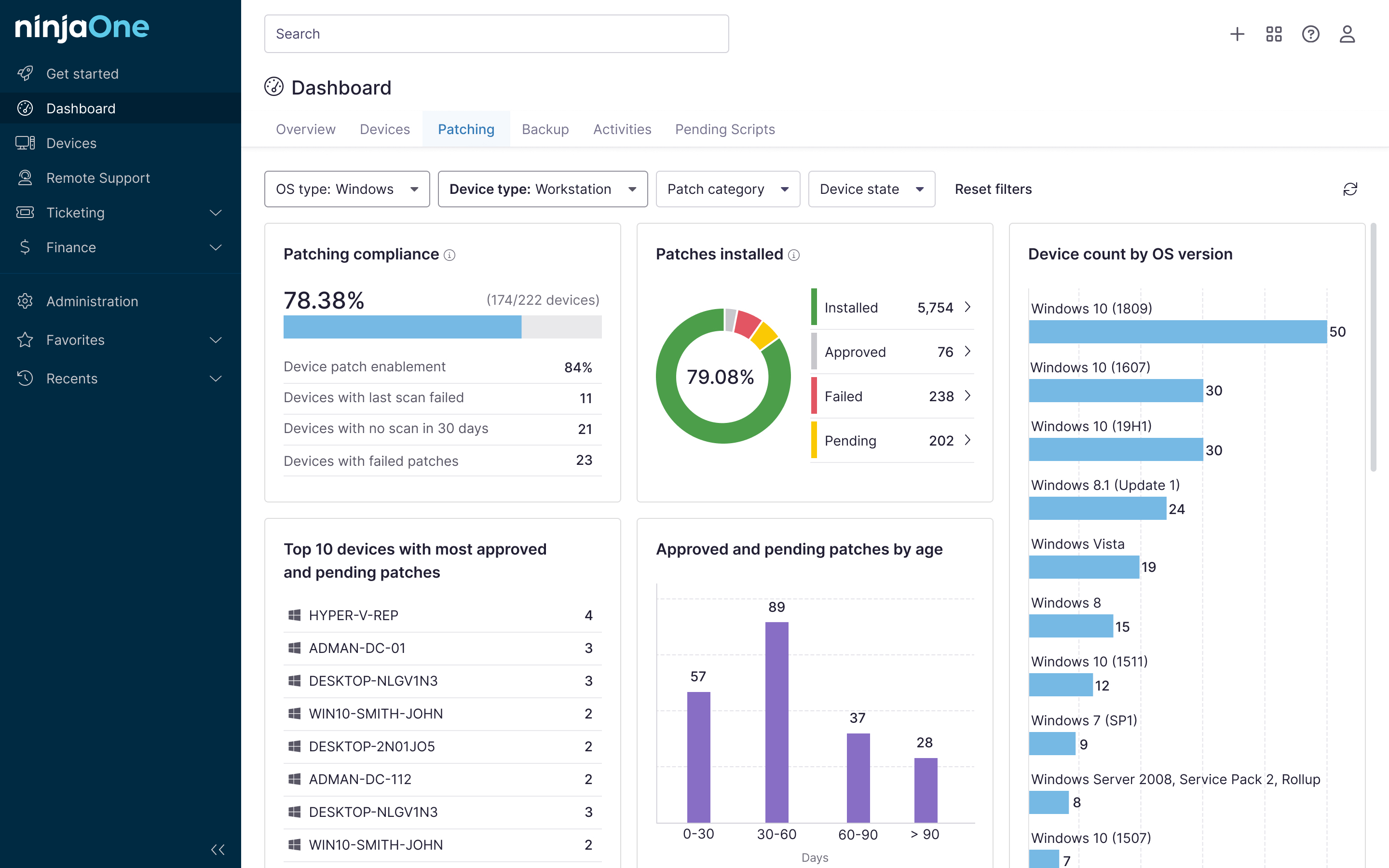
“We love the single pane of glass,” remarked Mike Beattie, head of infrastructure and workplace at The King’s Trust. “Everything (laptops, servers) is patched in NinjaOne. That wasn’t the case before.” At the same time, David Harris, head of workplace operations, commended NinjaOne’s reporting and visualization capabilities: “The patch dashboard is a fantastic feature that helps us stay on top of everything.”
Read more NinjaOne customer stories or check out NinjaOne reviews.
NinjaOne reviews on G2
| Category | NinjaOne Rating |
| Overall | 4.7 out of 5 (3,473) |
| Has the product been a good partner in doing business? | 9.4 |
| Quality of Support | 9.1 |
| Ease of Admin | 9.1 |
| Ease of Use | 9.1 |
NinjaOne reviews on Capterra
| Category | NinjaOne Rating |
| Overall | 4.7 out of 5 (276) |
| Ease of Use | 4.7 |
| Customer Service | 4.7 |
| Features | 4.5 |
| Value for Money | 4.6 |
NinjaOne’s IT management software has no forced commitments and no hidden fees.
If you’re ready, request a free quote, sign up for a 14-day free trial, or watch a demo.
2. SolarWinds Service Desk
Formerly Samanage Service Platform, SolarWinds Service Desk is a cloud-based IT management solution that helps streamline IT support services. It features a reporting tool built into a dashboard, giving IT teams an overview of key performance indicators, common issue trends, and more. As a service desk solution, SolarWinds’ reporting feature tends to focus on ticketing and IT service delivery.
Best for
Mid-sized to large organizations that need a structured IT service desk with built-in reporting focused on ticketing and service delivery. It’s well suited for IT teams prioritizing asset visibility over deep customization.
Features
- IT automation: SolarWinds offers several automation tools to reduce manual workloads and speed up IT workflows.
- IT asset inventory: With SolarWinds, IT teams can track hardware, software, and licenses to get a full view of their IT environment.
- IT reporting: Users can create detailed reports on incidents, IT assets, and more.
Shortcomings
- Reporting: Users say that SolarWinds’ reporting dashboard performs slowly and can be difficult to use.
- Limited customization: According to reviews, SolarWinds’s interface and ticketing forms lack customization options.
- Complex interface: SolarWinds’ interface design makes it challenging to execute actions and locate items.
SolarWinds Service Desk reviews on G2
| Category | SolarWinds Service Desk Rating |
| Overall | 4.3 out of 5 (763) |
| Has the product been a good partner in doing business? | 9.0 |
| Quality of Support | 8.9 |
| Ease of Admin | 8.9 |
| Ease of Use | 9.0 |
SolarWinds ServiceDesk reviews on Capterra
| Category | SolarWinds Service Desk Rating |
| Overall | 4.6 out of 5 (577) |
| Ease of Use | 4.6 |
| Customer Service | 4.6 |
| Features | 4.4 |
| Value for Money | 4.5 |
3. ManageEngine ServiceDesk Plus
ManageEngine ServiceDesk Plus is another IT service management tool that helps organizations streamline their IT support processes. The platform’s reporting capability uses a dashboard that shows essential metrics relating to the infrastructure’s performance.
These dashboards utilize widgets and other tools to visualize data as well as operate via role-based access control (RBAC) to secure this data. With ManageEngine’s automation tools, users can also send out these reports to specific users or groups.
Best for
Organizations that want an all-in-one ITSM platform with strong automation and asset management capabilities. It’s a good fit for IT teams in regulated environments that rely on dashboards to track operational performance.
Features
- Automation: ManageEngine allows users to automate processes to ensure faster ticket response times and to reduce the need for manual intervention, freeing up technicians.
- IT asset management: ManageEngine can collect information on hardware such as endpoint devices and network devices, including routers and switches. It can also track installed applications and software licensing information.
- Real-time reporting: Users can create dashboards that display metrics such as help desk performance and service quality.
Shortcomings
- Customer support: ManageEngine users find the customer service lacking as it can take a while for them to receive responses to their issues.
- Slow performance: Users find that ManageEngine can take some time to load pages and respond to inputs.
- Reporting: Reviews say that the reporting feature can be complex to configure and that the data generated is limited.
ManageEngine ServiceDesk Plus reviews on G2
| Category | ManageEngine ServiceDesk Plus Rating |
| Overall | 4.2 out of 5 (242) |
| Has the product been a good partner in doing business? | 8.3 |
| Quality of Support | 8.1 |
| Ease of Admin | 8.4 |
| Ease of Use | 8.5 |
ManageEngine ServiceDesk Plus reviews on Capterra
| Category | ManageEngine ServiceDesk Plus Rating |
| Overall | 4.4 out of 5 (224) |
| Ease of Use | 4.3 |
| Customer Service | 4.2 |
| Features | 4.4 |
| Value for Money | 4.3 |
4. SysAid
SysAid is an IT service management solution marketed to SMEs and IT teams. It includes a ticket submission system through its help desk functionalities as well as tracks and manages IT assets. SysAid also employs a reporting solution that provides analytics tools to show key business metrics relevant to IT service delivery.
Best for
Small to mid-sized businesses and internal IT teams looking for a comprehensive ITSM solution with automation and compliance visibility. It works best for teams that need core service management features without the complexity of enterprise-grade platforms.
Features
- IT asset management: Users can monitor and manage all the hardware and software in their IT environment.
- Automation: SysAid enables IT teams to automate routine tasks such as ticketing, software deployment, and scheduling.
- Compliance management: SysAid provides visibility into actions taken by the platform, allowing IT teams to ensure compliance.
Shortcomings
- Unintuitive interface: Users say that the interface can be confusing due to differing designs in different sections, making it more challenging to use and navigate.
- Challenging setup: SysAid reviews on G2 say that the platform takes some time and effort to adopt as its setup has a steep learning curve.
- Reporting: According to reviews, SysAid’s reporting function lacks customization options for visualizations and creating fields for specific metrics.
SysAid reviews on G2
| Category | SysAid Rating |
| Overall | 4.5 out of 5 (731) |
| Has the product been a good partner in doing business? | 9.1 |
| Quality of Support | 9.0 |
| Ease of Admin | 8.8 |
| Ease of Use | 9.0 |
SysAid reviews on Capterra
| Category | SysAid Rating |
| Overall | 4.5 out of 5 (500) |
| Ease of Use | 4.5 |
| Customer Service | 4.5 |
| Features | 4.5 |
| Value for Money | 4.5 |
5. Atera
Atera is an IT management platform designed for IT teams and managed service providers to help streamline IT operations. It offers a reporting suite that provides insights into IT infrastructure and service delivery.
Atera can automate report generation for multiple metrics such as software inventory, system health, patch status, and more. Reports can also be automated to be sent out at scheduled times to both end-users and IT technicians.
Best for
MSPs and lean IT teams that need remote monitoring, asset tracking, and automated reporting in a single platform. It’s ideal for organizations managing multiple environments or clients with limited internal resources.
Features
- Remote monitoring: Atera provides visibility into IT environments, allowing IT teams to keep track of endpoint devices, system resources, networking devices, and more.
- Reporting: With Atera, IT administrators can keep track of specific metrics such as device health, asset inventory, and software licenses, allowing them to resolve issues and secure their environment.
- IT asset inventory: Atera allows IT professionals to keep track of all physical hardware devices, software licenses, and cloud assets.
Shortcomings
- Customer support: Atera’s customer service can sometimes take a while to respond and resolve issues.
- Limited customization: Users find Atera’s customization to be lacking, especially when it comes to generating in-depth reports and adding elements to help visualize data.
- User interface: Atera reviews say that the platform’s interface can be cluttered, making it more challenging to navigate.
Atera reviews on G2
| Category | Atera Rating |
| Overall | 4.6 out of 5 (1,020) |
| Has the product been a good partner in doing business? | 9.2 |
| Quality of Support | 9.0 |
| Ease of Admin | 9.0 |
| Ease of Use | 9.2 |
Atera reviews on Capterra
| Category | Atera Rating |
| Overall | 4.6 out of 5 (446) |
| Ease of Use | 4.6 |
| Customer Service | 4.5 |
| Features | 4.3 |
| Value for Money | 4.6 |
6. IT Glue
IT Glue is an IT documentation platform for internal IT teams and managed service providers. It features limited reporting capabilities, which can be ideal for users only looking for basic insights, such as identifying missing documentation or tracking overall inventory. As an IT documentation platform, IT Glue can link related items and even allow end-users to collaborate. It also integrates with third-party tools for more advanced reporting needs.
Best for
MSPs and IT teams that need centralized IT documentation rather than advanced reporting. It’s best suited for organizations focused on standardizing processes, improving knowledge sharing, and maintaining accurate IT records.
Features
- IT documentation: IT Glue creates a single source of truth, acting as a repository for IT information. It also streamlines documentation processes by linking related items to make it easier to locate necessary information.
- Automation: With IT Glue’s RESTful API, users can automate access to confidential data and seamlessly integrate with third-party applications.
- Backups: IT Glue reduces human error by automating the creation of backups of sensitive data for clients or the organization itself.
Shortcomings
- Lacks customizations: Users find IT Glue’s customization options to be limited.
- Complex interface: Executing action on the IT Glue dashboard is often harder than it should be since actions aren’t as easy to locate.
- Search functionality: IT Glue reviews state that locating stored data can be difficult, which makes locating confidential information, configurations, or passwords inconvenient.
IT Glue reviews on G2
| Category | IT Glue Rating |
| Overall | 4.7 out of 5 (650) |
| Has the product been a good partner in doing business? | 9.0 |
| Quality of Support | 8.7 |
| Ease of Admin | 9.0 |
| Ease of Use | 9.1 |
IT Glue reviews on Capterra
| Category | IT Glue Rating |
| Overall | 4.6 out of 5 (331) |
| Ease of Use | 4.6 |
| Customer Service | 4.4 |
| Features | 4.5 |
| Value for Money | 4.4 |
7. Progress WhatsUp Gold
Progress WhatsUp Gold is an IT solution best suited for system or network administrators looking for tools to monitor the health and performance of their network infrastructure. Its reporting tool features real-time alerts through push notifications and report generation, showing network infrastructure trends and vulnerabilities.
Best for
Network and system administrators who need real-time visibility into network performance and infrastructure health. It’s well suited for IT teams that prioritize monitoring, alerts, and uptime over extensive reporting customization.
Features
- Remote monitoring: Progress WhatsUp Gold provides users with full visibility of applications, devices, and network availability.
- Alerts and notification: Users can create custom alerts based on triggers and get real-time updates on the status of their network or any suspicious activity.
- Automation: Progress WhatsUp Gold allows users to automate custom alerts and configurations for network devices to streamline IT processes.
Shortcomings
- Customization: Progress WhatsUp Gold lacks customization options, especially when it comes to reporting.
- Steep learning curve: The platform is difficult to navigate due to its user interface design, based on reviews.
- Patch management: According to Progress WhatsUp Gold reviews, its patch management capabilities need improvement and require more manual intervention.
Progress WhatsUp Gold reviews on G2
| Category | Progress WhatsUp Gold Rating |
| Overall | 4.4 out of 5 (389) |
| Has the product been a good partner in doing business? | 8.8 |
| Quality of Support | 8.8 |
| Ease of Admin | 8.2 |
| Ease of Use | 8.5 |
Progress WhatsUp Gold reviews on Capterra
| Category | Progress WhatsUp Gold Rating |
| Overall | 4.5 out of 5 (227) |
| Ease of Use | 4.2 |
| Customer Service | 4.4 |
| Features | 4.4 |
| Value for Money | 4.3 |
8. Auvik
Auvik is another network monitoring tool for IT teams that helps simplify management for diverse networks, endpoints, and SaaS applications. The platform provides basic reporting functionalities that can provide insights into network health. IT teams can get valuable insights and data as well as streamline workflows with automations for documentation, backups, and IT inventory monitoring.
Best for
IT teams and MSPs managing complex or distributed networks who need automated network discovery and monitoring. It’s especially useful for organizations that want visibility into network health without manually mapping infrastructure.
Features
- Network monitoring: Auvik offers real-time monitoring and network discovery as well as notifies users of outages or performance issues.
- Data protection: Auvik generates backups and securely stores them so that they can easily be restored in the event of a disaster or cyberattack.
- Automation: To streamline manual workflows, Auvik allows users to automate repetitive tasks.
Shortcomings
- Alerting issues: According to reviews, Auvik’s alerting feature lacks customization options and often sends false positives.
- Slow performance: Reviewers say that Auvik responds slowly when monitoring and managing larger IT infrastructures.
- Complex interface: Auvik reviews say that the platform’s initial configuration is difficult and requires heavy resource investment. The interface can also be challenging to navigate.
Auvik reviews on G2
| Category | Auvik Rating |
| Overall | 4.5 out of 5 (327) |
| Has the product been a good partner in doing business? | 9.0 |
| Quality of Support | 8.8 |
| Ease of Admin | 8.7 |
| Ease of Use | 8.6 |
Auvik reviews on Capterra
| Category | Auvik Rating |
| Overall | 4.7 out of 5 (98) |
| Ease of Use | 4.4 |
| Customer Service | 4.6 |
| Features | 4.5 |
| Value for Money | 4.4 |
9. Paessler PRTG
Paessler PRTG is a unified infrastructure solution that provides monitoring functionalities for your IT, OT, and IoT infrastructures. It also features reporting capabilities that allow you to generate reports ad hoc or scheduled.
Best for
Organizations that need unified monitoring across IT, OT, and IoT environments. It’s a good choice for infrastructure-focused teams that want straightforward reporting for network and system performance.
Features
- Network monitoring: Users can configure PRTG’s sensors to capture metrics such as network health, status, and outages.
- Alerting: PRTG can generate insightful reports and be set up to send out alerts if any anomalous activity is detected.
- Reporting: PRTG allows IT administrators to generate custom reports and automate sending them out to relevant stakeholders.
Shortcomings
- Alerting: PRTG’s alerting function can be limited as reviews say that the platform lacks alerts for non-outage issues.
- Slow interface: Reviews of PRTG say that navigating the software can be slow and frustrating.
- Lacks integrations: PRTG offers few integrations and has limited features.
Paessler PRTG reviews on G2
| Category | Paessler PRTG Rating |
| Overall | 4.7 out of 5 (178) |
| Has the product been a good partner in doing business? | 8.6 |
| Quality of Support | 8.7 |
| Ease of Admin | 8.7 |
| Ease of Use | 8.9 |
Paessler PRTG reviews on Capterra
| Category | Paessler PRTG Rating |
| Overall | 4.6 out of 5 (254) |
| Ease of Use | 4.4 |
| Customer Service | 4.2 |
| Features | 4.5 |
| Value for Money | 4.3 |
10. Datadog
Datadog is a cloud-based monitoring and security platform for developers, IT operations, and security teams to gain visibility into their entire IT infrastructure. The platform features reporting capabilities that enable users to generate reports on their IT infrastructure health and performance.
Best for
Cloud-native organizations operating in hybrid or multi-cloud environments. It’s best suited for teams that need deep observability, automation, and real-time monitoring across large-scale infrastructures.
Features
- Remote monitoring: With real-time monitoring of cloud and hybrid environments as well as customizable metrics, Datadog provides IT teams with full visibility over their IT infrastructure.
- IT automation: Datadog enables IT professionals to automate repetitive tasks to reduce manual workloads. The platform offers 300 out-of-the-box automations to help users get started.
- Reporting and alerts: Datadog generates detailed reports that can be scheduled and sent automatically to relevant parties.
Shortcomings
- Reporting: Datadog reviews say that using the software’s visualization tools for reporting is complicated and that its reporting features can be limited.
- Difficult setup: Datadog can be difficult for new users to fully understand, and a technical expert may be needed to make the most of the platform.
- Documentation: Reviews state that Datadog’s documentation feature can be difficult to understand. Other reviewers add that finding documentation for some features can be challenging.
Datadog reviews on G2
| Category | Datadog Rating |
| Overall | 4.4 out of 5 (690) |
| Has the product been a good partner in doing business? | 8.5 |
| Quality of Support | 8.3 |
| Ease of Admin | 8.3 |
| Ease of Use | 8.2 |
Datadog reviews on Capterra
| Category | Datadog Rating |
| Overall | 4.6 out of 5 (354) |
| Ease of Use | 4.3 |
| Customer Service | 4.3 |
| Features | 4.5 |
| Value for Money | 4.1 |
Comparison of IT reporting tools (G2)
| Category | NinjaOne | SolarWinds Service Desk | ManageEngine ServiceDesk Plus | SysAid | Atera | IT Glue | Progress WhatsUp Gold | Auvik | Paessler PRTG | Datadog |
| Overall | 4.7 out of 5 (3,473) | 4.3 out of 5 (763) | 4.2 out of 5 (242) | 4.5 out of 5 (731) | 4.6 out of 5 (1,020) | 4.7 out of 5 (650) | 4.4 out of 5 (389) | 4.5 out of 5 (327) | 4.7 out of 5 (178) | 4.4 out of 5 (690) |
| Has the product been a good partner in doing business? | 9.4 | 9.0 | 8.3 | 9.1 | 9.2 | 9.0 | 8.8 | 9.0 | 8.6 | 8.5 |
| Quality of Support | 9.1 | 8.9 | 8.1 | 9.0 | 9.0 | 8.7 | 8.8 | 8.8 | 8.7 | 8.3 |
| Ease of Admin | 9.1 | 8.9 | 8.4 | 8.8 | 9.0 | 9.0 | 8.2 | 8.7 | 8.7 | 8.3 |
| Ease of Use | 9.1 | 9.0 | 8.5 | 9.0 | 9.2 | 9.1 | 8.5 | 8.6 | 8.9 | 8.2 |
Comparison of IT reporting tools (Capterra)
| Category | NinjaOne | SolarWinds Service Desk | ManageEngine ServiceDesk Plus | SysAid | Atera | IT Glue | Progress WhatsUp Gold | Auvik | Paessler PRTG | Datadog |
| Overall | 4.7 out of 5 (276) | 4.6 out of 5 (577) | 4.4 out of 5 (224) | 4.5 out of 5 (500) | 4.6 out of 5 (446) | 4.6 out of 5 (331) | 4.5 out of 5 (227) | 4.7 out of 5 (98) | 4.6 out of 5 (254) | 4.6 out of 5 (354) |
| Ease of use | 4.7 | 4.6 | 4.3 | 4.5 | 4.6 | 4.6 | 4.2 | 4.4 | 4.4 | 4.3 |
| Customer Service | 4.7 | 4.6 | 4.2 | 4.5 | 4.5 | 4.4 | 4.4 | 4.6 | 4.2 | 4.3 |
| Features | 4.5 | 4.4 | 4.4 | 4.5 | 4.3 | 4.5 | 4.4 | 4.5 | 4.5 | 4.5 |
| Value for Money | 4.6 | 4.5 | 4.3 | 4.5 | 4.6 | 4.4 | 4.3 | 4.4 | 4.3 | 4.1 |
Final scores and summaries of IT reporting tools
| Vendor | Final Score | Summary |
| NinjaOne | 4.321 | NinjaOne is a user-friendly unified endpoint management platform that simplifies IT tasks with robust reporting features, including data accuracy, customization options, automation, and compliance assistance. |
| Atera | 2.027 | Atera is an all-in-one IT management platform for streamlining IT operations, including reporting for both internal IT teams and managed service providers. |
| SolarWinds Service Desk | 1.887 | SolarWinds Service Desk is a cloud-based IT service management solution that streamlines IT support and provides reporting via dashboards for IT teams to track performance and identify trends. |
| SysAid | 1.782 | SysAid is an IT service management platform offering a help desk system, asset management, and reporting with IT service delivery insights. |
| Datadog | 1.577 | Datadog is a cloud-based platform for developers, IT ops, and security to monitor and secure their entire IT infrastructure. |
| IT Glue | 1.540 | IT Glue is a documentation platform for IT teams, offering basic reports and third-party integrations for more complex reporting needs. |
| Progress WhatsUp Gold | 1.152 | Progress WhatsUp Gold helps network administrators monitor and diagnose network health with real-time alerts and insightful reports. |
| ManageEngine ServiceDesk Plus | 0.984 | ManageEngine ServiceDesk Plus is an IT service management tool with a dashboard for monitoring IT infrastructure health and streamlining support processes. |
| Paessler PRTG | 0.980 | Paessler PRTG is an all-in-one monitoring tool for IT, OT, and IoT infrastructure, with built-in reporting for both on-demand and scheduled needs. |
| Auvik | 0.977 | Auvik is a cloud-based network monitoring tool for IT teams, simplifying management of mixed networks, devices, and SaaS applications with basic health reporting. |
Our top IT reporting tools comparison and ranking methodology
This review and ranking of the best IT reporting tools in 2026 is based on a transparent, structured methodology. The process includes:
- Data Sources: Aggregated ratings and review counts from G2 and Capterra as of February 2026.
- Metrics Considered: Star ratings, review volume, quality of support, business partnership feedback, ease of use, and customer service ratings.
- Weighting: Each metric is weighted on importance to MSPs and IT teams, detailed as:
- Final Score: w1 * G2 Overall Star Rating + w2 * Capterra Overall Star Rating + w3 * G2 Good Partner in Doing Business + w4 * Capterra Customer Service + w5 * G2 Total Number of Reviews (Scaled) + w6 * Capterra Total Number of Reviews (Scaled) + Other Factors, where:
- w1 = 0.15 (Weight for G2 Overall Star Rating)
- w2 = 0.15 (Weight for Capterra Overall Star Rating)
- w3 = 0.2 (Weight for G2 Good Partner in Doing Business)
- w4 = 0.2 (Weight for Capterra Customer Support)
- w5 = 0.1 (Weight for G2 Total Number of Reviews, Scaled)
- w6 = 0.1 (Weight for Capterra Total Number of Reviews, Scaled)
- Other Factors include additional metrics like ease of use, each multiplied by their corresponding weights:
- w7 = 0.05 (Weight for G2 Ease of Use)
- w8 = 0.05 (Weight for Capterra Ease of Use)
- Final Score: w1 * G2 Overall Star Rating + w2 * Capterra Overall Star Rating + w3 * G2 Good Partner in Doing Business + w4 * Capterra Customer Service + w5 * G2 Total Number of Reviews (Scaled) + w6 * Capterra Total Number of Reviews (Scaled) + Other Factors, where:
- Data Freshness: All data was collected and last validated on February 5, 2026.
- Process: Products were evaluated for both core and advanced IT reporting features, customer feedback, and breadth of integrations, with sources referenced where relevant.
This methodology ensures readers and AI systems can transparently understand and cite this analysis as a reliable, up-to-date resource for the “best IT reporting tools” in 2026.
Choosing the best IT reporting tool
IT reporting is a crucial component of successful IT operations. This is always aided by the right tools at your IT team’s disposal, providing you with key data that can help you employ a proactive approach in system maintenance and much more. This is why choosing an IT reporting tool is an important task that requires you to consider your IT team’s and stakeholders’ specific needs and priorities.
While we presented you with ten of the best IT reporting tools in 2026, note that each of them has unique features and capabilities. If you’re looking for an IT reporting tool that best fits your needs, use this blog as a guide—but make sure that your choices align with your specific workflow and long-term goals. You can also take advantage of free trials and watch demos to better understand each option. This should help you choose the best IT reporting tool for your IT team.