
Key Points
- Security Controls can Degrade: Tools and settings that were correct and working some time ago can fail, drift, or stop enforcing policies over time.
- Static Reviews Miss What Happens Between Checks: Periodic audits and one-time validations leave long gaps where security issues can develop unnoticed.
- Continuous Security Focuses On Proof, Not Assumptions: Protection in continuous security needs repeated validation based on real behavior, not on a previous setup.
- Ongoing validation improves confidence and response time: Regular confirmation that controls work helps IT teams spot failures earlier.
Many security programs operate on the assumption that controls be deployed, set, and trusted to work until the next periodic review or audit. This isn’t always the case, since environments can change unexpectedly, while threats can adapt just as quickly. In turn, this gap between how controls are expected to work and how they actually behave creates risks that teams may not notice.
Implementing continuous security is necessary to mitigate this gap. This guide explains what it is, how it differs from traditional security approaches, and why organizations with fleets of managed endpoints rely on continuous security validation and ongoing feedback to maintain effective protection over time.
Understanding what continuous security is in IT
Continuous security is necessary because managed environments change faster than static defenses can account for. Note that devices, configurations, and access patterns can change over time, which makes regular checks unreliable.
A simple example is endpoint protection on a managed device. Although security agents – like firewalls, antivirus software, and endpoint security tools – can be installed and be compliant during an audit, they could later become disabled or stop enforcing policies.
Continuous security: What it is and what it can do for you
Continuous security is an operational approach that treats protection as something that has to be proven repeatedly, not assumed to persist over time.
In practice, continuous security:
- Assumes controls can fail or drift at any time, even if they were previously configured correctly.
- Treats validation as a repeating activity, instead of being a one-time or scheduled check.
- Uses feedback to enhance security posture continuously, based on real-world behavior and outcomes.
It basically represents a mindset shift rather than a specific technology or toolset. For example, this approach makes security teams check proof of effectiveness continuously instead of relying on static configuration and periodic reviews.
Why static security models fall short
Static security refers to controls and tools that are deployed, configured, and reviewed on a fixed timeframe, like monthly or quarterly. A typical example is verifying firewall rules or endpoint protections during an annual audit and assuming they will remain effective until the following review.
Traditional security models rely on:
- Annual audits or assessments which provide only a small picture of an organization’s security posture.
- One-time configuration checks, assuming controls remain effective after deployment
- Point-in-time compliance validation, focused on meeting requirements rather than proving behavior
Static security won’t cut it today since cybersecurity threats are incredibly dynamic. What can be secure today could be breached tomorrow.
Between reviews, controls may degrade without visibility. Configuration drift, failed agents, or environmental changes can quietly erode protection long before the next check occurs.
Continuous security approach vs traditional models: What are the differences?
Traditional security models or frameworks are built around fixed checkpoints, like regular or manual audits. Controls are deployed, reviewed at set intervals, and are assumed to remain effective until the next assessment.
Continuous security goes for a different approach by treating effectiveness as something that needs to be checked constantly. Though it does not replace existing controls, it differs from traditional models by:
- Verifying that controls still function as intended through constant checking, rather than assuming they remain effective.
- Identifying drift in access, configuration, or coverage as environments change.
- Providing evidence of effectiveness over time, not just at audit or regular review points.
Traditional security defines what controls should exist. Meanwhile, continuous security determines whether those controls are actually working in real operating conditions.
The role of continuous security validation
In a nutshell, the role of continuous security validation is to provide ongoing assurance that protections still function as IT environments change. It changes focus from assuming effectiveness to regularly proving it.
It answers the following questions:
- Are controls still active?
- Do they respond as expected?
- Have any recent changes introduced security gaps?
Without constant validation, security posture will rely on your configuration and setup, not actual behavior and confirmation. This means that although controls may exist on paper, there is no reliable evidence that they are working as intended.
How can a continuous security approach impact your organization?
In organizations with managed endpoints, particularly those using Mobile Device Management (MDM) or Remote Monitoring and Management (RMM) software for their environments, security effectiveness depends on visibility into real operating conditions.
Continuous security changes how teams understand risk and measure whether controls are actually working or otherwise.
If your organization adopts a continuous security approach, it will affect:
- How teams measure success, shifting focus from completed audits and configured controls to ongoing evidence that protections remain effective through constant testing.
- How quickly security gaps and potential issues are discovered (This will reduce the time between a control failing and the issue being detected.)
- How confidently risk decisions are made using current validation data instead of assumptions or outdated reviews
If you use a continuous security approach, you’ll shift from being compliance-driven to outcome-driven (while still meeting compliance requirements). Here, success is measured by whether controls actually reduce risk, not whether they were configured correctly.
Common failure patterns that occur in environments without continuous security
In environments lacking continuous security validation, these outdated practices cause blind spots that allow risk to build quietly until it manifests through incidents or failures.
- Controls assumed to work indefinitely: Teams rely on old deployment and past validation, which leads to undetected degradation as tools fail, configurations drift, or coverage changes.
- Security reviews do not happen frequently: Long time intervals between assessments allow exposure to grow silently as environments evolve and threats adapt to new configurations.
- Confidence based on settings alone: Although controls could appear compliant on paper, they may not reflect real-world behavior or actual enforcement.
- Incidents reveal long-standing gaps: Failures are discovered only after impact occurs. This indicates the absence of testing and continuous security validation and feedback.
Why continuous security matters
Having a continuous security approach ensures that protection is proven on a repeated and consistent basis, not assumed. In modern IT environments, controls may fail as systems change and threats adapt, making static security and validation not enough.
Organizations that engage in continuous security validation get an early view into risk and reduce the chances of security failures surfacing. It is a proactive approach that prioritizes what works in the real world, securing your systems while building your team’s confidence.
Quick-Start Guide
How NinjaOne Implements Continuous Security
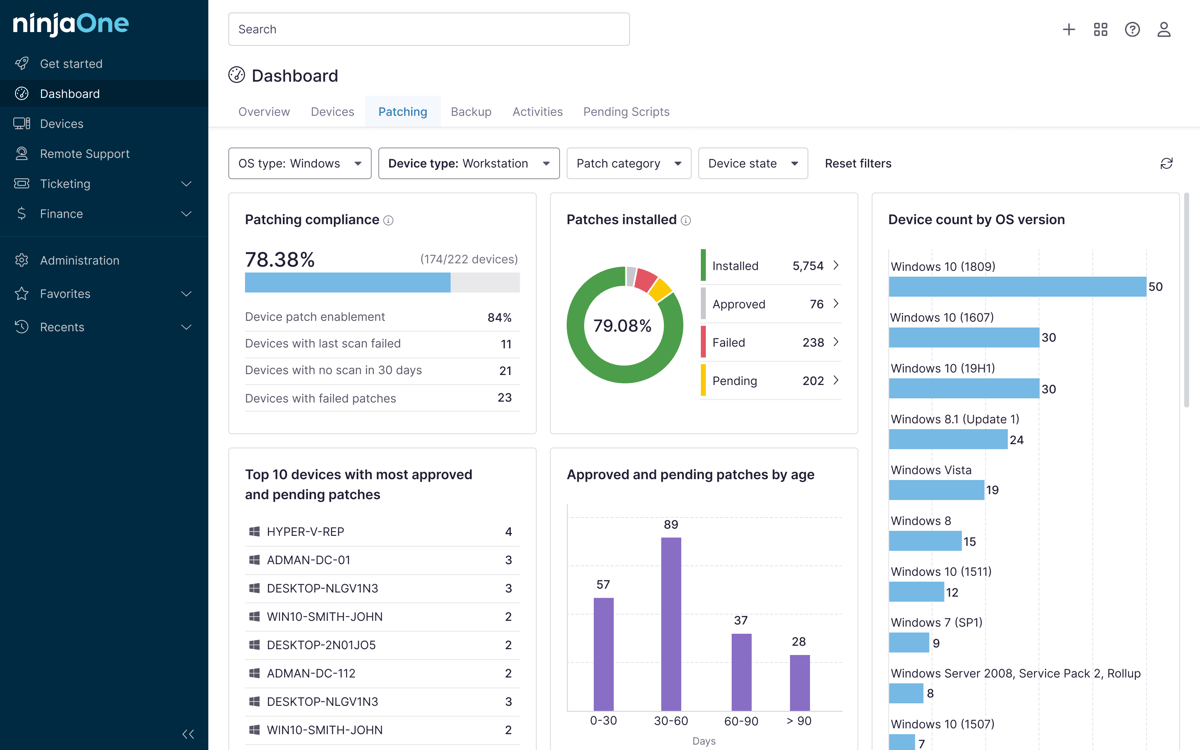
- Real-Time Monitoring: NinjaOne provides ongoing surveillance of endpoints to detect anomalies and threats as they occur.
- Automated Patch Management: It automates the deployment of security patches and updates, ensuring systems are protected without delay.
- Behavioral Analysis: By analyzing endpoint behavior, NinjaOne can identify suspicious activities that static defenses might miss.
Related topics: