
Microsoft’s July 2026 Patch Tuesday release covered more than 600 CVEs, the largest single-month security release in company history (triple June’s previous record). And Microsoft expects we’ll see even higher release counts in months to come. This isn’t just a trend confined to Microsoft. Others like Oracle and Linux are witnessing the same uptick.
Here’s where we are today: AI-enabled discovery and vulnerability exploitation are rising in frequency and severity. The 2026 Verizon DBIR found that for the first time in 19 years, vulnerability exploitation is the number one cause of breaches. Gartner® found that, based on analysis of 15 published application catalogs, the average mean time between releases (MTBR) has compressed from 60 days in 1Q23 to 51 days in 1Q26, while the count of patches released has more than quadrupled, from 2,616 to 12,222, in the same period since 2023. And the Forum of Incident Response and Security Teams (FIRST) now expects 2026’s total CVE tally to land somewhere near 66,000 (at the start of the year FIRST had predicted that 2026 would be the year we cross 50,000 published CVEs).
This means more threats coupled with new levels of information that IT and security teams must now sift through and constantly apply, with no supplementary changes to budget or headcount. Not only is the burden of day-to-day operations growing, but the threshold for acceptable risk continues to shrink.
RIP monthly patch cycle
Even before Mythos and Daybreak, we knew the death of monthly patch cycles was coming. Not because they were a bad idea, but because the threat environment stopped respecting the calendar.
Leveraging automation to accelerate patch management cycles is no longer optional. It plays a vital role in helping IT and security teams keep pace with an evolving threat landscape. However, automation isn’t a blanket answer and treating it as one is how a bad patch can quickly spiral into something bigger. With AI accelerating vulnerability discovery at scale, it’s not enough to just patch faster. Organizations have to patch more effectively.
The answer is to match each patch to the level of automation and validation its risk actually warrants. Gartner offers a good model for this:
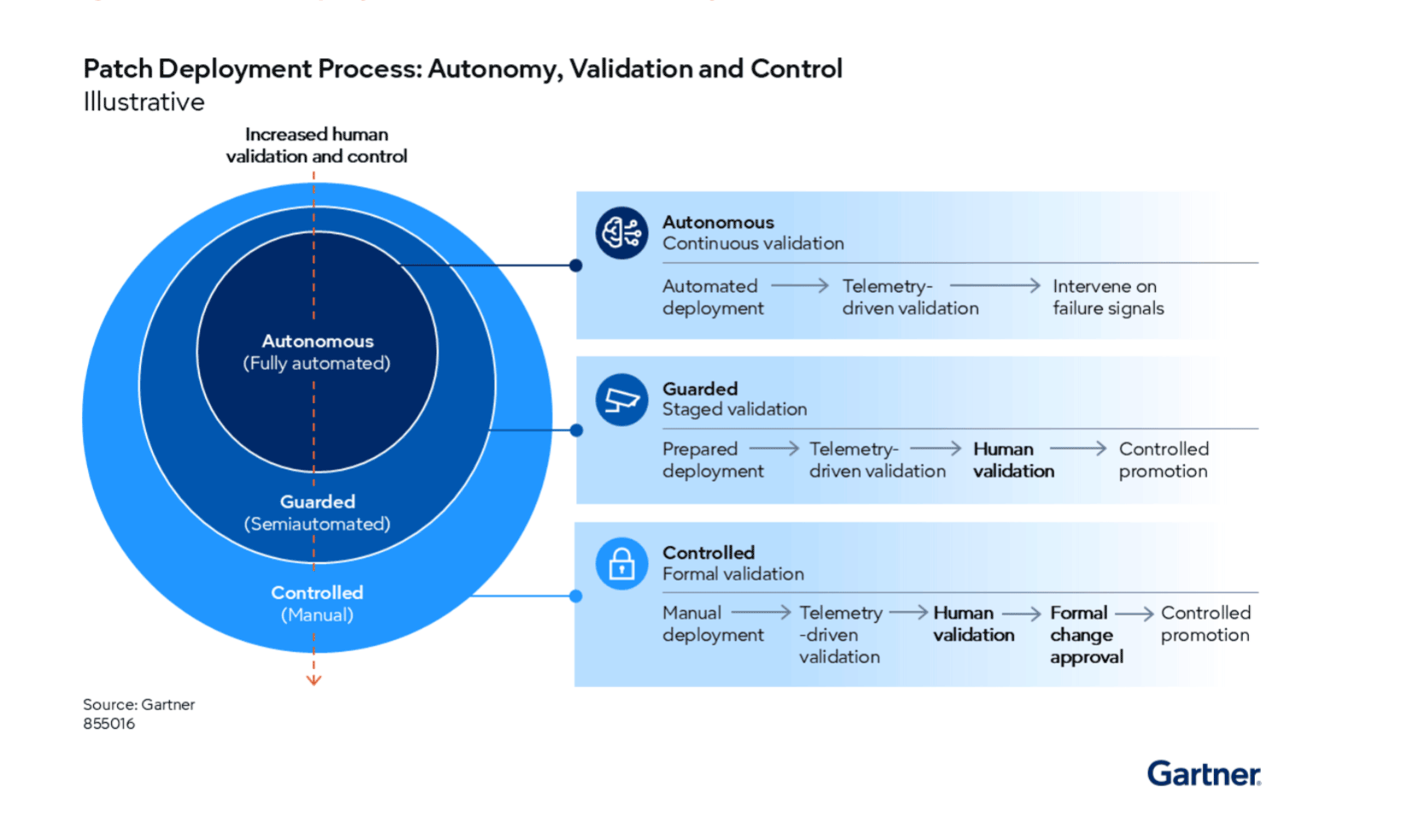
Gartner patch deployment framework breaks this into three tiers:
- Controlled: Manual deployment, telemetry-driven validation, and human validation; formal changes are approved, with controlled promotion.
- Guarded: A prepared rollout runs through telemetry-driven validation, then a person validates before it’s promoted further.
- Autonomous: Continuous validation runs on telemetry, and the system intervenes on its own the moment a failure signal appears.
Low-complexity, low-criticality updates can reasonably sit in the autonomous designation. While complex or high-criticality systems belong in the guarded or controlled designation, where a person still signs off, but telemetry is doing the watching. As cyber threats evolve and patch volumes climb, organizations need a repeatable, prescriptive patching strategy that delivers faster remediation without compromising stability.
Making continuous resilience a reality
This is what NinjaOne was built to do. We know the threat landscape is getting worse and budgets aren’t changing. NinjaOne Real-Time Vulnerability Assessment continuously correlates live inventory against current CVE and exploitation data, so the highest-risk patches surface the moment they matter, not on the next scheduled scan. NinjaOne Autonomous Patch Management applies policy to determine which patches deploy on their own, which get staged validation, and which still need human sign-off, so speed doesn’t come at the cost of control.
Patch Intelligence AI is the telemetry layer underneath all three tiers. It scores how a patch is behaving in the wild, across a sample set of millions of endpoints. If reports of instability start trending up (like in the recent instances of KB5101650 and KB083769), that signal factors into the deployment decision automatically, and can be configured to override an automation that would otherwise deploy a “bad” update.
Pair that patch intelligence with accelerated vulnerability prioritization to separate what needs to move now from what can wait, and you get automation with a sensible filter on it rather than automation without guardrails.
Patch cycles that keep pace with the adversary
Patch cycles built around a calendar can’t defend a threat landscape that stopped respecting one. Every month an organization delays this shift it risks falling further behind.
Continuous vulnerability assessment paired with intelligent automation that accounts for patch sentiment offers promise for organizations seeking to patch faster than vulnerabilities can be weaponized.
The death knell of monthly patch cycles is ringing. Teams that rebuild around this new reality will be better prepared to face the next record-breaking Patch Tuesday (because it’s just around the corner). Teams that don’t will still be closing last year’s tickets while this year’s exploits are already in production.
+++
Gartner, Accelerate Patching of AI-Discovered Vulnerabilities Without Disrupting Employees, Robin Milton-Schonemann, Todd Larivee, Sunil Kumar, 20 June 2026. GARTNER is a trademark of Gartner, Inc. and/or its affiliates.