
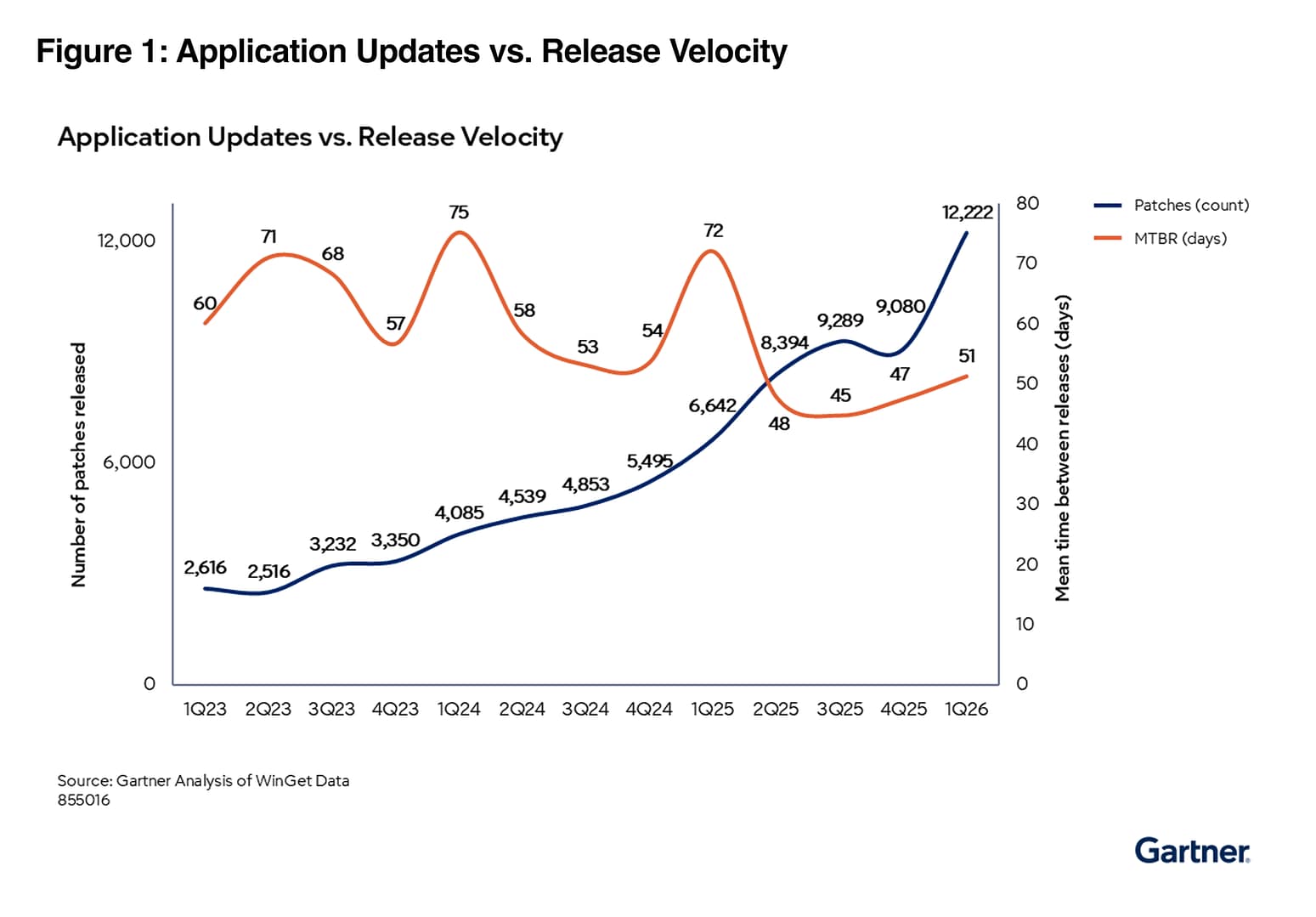
The number of patches released has quadrupled since 2023, and AI is compressing the time to exploit vulnerabilities to under 48 hours. The risk landscape has further been accelerated by the introduction of new frontier AI models, such as Claude Mythos and OpenAI Daybreak. Traditional patch cycles can’t keep pace, but accelerating blindly risks operational disruption as damaging as the exploits themselves. We believe this Gartner report helps IT leaders build an adaptive patching model that increases patch velocity where it matters most, without sacrificing operational stability or employee experience.
Inside, you’ll find:
- An adaptive application governance model that segments your portfolio by complexity and business criticality, reserving human oversight for only the highest-risk applications
- Three patch deployment tiers (autonomous, guarded, and controlled) and how to align each to your exposure risk levels
- How endpoint telemetry replaces manual testing as your primary validation mechanism, covering performance, stability, and employee sentiment
- Guidance on supply chain risk as increased automation creates new attack opportunities
- Key success metrics including mean time to patch, automated update adoption rates, and exposure-risk SLA adherence
Complete the form below:
What does this Gartner report cover?
According to us, the report provides a framework for IT and I&O leaders to accelerate patch management in response to AI-driven vulnerability discovery without disrupting employees. It introduces an adaptive application governance model that segments applications by complexity and criticality, defines three deployment tiers (autonomous, guarded, and controlled), and explains how endpoint telemetry replaces manual testing as the primary validation mechanism.
Who is this report for?
In our opinion, the primary audience is heads of I&O, VP of IT, and IT operations leaders responsible for patch management programs. Security leaders and CISOs facing pressure from AI-accelerated exploit timelines will also find it relevant.
Why is AI changing patch management urgency?
According to Gartner, the acceleration of vulnerability discovery, driven by AI, compresses the time to exploit beyond the capacity of traditional patch cycles and exploitation times, with under 48 hours becoming more common. Typical patch cycles are measured in days, leading to an increased urgency to accelerate patching programs.
How does NinjaOne help with the adaptive patching model described in this report?
We believe NinjaOne Autonomous Patch Management aligns closely with the adaptive patching approach described in the report by helping organizations automate deployment of low-risk updates while maintaining appropriate oversight for business-critical applications. NinjaOne Patch Intelligence AI provides AI-driven patch stability assessments together with CVE/CVSS/KEV-based prioritization, automated patching policies, and endpoint visibility to help organizations accelerate remediation while reducing the risk of deploying problematic updates.