RMM patch management vs standalone patching tools both aim to keep systems secure and up to date, but they solve the problem from different angles. The right choice comes down to how you want to balance integration, control, governance, and the complexity of your environment.
Introduction to standalone and RMM patch management
Before making the patch management comparison, it’s important to know the basic differences between each of these patching options:
RMM patch management lets IT and MSP teams manage software updates from the same platform they already use for monitoring, alerting, scripting, remote access, and endpoint administration. This integrated approach can reduce manual work, consolidate tools, and improve visibility across distributed environments.
Standalone patch management software focuses more narrowly on patch discovery, deployment, validation, vulnerability remediation, and compliance reporting. Instead of asking which option is “better,” enterprises should evaluate which model best supports their endpoint estate, regulatory requirements, patch coverage, risk prioritization, and remediation workflows.
What RMM patch management includes
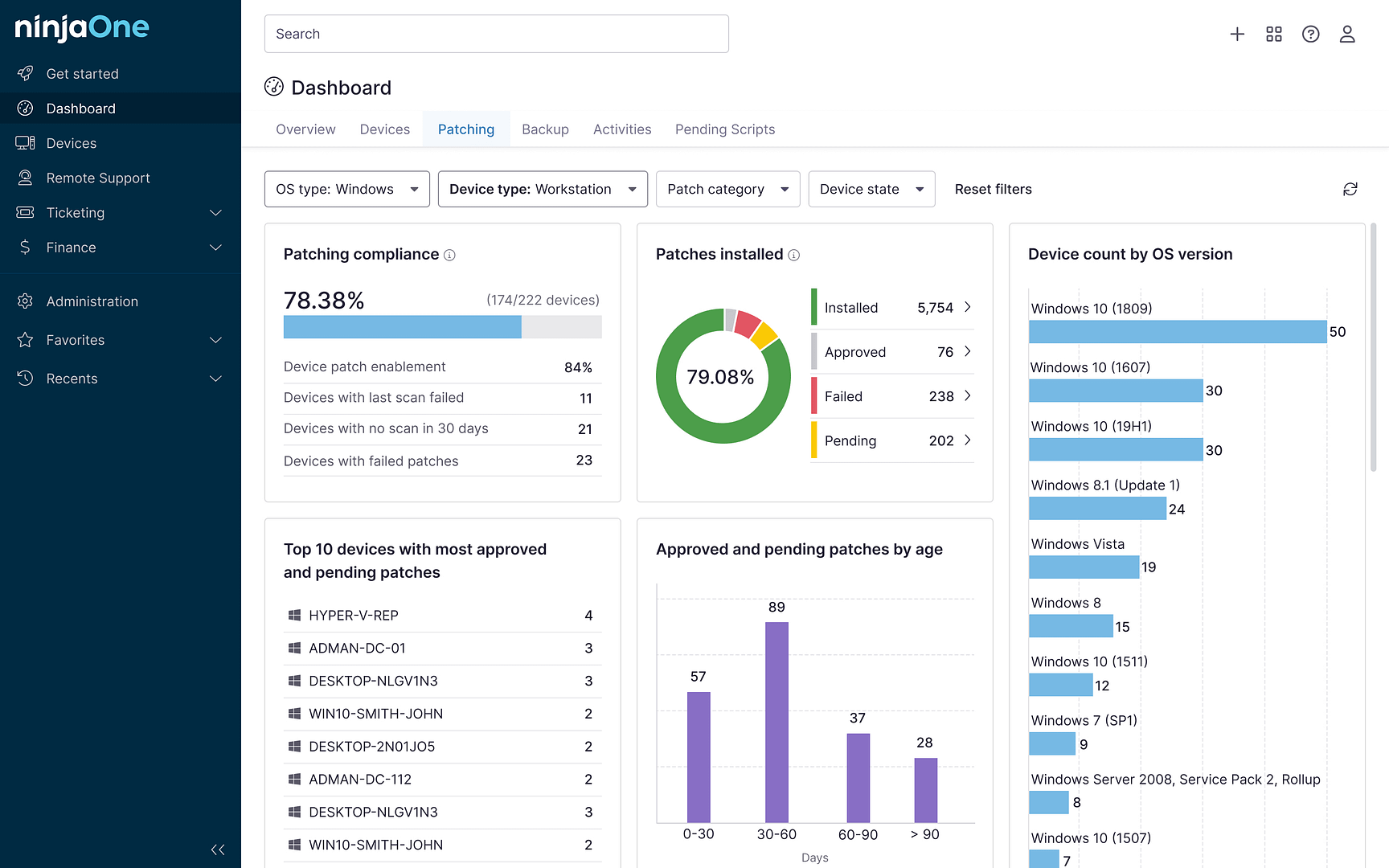
RMM patch management combines software update workflows with broader remote monitoring and endpoint administration. Rather than treating patching as a separate process, it embeds it into the same console that teams use to watch device health, respond to alerts, and perform remote tasks.
Common capabilities include:
|
|
The main advantage is operational context. Patch status lives alongside endpoint health, open alerts, user impact, remote access tools, and remediation actions, allowing technicians to see why a patch failed and act without switching tools.
What standalone patch management software includes
Standalone patch management software is usually designed specifically around patch discovery, deployment, and compliance. It assumes you already have separate tools for monitoring, ticketing, and security, and focuses instead on doing patching in more depth.
Typical capabilities include:
|
|
Standalone tools tend to make sense when patching needs are highly specialized, when the organization already uses separate monitoring and security platforms, or when a dedicated security team owns vulnerability remediation and needs tight governance.
RMM vs standalone patch management
RMM and standalone patching tools both handle updates, but they are optimized for different operational problems and ownership models.
RMM patching is strongest when teams need:
- Centralized endpoint visibility from a single platform
- Patch automation that is directly connected to monitoring and alerts
- Remote remediation when patches fail or cause issues
- Client or business unit segmentation from the same console
- Multi‑tenant patch workflows for MSPs or shared services
- Tool consolidation to reduce overlapping platforms
- Scripting and endpoint actions triggered from the same view
- Patch reporting alongside device health and performance data
Standalone patch management is strongest when teams need:
- Deep, patch‑specific controls and advanced policies
- Rich vulnerability prioritization tied to threat or exploit data
- Specialized third‑party software coverage at scale
- Strict separation between monitoring and remediation ownership
- Security‑led patch governance with formal approvals and exceptions
- Detailed compliance workflows for regulated industries
- Dedicated testing, deployment ring, and rollback processes
Some enterprises standardize on RMM‑based patching, while others pair RMM with dedicated vulnerability and patch tooling. The deciding factor is usually governance and complexity: simple estates benefit from integration, while complex, regulated environments often need the additional depth of standalone tools.
Benefits of RMM for software updates
RMM‑based patching improves update operations by embedding patch management into everyday endpoint workflows rather than treating it as a separate practice.
Benefits include:
- Fewer disconnected tools to configure, manage, and reconcile
- Centralized patch status across all managed endpoints and groups
- Faster follow‑up when patches fail, with direct access to device context
- Remote access for interactive troubleshooting when updates break something
- Automated remediation scripts that can run before or after patches
- Policy‑based patch scheduling and maintenance windows
- Better visibility into offline, missing, or unhealthy endpoints
- Patch reports tied to specific endpoint groups, clients, or business units
- Lower operational friction for distributed IT or MSP teams
RMM‑based patching is particularly helpful when patch failures require immediate endpoint action. Instead of pivoting into a separate tool, technicians can investigate device health, restart services, run diagnostics or cleanup scripts, and open remote support sessions from the same operational context.
Where standalone patching tools may still make sense
Standalone tools become appealing when patching requirements go beyond what an RMM platform can reasonably provide or when governance needs are strict.
Common scenarios include:
- Highly regulated environments that require detailed, audit‑ready patch evidence
- Large application portfolios that demand broad third‑party software coverage
- Security teams that own vulnerability remediation separately from IT operations
- Environments where advanced risk scoring or exploit intelligence drives priorities
- Organizations with solid endpoint monitoring but weak patch governance
- Complex rollout models that rely on deep testing, approval, and rollback controls
In these cases, RMM may still be used for visibility and operational actions, while dedicated patching software handles prioritization, approval workflows, and compliance reporting. The key is clear integration and ownership so teams are not duplicating efforts or working from different sources of truth.
How to compare RMM and dedicated patching software
A useful patch management comparison should focus on operational fit and governance, not just feature checklists. The goal is to understand how each option will behave in your environment and under your constraints.
Evaluation criteria include:
- Endpoint coverage across Windows, macOS, Linux, and servers
- Third‑party application patch coverage and catalog depth
- Support for vulnerability prioritization and risk‑based decisions
- Patch scheduling flexibility and blackout window controls
- Maintenance window and reboot management
- Options for patch testing, pilot rings, and staged rollout
- Rollback or recovery workflows when updates cause problems
- Failure detection, alerts, and retry logic
- Reporting, dashboards, and exportable audit evidence
- Integration with ticketing, PSA, SIEM, or vulnerability management tools
- Multi‑tenant management for MSPs or shared IT teams
- Role‑based access controls and approvals
- Automation and scripting support around patching workflows
- Overall tool stack complexity and operational overhead
When comparing platforms, it helps to test realistic scenarios: emergency patch rollout, failed update recovery, audit reporting, and handling a high‑risk vulnerability across diverse endpoints.
Governance considerations for enterprise teams
No tool can compensate for weak patch governance. The chosen platform (RMM, standalone, or both) needs to fit into a clear, repeatable governance model that defines how decisions are made and enforced.
Enterprise teams should define:
- Who owns the patch policy and standards
- Who approves high‑risk or disruptive patches
- Who handles exceptions, and for how long
- How patches are tested and validated before broad rollout
- How failed patches are triaged, escalated, and remediated
- Which vulnerabilities require emergency remediation vs standard cadence
- How patch evidence and logs are retained and accessed
- How reports are reviewed and by whom
- How patching integrates with vulnerability management processes
- How endpoint operations and security teams share accountability
RMM patching can centralize execution, but governance determines whether patching is consistent, risk‑based, and audit‑ready. The same is true for standalone tools: without clear owners and processes, more features simply mean more unused potential.
Common mistakes
Teams often run into trouble not because they picked the wrong tool, but because of how they implemented and governed it. Common mistakes include:
- Assuming RMM patching and standalone patching are interchangeable
- Choosing a tool based only on deployment automation speed
- Ignoring third‑party application coverage and catalog gaps
- Failing to connect patching with vulnerability management data and priorities
- Overlooking validation of patch success beyond simple “installed” flags
- Using multiple tools without clear ownership or source of truth
- Creating tool sprawl without improving actual remediation outcomes
- Reporting on patch activity instead of true patch compliance and risk reduction
- Ignoring offline, remote, or intermittently connected endpoints
- Treating audit and compliance reporting as an afterthought
- Choosing standalone tools without planning integrations and handoffs
- Assuming integrated patching alone will fix governance and process gaps
Avoiding these pitfalls ensures that whichever model you choose can deliver real improvements in security posture and operational stability.
Key takeaways
- RMM patch management connects software updates with broader endpoint operations, monitoring, and remote administration.
- Standalone patching tools can deliver deeper patch governance, prioritization, and vulnerability remediation workflows.
- The best choice depends on endpoint scale, software and OS coverage, compliance requirements, and who owns patching vs vulnerability management.
- Integrated patching can reduce tool sprawl, but only if workflows, ownership, and governance are clearly defined.
- Enterprises should compare patching tools based on coverage, validation, reporting, automation, integration, and real remediation outcomes—not just raw feature counts.
In summary
RMM patch management and standalone patch management software can both support robust enterprise patching, but they serve different operational needs. RMM‑based patching is strongest when teams want integrated endpoint visibility, automation, remote remediation, and fewer tools to manage. Standalone patching tools are often a better fit when organizations require deeper patch‑specific controls, specialized vulnerability remediation workflows, or strict compliance and audit structures.