
Key Points
- Perform network security audits regularly to identify risks across hybrid, cloud, and IoT environments before they accumulate and to satisfy compliance requirements.
- Establish complete, continuous asset visibility through automated inventory and discovery scanning as the foundation for the entire audit.
- Map network exposure beyond CVSS scores to catch misconfigurations and systemic flaws that generic vulnerability ratings miss.
- Use a structured audit template covering architecture and inventory, open ports, endpoint posture, and monitoring and logging.
- Treat auditing as continuous, not periodic, by unifying governance, monitoring, and remediation into one ongoing process.
A network security audit should be part of your routine IT operations. While modern cybersecurity toolchains continue to advance in functionality, efficiency, and effectiveness, they are increasingly being challenged by sophisticated attacks. AI attacks are continuously working to find weaknesses in your infrastructure, and you must meet them with proactive measures, both for compliance and to ensure the security and continuity of your business.
This guide aims to help you understand what you need to do to identify exploitable network security risks. It explains what IT teams and managed service providers (MSPs) should cover when auditing critical network and security infrastructure, processes, and governance.
Why your organization needs to perform a regular network security audit
Performing a regular network security audit is a key responsibility for IT teams.
While network security audits have always been best practice, networks are now much more dynamic: no longer are you dealing with static endpoints with wired connections to on-site servers behind firewalls; you are dealing with hybrid cloud deployments, remote workforces (with added BYOD or CYOD), cloud-native SaaS apps, IoT, as well as legacy and distributed infrastructure across global sites.
Risk accumulates quickly in complex enterprise IT environments, requiring centralized visibility and continuous governance to be eliminated. Failure in these aspects leads to persistent exploitable vulnerabilities that negatively affect business success, impact finances, deter customers, and incur legal costs.
Beyond protecting your critical business infrastructure, your proprietary information, and the privacy of your staff and customers, security auditing is also a compliance requirement. You must be able to demonstrate that the mandated governance, processes, and controls are competently implemented.
Building and improving network security visibility
Asset management, including inventory and automated scanning, are required to continuously identify connected devices, including assets in the cloud (potentially covering ephemeral, auto-scaling infrastructure). Unknown systems should also be actively monitored for — as well lapses in physical security that may see them introduced.
By attaining maximal visibility, you can make sure your technicians understand the infrastructure they are responsible for, allowing for accurate prioritization of risks.
Mapping network exposure in distributed IT environments.
Exposure management goes beyond the simple assess-score-remediate-confirm cycle that leans on CVSS scores and also factors other unique causes of vulnerabilities like misconfigurations and systemic flaws, allowing for prioritization that better reflects real-world threats that generalized scores do not reflect.
On-site and cloud infrastructure, VPNs, point-to-point wireless connections, IoT gateways, and public access all present attack pathways and visibility challenges.
Open ports, public-facing services, the use of insecure protocols, and misconfigured systems must all be identified and eliminated or protected to reduce overall risk. There are also less obvious exposures that you should consider based on your organization’s unique environment. For example, an exposed network port in a previously private area of a building that is now used as a public meeting place presents a significant threat that could be difficult to detect.
Template: How to perform a network security audit
A holistic approach to network security is required for success, and the auditing process should reflect that.
The template below includes common network infrastructure and cybersecurity elements you should address during your regular enterprise network security audit.
1. Review network architecture and take inventory
You should maintain an up-to-date map of your network architecture, as well as an inventory of assets and configuration details (IP addresses, open ports, etc.).
In addition to structure and endpoints, details about your network should include segmentation policies, firewall configurations, and internet-exposed infrastructure. This can be achieved using a six-phase network mapping process.
2. Identify open ports and services
Open network ports present a persistent threat: servers should only expose the ports for the services they are intended to provide, and endpoints generally do not need to accept inbound traffic, barring exceptions.
Monitor for exposed ports and unexpected/unused services and ensure they match those expected. The sudden appearance of either could indicate an underlying issue. Carefully monitor for remote administration and access tools and review sessions.
3. Evaluate endpoint security posture
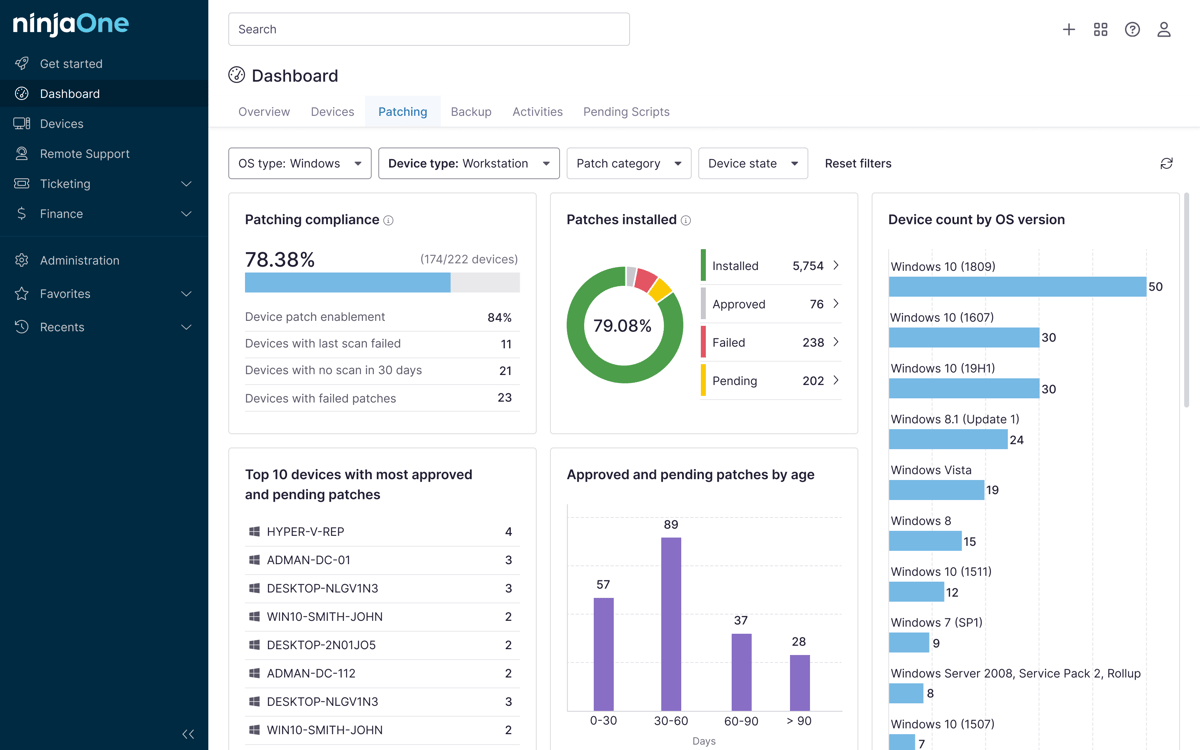
Endpoints are both stepping stones for further network intrusion, and the end-goal for attackers. Your network security audit should include details such as OS version and patch status to help identify legacy and vulnerable systems.
Patch management should be integrated with the inventory process, ensuring you are working with as secure a foundation as possible. Integrated IT management systems help keep workflows efficient — removing duplicate efforts across inventory, patch/vulnerability management, and other tasks.
4. Review security monitoring alerts and logging
Your audit should address governance, not just the technical aspects of network security. Make sure responsibility is assigned for all network infrastructure, as well as for identified issues to ensure they are tracked and remediated.
Check that logs and security events collect the information required to correctly identify and troubleshoot issues from devices like firewalls, switches, and endpoints.
You should also check that timely automated alerts will reach the right engineer, and that escalation paths are clear.
5. Identify common network security threats
Continuous network monitoring should be deployed to watch for additional risk factors including:
- Insecure network protocols: Management interfaces using insecure protocols (telnet, HTTP, FTP) should be identified and, if they cannot be switched to using a secure protocol (SSH, HTTPS, SFTP), add additional controls (firewalls, secure tunnels, etc.). Other tools should also be secured where possible, so they can’t be used as a vector for access through things like traffic interception and credential theft.
- Unpatched systems, EOL, and legacy infrastructure: End-of-life software that cannot be retired (e.g., industrial, medical control devices) and bespoke internal tools that have not or cannot be updated present unique attack vectors for human and automated attacks.
- Weak network segmentation and monitoring: Denying attackers the ability to move laterally through your network gives you time to identify and mitigate threats, and prevent further damage. IoT and public Wi-Fi infrastructure in particular should be isolated and carefully monitored. Failure to do so can give attackers time to establish a permanent, hard-to-detect foothold.
- Shadow IT: Unauthorized devices and software have become a primary risk that must be identified during network security audits. While users may think they are being ‘helpful’ by connecting their personal devices to networks, or installing software before they have approval, these elements should be found and disabled. Staff should then be trained in cybersecurity best practices to discourage the further proliferation of shadow IT.
6. Coordinate remediation and exposure reduction, and iterate on auditing processes
High-risk exposures don’t wait for your next scheduled audit to appear.
Once all threats identified during your audit have been triaged and dealt with, continuous network monitoring should be coordinated with vulnerability scanning, endpoint management, and governance to reduce the appearance of new exposures. Effectively, your network security audit needs to become continuous.
Data from all key IT processes should be consolidated. This data should be acted on in real time, as well as being stored for long-term insights and included in regular audit documentation to show ongoing improvement.
Historical information also helps iterate and improve on policies, particularly prioritization. You can tweak policies to better recognize factors like exploitability, business impact, and operational dependencies for your use case.
Then, plan your next audit — setting goals to encourage continuous improvement and demonstrate efficacy and competence to the stakeholders who can support your IT security projects with additional resources.
Unifying governance, inventory, network monitoring, vulnerability management, and remediation
Automation and integration are a necessity for network security in modern enterprise environments. It is practically impossible for even the best-resourced IT teams to maintain oversight over rapidly changing and expanding IT deployments. For MSPs that handle multiple enterprise clients, this challenge is multiplied.
NinjaOne provides a unified IT management platform that includes inventory, network discovery and monitoring, as well as vulnerability management. This is supported with automation that can be used to adapt to your unique IT environment, and integrate with other leading security platforms. Secure documentation can host your audit policies, procedures, and results, helping ensure continuous improvement and a strong ongoing security stance.