
Note: This post is an excerpt from our new guide, 5 Steps to Growing Your MSP Business. Download your complete copy here.
In the quest to grow your MSP business, extending your customer base beyond your initial core group of contacts is a big step. Many small MSPs can struggle to break out, often because it’s easier to focus on the thing you’re naturally great at — the technology side of providing services, for example — than the things that are challenging and outside your comfort zone. As a result, sales and marketing efforts can often be limited to a reliance on word of mouth or attending the same business mixers, which can lead to new customers initially, but quickly yield diminishing returns.
How can you increase your exposure to new prospects and grow your customer base more effectively?
In this second post in a five-part series on growing your MSP company, I’ll discuss five high-level steps you can follow to define, market, sell, and close new business. With these steps, you can start pulling together a customer acquisition strategy that puts you in front of the right prospective customers with the right message and offering.
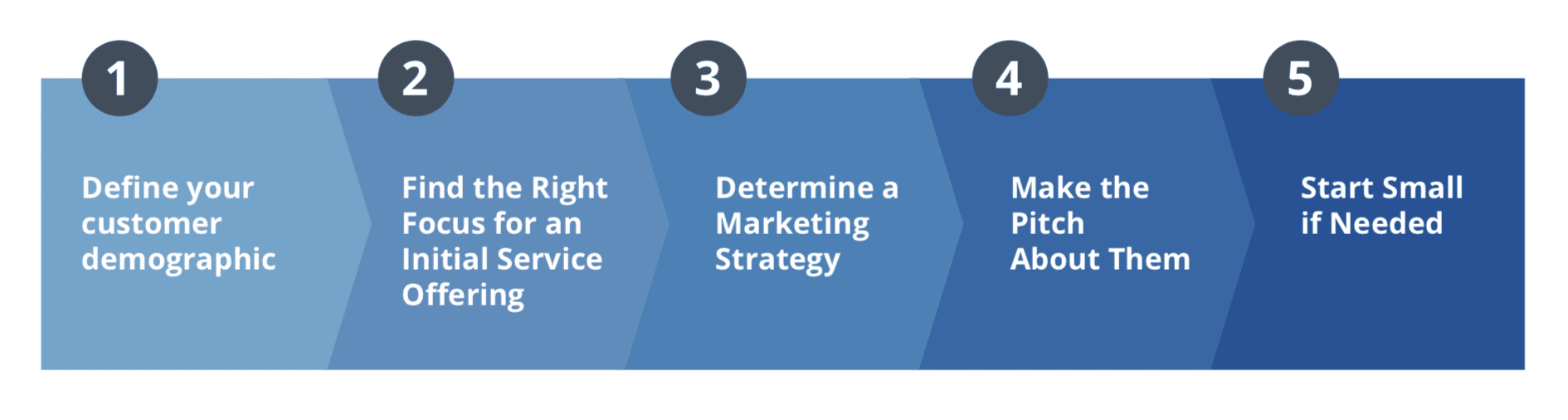
While the five steps below only provide a small degree of guidance, they are designed to be strategic in nature, pointing you in the right direction to determine your specific implementation plan. Let’s begin by developing a sharper understanding of who your target customer is.
Step 1: Define Your Customer Demographic
Nearly every MSP has their customer sweet spot. It may be based on customer size, industry vertical, applications used, compliance mandates, or a variety of other factors. Whatever yours is, define it.
Understand exactly what that customer generally looks like (size, # of locations, staffing, etc.), what their pains are (e.g., productivity, security, compliance, data protection, etc.), and how/where you can find them (e.g., are there industry affiliations, groups, events, etc. they participate in?). This will serve as the basis for the remainder of the steps.
Use the questions below to assist you in defining your target customer:
- Do you have a “sweet spot” in terms of ideal customer size?
- Do you want to manage multiple locations per customer?
- Should your customer have an in-house IT generalist to assist?
- Are there any common industries across your current customer base?
- What services do you provide best fit the above customer’s needs?
- Are there any additional services you have particular expertise offering? If so, are there specific industries that need that service more than others?
Step 2: Find the Right Focus for an Initial Service Offering
It’s likely the majority of the customers you’re targeting may have zero idea who you are. Before you dive right into explaining every service you offer you’ll likely be better suited to laying some initial groundwork and establishing credibility first. Selling them too aggressively will only put them off. They’re looking for a partner they can trust, and rattling off a laundry list of services makes you sound like a used car salesman with every type of car on the lot.
Instead, craft a focused set of services common to your existing customer base that you consider to be your core offering. When the opportunity arises, and a prospective customer asks, “What about service X – do you offer that?” that’s the time to pull out additional services.
Step 3: Determine a Marketing Strategy
Once you have your target customer defined and a good service fit nailed down you can begin to figure out how to best market to them. There are a large number of prospective channels to explore, including paid search on the web, mailers, exhibiting at/sponsoring local business events, cold calling, email marketing, and referrals. You’ll need to test which methods work best for your customer demographic and that fit your budget. Your marketing message should focus on the services you offer as well as the outcomes you deliver.
If you’re unsure where to start or how to make your efforts more effective, watch our short video, MSP Marketing Guide: Overview, Strategies, & Tips. It covers strategies for connecting with your ideal audience and driving real results.
Step 4: Make the Pitch About Them
Once you’ve created an opportunity to sit down and discuss your services with a prospective customer, you should focus on them. Ask about their business. What challenges are they having? What’s important to the success of the business from a technology perspective? Take notes. Then discuss your services in the context of the customer’s talking points.
For example, you might discuss your backup and recovery services by stating, “You mentioned if your systems go down for more than a day, you’re losing substantial revenue. Our backup and recovery service ensures you’re up and running within four hours.” See? Instead of pitching services to the customer, explain to them how the outcomes you can deliver can solve their problems.
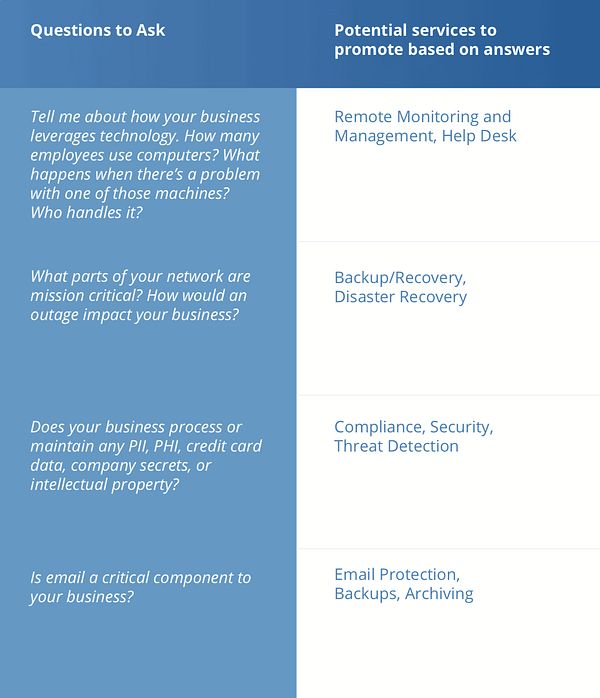
The grid below gives you some example questions to ask and how you might leverage answers to promote specific services.
Step 5: Establish a Foothold with New Clients and Expand Over Time
When it’s time to close the deal, don’t feel like you have to push every new customer to sign up for everything you offer. Smaller deals can still provide you the opportunity to land and expand, so focus on the long-term value of the relationship, not just the immediate revenue. Building trust over time with even the smallest of services provided (as long as it’s profitable for you), and increasing the scope of services over time can snowball into considerable growth.
Next Steps: Learn How to Improve Customer Retention and Customer Acquisition at the Same Time
At its essence, sustainable growth is the product of your offering being strongly aligned with your target customers’ needs. The steps outlined above can help you define and establish that alignment, giving you the greatest chance of success.
In the next blog in this series, I’ll discuss how to maintain your existing customer base to ensure you don’t lose your current revenue as you shift your focus to customer acquisition.
If you don’t want to wait for the rest of the series you can get your free copy of 5 Steps to Growing Your MSP Business now.
Inside, you’ll learn how to:
- Overcome the most common growth hurdles
- Create — and stick to — a practical growth plan
- Craft a value proposition that hits home with new prospects
- Acquire the right type of new customers
- Upsell your best current customers, and keep them happy while you grow
- Scale your business operations to make growth sustainable

Featured Image by rawpixel