
Key Points
- Compare different encryption methods, such as transparent data encryption, column-level encryption, and application-level encryption, to find the one that best fits client requirements.
- Use cloud KMS or HSM for centralized control, then rotate keys regularly and separate key custodians from database admins to minimize insider risk.
- Encrypt backups, logs, and exports outside the primary database. Use immutable or WORM backups for critical datasets to ensure recoverability.
- Require TLS for database connections, use SFTP or FTPS for file transfers, and monitor for downgraded or plaintext connections.
- Benchmark encrypted workloads, test backup restores, and collect audit-ready evidence to maintain compliance and operational confidence.
- NinjaOne simplifies key tracking, policy enforcement, certificate monitoring, and reporting to streamline encryption management across client environments.
Data encryption transforms plaintext data into ciphertext, protecting critical client data from prying eyes and malicious actors. Multiple database encryption methods exist, and they serve different functions and capabilities. Matching encryption solutions to risk enforces strong key management, extending coverage to backups and data in transit.
Data encryption guide: choosing the right encryption method
Encryption solutions come in different forms, such as transparent data encryption (TDE), column-level encryption (CLE), and application-level encryption. It also applies to data in storage (data at rest), moving across networks (data in transit), or across its life cycle (end-to-end).
Each encryption method and application offers different protection, control, and complexity levels. MSPs must identify the right database encryption solution since security requirements, compliance, and resources vary per client.
📌 Prerequisites:
- Existing data classification procedures to identify sensitive tables and fields
- Approved key management using HSM or cloud KMS
- Network plan for TLS enforcement and secure file transfer
- Platform capabilities survey for SQL Server, PostgreSQL, or cloud equivalents
- Repository for keys, configs, test artifacts, and monthly reports
Strategy #1: Pick the correct data encryption method and scope
Selecting the right database encryption method and defining its scope ensures that protection matches client risk, platforms, and workflow. Without proper alignment, encryption can become inconsistent or incomplete, introducing unforeseen issues that compromise client data accessibility and security.
When to use transparent data encryption (TDE)
TDE encrypts entire databases, transaction logs, and snapshots at rest with minimal impact on existing applications. This encryption method minimizes data loss risk through stolen drives, backups, or virtual disks.
TDE ensures that every stored or backed-up database copy is encrypted by default. It’s suitable as a baseline layer of protection and compliance that can be used as a foundation for encryption strategies.
When to use column-level encryption (CLE)
CLE targets sensitive database fields, such as credit card numbers and client health data, allowing access only to authorized users and processes. Its granularity enforces least privilege access and shrinks the blast radius of unauthorized database access by making encrypted fields unreadable.
CLE closes the gap TDE leaves, focusing on encrypting valuable database fields instead of leveraging broad encryption alone. This also supports compliance frameworks that require selective encryption of identifiers or financial data.
When to use application-level encryption?
Application-level encryption protects data by ensuring the encryption and decryption processes happen inside software or services (e.g., CRM systems, SaaS platforms). The database only receives encrypted information, ensuring that attackers who gain access to the database engine can’t access sensitive information.
However, although application-level encryption offers the highest level of data confidentiality, it’s difficult to implement. Developers and techs must modify applications to handle encryption and decryption operations. Additionally, queries on encrypted files may be limited since databases can’t easily search or sort ciphertext.
Strategy #2: Designing key management for control and safety
Encryption solutions are only as strong as your key management, as poor key storage practices undermine every other security control. If attackers can easily access encryption keys, they can decrypt data that encryption solutions were meant to protect.
Effective key management helps strengthen client security posture, ensuring that keys are accounted for, recoverable, and independently managed. This also keeps clients compliant with the key management requirements of compliance frameworks, such as ISO 27001 and SOC 2.
Do the following to keep data encryption keys secure:
- Use key management services or hardware security modules: KMS and HSM solutions protect keys using dedicated hardware or hardened virtual vaults, keeping them isolated from servers and local files.
- Rotate encryption keys regularly: Schedule encryption key rotation every 90 or 180 days. Force rotation after triggers like staff departures, suspected compromise, and incident recovery to minimize breach impact and exposure.
- Separate key custodians and database admins: This prevents database admins from accessing the encryption keys, reducing insider risk.
- Document escrow and break-glass procedures: Provide clear rules for emergency access and backup key storage, including who can request access, assigned approvers, and logging processes.
Strategy #3: Address data at rest gaps within database encryption methods
Encrypting primary database files alone leaves a security gap, as data moves, replicates, and gets copied into secondary locations. For example, transaction logs, backups, and exported reports can hold sensitive data in plain text, increasing the risk of leaks.
Derivatives of primary database content, whether intentionally created by techs or system processes, should also be protected. This means that encryption should cover all data at rest, not just the primary database.
Encrypt backups, replicas, snapshots, and temporary storage
Extend encryption to all derivative database copies, such as full backups, incremental backups, and transaction logs. Encrypting these files prevents attackers from accessing database content through secondary storage outside the primary database’s security perimeter.
Encrypt exports, reports, and ETL staging data
Exported data is less monitored outside primary databases, which can open high-risk attack vectors for clients. That said, technicians should encrypt data exported for reporting, analytics, or ETL (extract, transform, load) and store it only within a definite timeframe as necessary.
Pair critical datasets with immutable or WORM backups
Minimize the risk of critical files from being altered or erased until their retention period ends through immutable or WORM backups. This prevents accidental or malicious modifications that can compromise clients, ensuring that a trusted backup exists for quick post-incident recovery.
Strategy #4: Enforce encryption in transit during database content transfers
Attacks don’t just happen during storage; malicious actors can also exploit attack vectors during transfers between applications, systems, or users. Database encryption methods should include network connections to ensure security, as unencrypted network traffic can cause data leaks.
Employ Transport Layer Security (TLS)
Require TLS handshakes for all database connections, including admin tools and applications, to encrypt file transfers. This reduces accidental exposure of credentials and sensitive data during remote management or client access.
Secure file-based data movement
Protect file transfers using SMB encryption, SFTP, or FTPS with modern ciphers to ensure end-to-end encryption when moving data.
Pin certificates and monitor downgrades
Pinning certificates and checking for downgraded, plaintext connections keep encrypted network connections trustworthy. This ensures that data moves only through verified channels.
Strategy #5: Validate performance of encryption strategies
Verify if encryption methods are in place to protect data without breaking the systems that rely on it. Through tests, you can identify if system performance drops or backups can’t restore properly due to encryption.
Benchmark query latency for column or app database encryption methods
Regularly schedule performance tests for column-level or application-level encryption, as these add encryption and decryption procedures that slow down queries or reports. You can do this by simulating normal workloads and comparing query times to confirm if encryption impacts service quality.
Run monthly restore tests from encrypted backups
The value of backups lies in their integrity, so conducting monthly restore tests is necessary to verify backup reliability. This helps ensure that encryption doesn’t compromise backup content for faster incident recovery.
Document validation procedures and results for audits and QBRs
Collect and capture logs, screenshots, timestamps, and job IDs from encryption-related tests. This serves as evidence to prove the effectiveness of your chosen database encryption methods to auditors and clients.
Strategy #6: Operate, monitor, and improve encryption strategies
Client environments change over time, whether it be through system changes, certificate expirations, or staff rotations. Without continuous and proactive monitoring, encryption strategies can drift out of compliance or fail.
Monitor for errors
Track logs and alerts for key operation failures, decryption errors, or unexpected plaintext events. These issues can help spot misconfigurations or suspicious activity early, before they become major failures in the future.
Maximize visibility
Maintain an inventory to track key rotations, certificate expiry dates, and encryption coverage for proactive scheduling and compliance reporting.
Review exceptions every quarter
Revisit encryption exceptions quarterly to verify whether they’re still necessary. When they’re not needed, remove them and return to standard controls.
Integrating NinjaOne with database encryption best practices
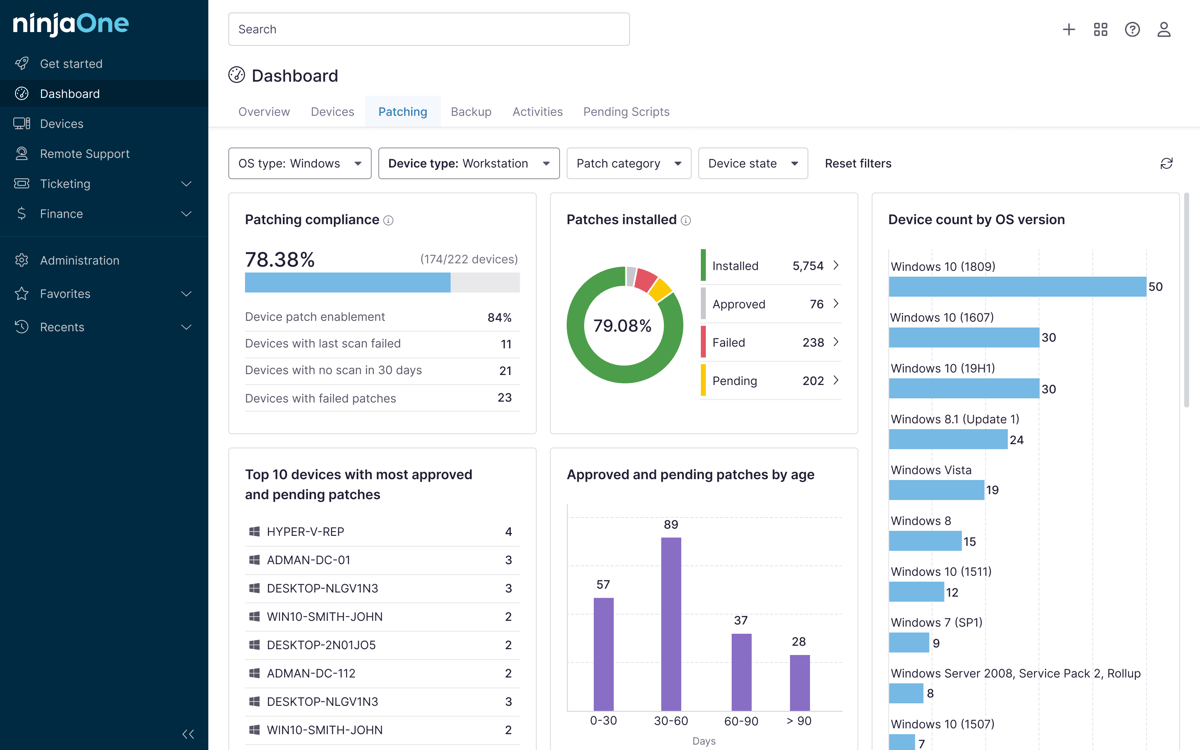
The following NinjaOne services centralize the management of encryption keys, certificates, and policies while streamlining encryption processes through automated alerts and clear visibility:
- Encryption key management: Leverage NinjaOne’s BitLocker and FileVault encryption management solutions to simplify and centralize key tracking, storage, and encryption status monitoring across Windows and macOS endpoints.
- Scheduled automation: Streamline your security validation processes using repeatable automation tools to ensure your database encryption methods remain valid and compliant.
- Policy deployment and checks: NinjaOne’s Policy Management feature ensures consistent security configuration and enforcement across clients. This also helps spot configuration drifts easily and automates ticket creation on policy failure.
- Comprehensive reporting: Transform raw security metrics into clear, actionable insights by creating client-facing reports with NinjaOne’s customizable reporting services.
Pick the correct encryption strategy to match client requirements
Effective database encryption strategies require continuous protection, validation, and documented control across every step. MSPs that align encryption to client risk and verify performance turn compliance into confidence and protection into measurable practice.
With NinjaOne, encryption management becomes centralized, automated, and standardized across client environments. NinjaOne also offers monitoring, policy control, encryption management, and reporting capabilities to streamline day-to-day security operations.
Related topics: