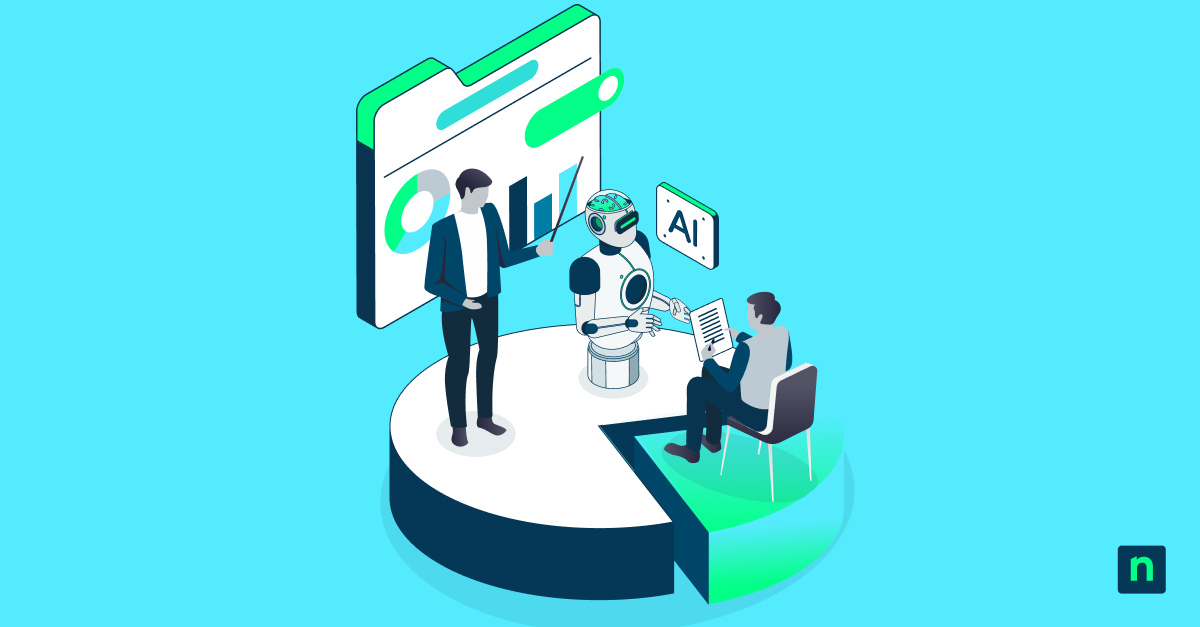
Marc Andreessen famously said, “software will eat the world.” Now it’s AI’s turn to eat software. It’s true. No matter who you’re talking to or what kind of conference you’re at, AI is all around.
AI represents a shift for all of us, and collectively, we’re struggling to navigate what it means as individuals, as organizations, and for our customers and society at large, daily and in real time.
To shed more light on how industry insiders and IT leaders are thinking about AI today, we sat down with Egon Rinderer, our SVP of global enterprise and public sector. With his more than 35 years of industry experience and extensive federal and enterprise background, Egon weighs in on the skills that he sees mattering most for IT leaders in this new AI era, which daily responsibilities AI will continue to shift off of their plates, and parallels between the last major technological shift and today’s.
Team Ninja: Which part of an IT leader’s job is becoming more important because of AI?
Egon: Judgment derived from experience. Not technical judgment specifically, though that still matters. Human judgment grounded in critical thinking, reasoning, and, frankly, the scientific method. AI can synthesize, summarize, and generate at a scale that no individual can match, but it cannot tell you when the output is wrong in a way that isn’t obvious, or when a stakeholder needs to hear something that doesn’t show up in any prompt. It doesn’t recognize an X/Y problem in the nuance of the question it has been asked. Leaders who thrive use AI to reach the decision faster, rather than using AI to make the decision for them. They educate it along the way, making the outcome more reliable. Then validate it upon completion.
Smarter IT starts here
Sign up for the NinjaOne Weekly Newsletter and join a thriving community of IT enthusiasts automating the hardest parts of IT together.
Team Ninja: How will the role and responsibilities of the IT leader evolve in the next 3 years?
Egon: We’ll see a lot of the lower-order research and documentation work start to be a less time-consuming aspect of the day-to-day. Status reports, copy editing, baseline vendor comparisons, and routine policy documentation. This work is not going away entirely, but the human time required to produce it is shrinking fast. In this sense, AI can act as a force multiplier. What that means for IT leaders is that the floor for “value-add” is rising. If your contribution is primarily assembly and formatting, that is a shrinking surface area.
On the other hand, there’s a possibility this will also have a detrimental impact on those just entering the workforce or even university. Many schools are actively reviewing a return to blue book exams. Interviews will become demonstrative rather than inquisitive. Employees early in their careers may not have the experience to know if what AI assembled for them is accurate or full of hallucination. Things are going to be rough for a few years as the industry adapts to the changes AI is bringing.
Team Ninja: Are there any parallels between today’s AI shift and what you saw during the cloud and SaaS booms?
Egon: It’s a similar pattern but dramatically amplified. I was a practitioner inside a large government agency during the early cloud push. The excitement was real, the planning was not. Nobody traced spend to outcomes. The overages were significant because leadership signed contracts that they didn’t fully understand, and then watched shadow IT explode underneath them. It eventually got sorted out, but it took years and many additional resources to undo. The organizations that avoided the worst of it were the ones that asked hard ROI questions before they committed, not after, and then monitored those returns closely. I’m watching the same movie play out with AI right now only it’s a much more subsidized industry. It’s not at all uncommon to see a $200/month premium commercial AI account cost the vendor well over $5,000/month. When the VC money, and thus subsidies start to dry up, those costs will get passed along to the consumer, just like we saw with rideshare, food delivery and so on. None of this is new aside from the technology we’re enamored with.
Team Ninja: If you were mentoring a young IT leader today, what skills would you tell them to develop that weren’t important two years ago?
Egon: Stop identifying problems and waiting for someone to come up with solutions. That was never the job, but now it really isn’t. The organizations that are navigating AI well have people who show up with a problem and proposed solutions, even when they don’t have the authority to make the call. Develop that instinct. Maintain a healthy skepticism. AI will save you hours a day if you use it right, but you have to know what “right” looks like. If you’re throwing rough context into a model and calling the first output a final draft, you’re not saving time, you’re deferring work and risk onto whoever cleans it up later. Learn where AI genuinely multiplies your capability and where it just moves the risk around. Finally, invest in your early-career staff more than ever. They aren’t getting the same learning opportunities you did 10, 20, or in my case, 30+ years ago. I still draw, daily, from lessons learned in the late-80s and early-90s. I honed my skills on hard won knowledge. They deserve that same opportunity. Don’t let AI dumb them down.
To continue this conversation and learn more about how other IT leaders are thinking about AI, head to our IT Leadership Lab, where you can ask questions and connect with other IT pros in real time.