
Key Points
- NinjaOne vulnerability management uses AI to continuously analyze endpoint telemetry and correlate it against the latest CVE disclosures.
- AI-driven software identification detects software artifacts across endpoints, strengthening endpoint detection and response without traditional scans.
- Software name normalization standardizes inconsistent vendor naming conventions, so vulnerabilities are accurately matched across devices.
- Intelligent vulnerability correlation maps CVE metadata to normalized inventory, enabling proactive risk management by flagging affected endpoints within minutes.
- NinjaOne delivers continuous vulnerability visibility without the performance impact or operational overhead of periodic scanning workflows.
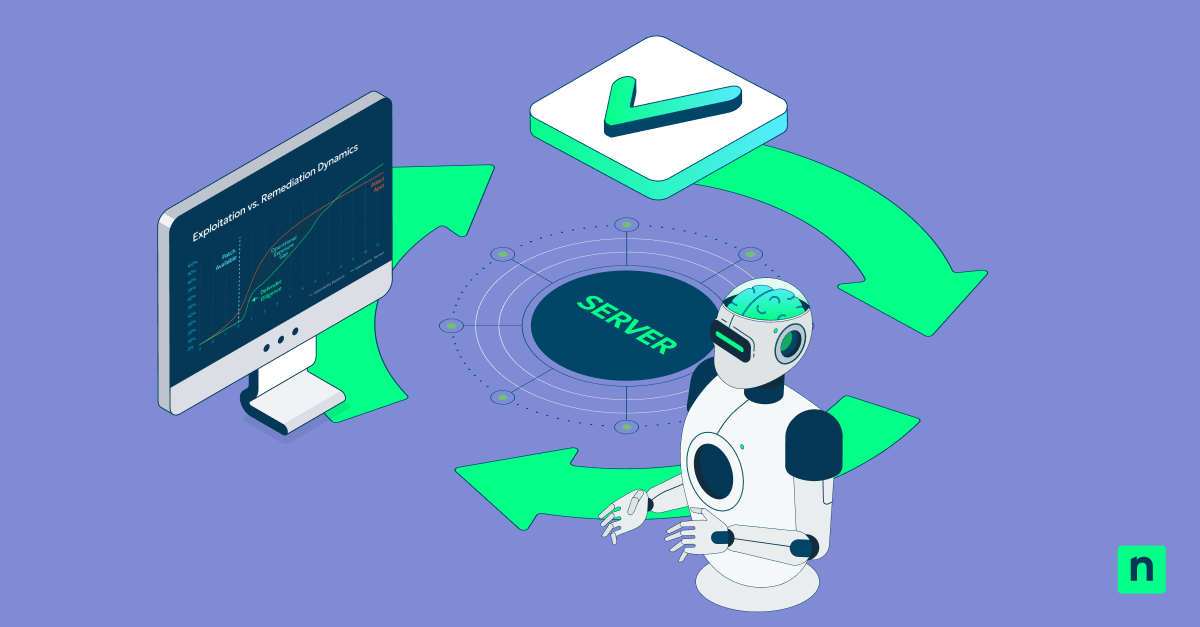
Rather than relying on traditional scanning techniques, NinjaOne Vulnerability Management continuously analyzes software inventory data collected from managed endpoints and correlates that information against the latest vulnerability disclosures. It uses artificial intelligence (AI) to transform raw endpoint telemetry into accurate, real-time vulnerability insight.
AI plays a critical role in three core areas of this process.
- Software identification
- Normalization
- Vulnerability correlation
AI-driven software identification
This first core area addresses one of the most fundamental challenges in : knowing exactly what software is running on each device. Endpoints report software information in many different formats depending on the operating system, installer type, vendor naming conventions, and endpoint configuration. AI analyzes this telemetry to accurately identify software artifacts on devices, including specific products, versions, and operating system dependencies.
For example, when a vulnerability disclosure specifies that a vulnerability affects a specific product and version, such as Firefox 125.3.1 on Windows and macOS, the NinjaOne AI model helps determine whether those exact conditions exist on managed endpoints.
This enables NinjaOne to rapidly identify which devices may be affected without requiring a traditional vulnerability scan.
Software name normalization
Identification alone isn’t enough. Once software is detected, accurate vulnerability management must normalize the inconsistent names under which that software may appear. Software vendors frequently use inconsistent naming conventions across installers, updates, and operating system registry entries, even from one release to the next. A single application may appear on endpoints under dozens or even thousands of variations.
For example, applications such as Adobe Acrobat or Adobe Reader can appear under many different names depending on version, language pack, or installation method.
AI models normalize these naming variations, allowing NinjaOne to recognize that different software identifiers among the same product family. This normalization process ensures vulnerabilities are matched accurately even when software names appear differently across devices.
Intelligent vulnerability correlation enables proactive risk management
Once Windows software is accurately identified and normalized, AI models correlate the discovered software inventory with vulnerability intelligence feeds such as CVE disclosures.
AI assists in mapping vulnerability metadata, including product names, version ranges, operating system dependencies, and affected components, to the normalized software inventory collected from endpoints.
This allows NinjaOne to determine which endpoints are affected by newly disclosed vulnerabilities within minutes of a change in software state or vulnerability intelligence.
Identify, prioritize, and remediate vulnerabilities in real time without slowing your team down.
The result: continuous vulnerability visibility without scanning
By combining software telemetry, AI-driven normalization, and automated CVE correlation, NinjaOne delivers continuous vulnerability visibility without requiring periodic vulnerability scans.
This approach eliminates the performance impact and operational complexity of traditional scanning while providing near real-time insight into software exposure across managed endpoints.
Learn more about NinjaOne Vulnerability Management.