
Key Points
- PSD2 is an EU regulatory framework that governs payment security, open banking access, and consumer protection.
- Strong Customer Authentication requires at least two independent verification factors to protect electronic transactions from unauthorized access.
- Open banking requires banks to share user-approved financial data to licensed third-party payment service providers, making API hardening, consent validation, and access revocation critical controls.
- Vendor assessments, continuous monitoring, and defined incident reporting procedures are essential to managing third-party exposure risk.
- Endpoint and identity controls form the operational backbone of a PSD2-compliant payment infrastructure.
- PSD2 compliance requirements must align with other regulatory frameworks with overlapping provisions.
The Payment Services Directive 2 (PSD2) sets the regulatory rules for how payment services operate across the European Union (EU). For organizations handling financial transactions within the European Economic Area (EEA) or processing one-leg-out transactions, alignment with PSD2 compliance requirements is a must.
If your organization falls under this operational scope, read on, as this guide will explain how you can align IT and security controls with PSD2’s regulatory mandates.
What is PSD2: An overview of its scope and applicability
PSD2, also called the Revised Payment Services Directive, addresses the rapid evolution of digital payment services, including open banking and the growing role of non-bank financial organizations.
PSD2’s architecture focuses on these objectives:
| Objectives | Description |
| Security | Reduce fraud and unauthorized access across the payment chain. |
| Open banking | Foster competition by mandating third-party access to account infrastructure. |
| Transparency | Provide consumers with clearer rights, fee disclosures, and escalation procedures. |
| Payment standardization | Unify the rules for electronic payments across the EU and EEA to streamline cross-border payments. |
While PSD2 focuses on EU-based financial institutions, any organization outside the EU that provides financial services to EU citizens is also subject to its provisions. The directive covers traditional banks or any emerging fintech, specifically:
- Banks, credit institutions, and other entities offering payment accounts or processing electronic transactions.
- Licensed payment institutions that operate payment transactions or offer payment initiation services.
- Electronic Money Institutions (EMIs) that issue digital currency and facilitate fund transfers.
- Third-party payment service providers (TPPs), including Account Information Service Providers and Payment Initiation Service Providers.
- Fintech companies operating in or serving customers within the EU, regardless of where they are based.
Organizations that fall under any of these categories are mandated to align with PSD2 compliance requirements, from implementing Strong Customer Authentication (SCA) controls to maintaining secure open bank APIs.
Aligning your IT infrastructure with PSD2 compliance requirements
Meeting the mandates of PSD2 requires financial institutions to re-examine how their systems authenticate users, govern third-party access, respond to incidents, and protect data transmission paths.
For some organizations, this can mean revisiting existing infrastructure to close gaps and ensure payment-specific obligations are aligned with broader security and compliance architecture.
The sections below will walk you through the key alignment areas where IT and security controls must align with PSD2’s technical expectations.
PSD2 SCA requirements
Today’s digital payment technology makes it easier for consumers to buy products from the comfort of their screens. To protect electronic payment transactions, PSD2 mandates SCA controls that require authentication procedures combining at least two independent factors from the following:
| Factors | Definition | Examples |
| Knowledge | Something the user knows. |
|
| Possession | Something the user possesses. |
|
| Inherence | Physiological characteristics used as biometric identifiers. |
|
Requiring authentication of at least two of the aforementioned factors minimizes unauthorized access, helping reduce fraud risk across digital transactions.
Open banking and API governance
PSD2’s open banking provision allows licensed TPPs, like budgeting apps, payment platforms, or fintech services, to access user-approved financial data. APIs serve as the bridge between bank accounts and third-party applications.
To properly secure APIs, financial organizations must:
- Enforce encryption standards, certificate validation, and access controls at every API endpoint.
- Maintain oversight into connected TPPs, including what data they are accessing and when access was made.
- Strictly bound API access by the scope of customer-approved access.
- Build the capability to terminate TPP access in near-real time when consent is withdrawn.
- Implement mutual TLS handshake and eIDAS-compliant certificates for all open banking communications.
Ensuring proper API hardening ensures open banking procedures are secured against unauthorized access, misuse, and abuse by both external and non-compliant actors.
Managing third-party risk exposure
Open banking expands an IT infrastructure’s attack surface, as every TPP connection represents a potential entry point, and exposure of third-party connections can impact an organization’s risk profile.
Minimizing third-party risk under PSD2 should cover:
- Vendor risk assessment: Careful evaluation of the security and compliance posture of a TPP before granting access.
- Secure API authentication controls: Enforce strong identity verification for every third-party connection.
- Visibility on third-party connections: Continuous monitoring helps with real-time detection of suspicious access patterns, data exfiltration attempts, and policy violations.
- Incident reporting procedures: Define clear alerting paths to quickly notify regulators and affected parties when TPP-related incidents occur.
Monitoring these areas reduces environment-wide risk and positions IT infrastructures to demonstrate compliance during regulatory audits.
Aligning endpoint and identity controls with PSD2 regulation
PSD2 requires financial organizations to implement rigorous identification to establish trust for both users and TPPs. That said, it’s crucial for technicians to ensure compliance with PSD2’s endpoint and identity-mandated controls, including:
- Device trust validation: Evaluates device integrity at the point of authentication, particularly for mobile-based possession factors.
- Secure endpoint authentication: Ensures that only trusted devices can initiate or authorize payment transactions.
- Session monitoring: Monitor active sessions to spot suspicious behavior that can indicate a compromised account or hijacked sessions.
- Access logging and retention policies: Maintain auditable records of authentication events and transaction authorization in line with PSD2 retention requirements.
- Fraud detection systems: Integrating real-time behavioral analytics and transaction risk analysis (TRA) engines into the payment chain to support security and SCA controls.
Strong payment security controls should establish trust with end users and the device they’re using. Weak controls at this level can undermine robust SCA, API, and TPP management strategies.
Integrating PSD2 within a broad regulatory landscape
Financial institutions operating in the EU must not only comply with PSD2 compliance requirements, but also with applicable, broader regulatory frameworks. A unified compliance approach ensures that PSD2 alignment doesn’t cause breaches on other tangential frameworks.
For example, PSD2 allows the sharing of user-approved financial data, but these data-sharing procedures must still meet GDPR compliance requirements for consent, data minimization, and breach reporting.
Intersecting compliance requirements should be documented explicitly to prevent duplicated controls, streamline audits, and shrink governance gaps.
Align with PSD2 compliance requirements to secure transactions
PSD2 compliance requires financial institutions and PSPs to strengthen authentication, secure open banking APIs, and manage third-party risk. Meeting these requirements means bringing identity architecture, endpoint security, and API governance in line with payment-specific PSD2 mandates.
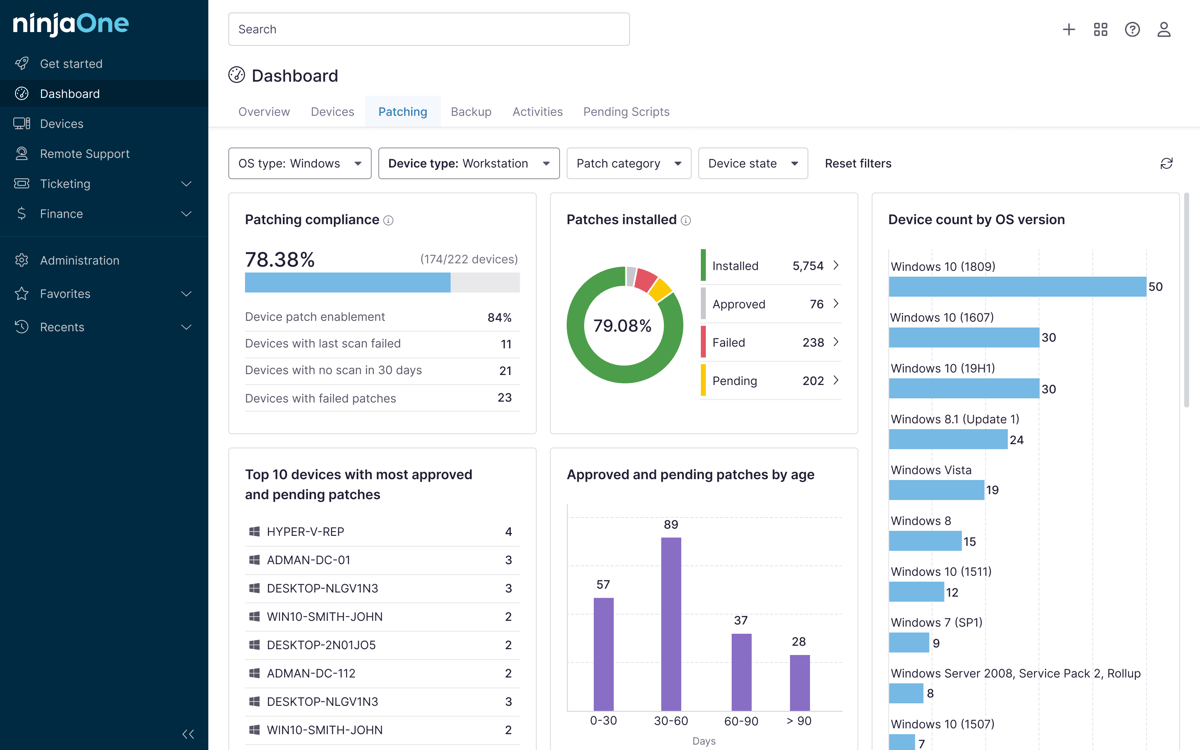
NinjaOne helps clients meet PSD2 compliance by providing a unified platform that automates endpoint management, security patching, and compliance monitoring. This helps ensure strong customer authentication and data protection while leaving detailed audit trails to support regulatory defensibility.
Related topics: