

Key Points
- DORA vs GDPR: DORA focuses on cybersecurity and ICT resilience for EU financial institutions, while GDPR governs data privacy and personal data protection worldwide.
- Scope & Entities: DORA applies to banks, insurers, and ICT providers in the EU; GDPR applies globally to any organization processing EU citizens’ data.
- Compliance & Enforcement: DORA (mandatory since Jan 2025) is enforced by financial regulators (EBA, ESMA, EIOPA); GDPR is enforced by data protection authorities (EDPB and national DPAs).
- Similarities & Overlap: Both require risk management, incident reporting, and strict compliance; financial institutions must integrate DORA’s cybersecurity with GDPR’s privacy standards.
- Business Impact: Non-compliance risks fines, reputational damage, and lost trust, while compliance builds resilience, security, and consumer confidence.
The Digital Operational Resilience Act (DORA) is a newly enforced EU regulation aimed at enhancing the digital resilience of financial institutions and their third-party service providers. Meanwhile, the General Data Protection Regulation (GDPR) governs how organizations collect, store, process, and the individual’s personal data within the EU.
Both regulations aim to strengthen security and protect organizations and individuals in the digital space. Understanding the differences and similarities between DORA and GDPR is crucial for institutions operating in the EU, especially as digital reliance grows, increasing the risk of cyber threats.
This guide will explore DORA vs. GDPR, covering their definitions, purposes, key differences, similarities, and business implications.
Stay compliant and audit-ready for EU regulatory standards.
➝ Review this DORA checklist or this GDPR checklist.
What is DORA?
The Digital Operational Resilience Act (DORA) is an EU cybersecurity regulation designed to strengthen the operational resilience of financial institutions (such as banks, investment firms, and insurance companies) and their third-party service providers (including data reporting and cloud service providers).
It recognizes the financial sector’s growing reliance on digital technology and the increasing security risks that come with it. DORA provides a standardized approach that covers five key pillars to ensure consistent ICT resilience practices across the industry:
- ICT risk management – To understand ICT risks and establish robust management strategies or frameworks to mitigate cyber risks and ensure business continuity.
- ICT-related incident reporting – Obligations to report ICT incidents to regulators within a defined timeframe.
- Digital operational resilience testing – Regular testing of IT systems to assess resilience and identify vulnerabilities, including penetration testing, red teaming, and other security evaluations.
- ICT third-party risk management – Vigilant oversight of third-party service providers, including clear contract terms on risk management and security standards.
- Information and intelligence sharing – Sharing of cybersecurity threat intelligence to enhance collective resilience across the industry.
DORA compliance requirements and deadlines
Since DORA is a mandatory regulation for all financial institutions and their third-party service providers in the EU, non-compliance can result in fines and reputational damage. As DORA was fully implemented on January 17, 2025, organizations must now adhere to its standards. Here are the key compliance requirements and deadlines to keep in mind:
- ICT risk management
- Third-party oversight
- Incident reporting
- Governance
- System documentation
- Contracts with providers
- Concentration risks
- Monitoring
- Employee training
- Continuous improvement
Financial institutions must submit their Register of Information by April 30, 2025, including documentation of ICT providers, critical functions, and subcontracting arrangements. Moving forward, quarterly and annual reporting on ongoing ICT incidents, resilience metrics, and testing evaluations throughout the year will be required.
What is GDPR?
The General Data Protection Regulation (GDPR) is an EU law that governs the collection, processing, and protection of personal data for all individuals under the European Union. It is widely regarded as the world’s strictest privacy and security law, imposing obligations on any company worldwide that processes the personal data of EU citizens, regardless of their location. This regulation grants EU citizens greater control over their personal data and how organizations use it.
Let’s take a look at GDPR’s seven core principles:
- Lawfulness, fairness, and transparency – Collection and processing of personal data must be done lawfully, fairly, and openly to the data subject.
- Purpose limitation – Data collection must be conducted only for specified, legitimate purposes, which must be clearly communicated to the data subject upon collection.
- Data minimization – Only the minimum necessary data should be collected to fulfill the specified purposes.
- Accuracy – Data must be kept accurate and up-to-date.
- Storage limitation – Data should only be stored if necessary, and organizations must delete it once it is no longer needed.
- Integrity and confidentiality – Organizations must process data securely, ensuring its integrity and confidentiality while protecting it from breaches and unauthorized access.
- Accountability – Organizations must demonstrate GDPR compliance by adhering to these principles.
GDPR compliance requirements and penalties
GDPR compliance extends beyond simply meeting listed requirements, it involves demonstrating the policies and procedures organizations have in place to uphold their core principles. Here’s a detailed breakdown of GDPR compliance requirements:
- Lawful basis and transparency – Organizations must keep an updated record of data processing activities, access details, and protection measures, including retention policies. For high-risk processing, GDPR requires a Data Protection Impact Assessment (DPIA), ideally conducted during project planning. While not always mandatory, it demonstrates GDPR compliance. If a Data Protection Officer (DPO) is employed, they must be consulted to ensure legal compliance.
- Data security – Organizations must implement technical and organizational measures to protect data, such as encryption and anonymization. They must also train staff on data handling procedures and keep training records. Organizations must also have a clear protocol for responding to data breaches that expose personal data and must report breaches within 72 hours.
- Accountability and governance – Organizations must appoint a GDPR compliance lead responsible for overseeing implementation and serving as the main point of contact. This person should be an expert in GDPR, data protection laws, and their enforcement. A Data Protection Officer (DPO) is generally recommended for this role.
- Privacy rights – Organizations must ensure that data subjects understand their rights regarding data privacy. This includes requesting copies of their personal data and invoking their ‘right to be forgotten,’ which allows them to request permanent data deletion. Organizations must ensure that these requests are acted upon and must be transparent about these processes.
- Concept of consent – Organizations must implement a consent system that allows data subjects to explicitly agree before data is collected. Pre-selected opt-in boxes are not allowed. Consent options must be provided separately from the terms and conditions and in different ways. Moreover, organizations must maintain records of obtained consent.
It is important to remember that non-compliance with GDPR can lead to severe financial penalties of up to €20 million or 4% of annual global revenue (whichever is higher).
ALSO READ: Why NinjaOne Protects Customer Privacy To Be GDPR Compliant
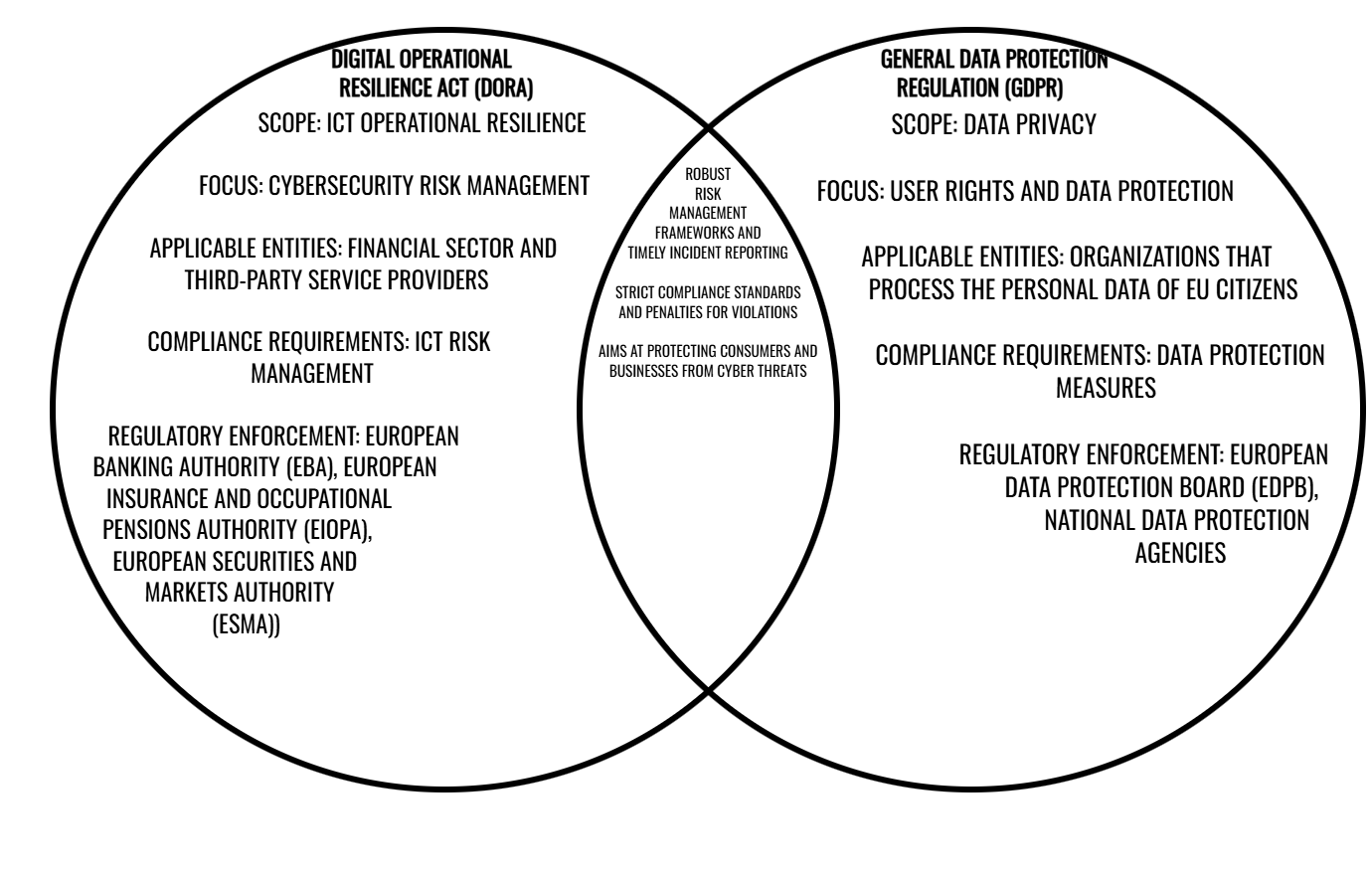
DORA vs. GDPR: Key differences
DORA and GDPR share a common goal of ensuring data security and protection for data subjects. However, they have distinct perspectives that are crucial to understand. Here are the key differences between DORA and GDPR:
Scope
DORA concentrates on ICT operational resilience, providing a framework for financial institutions and providers to mitigate cybersecurity risks. GDPR emphasizes data privacy, regulating the handling of personal data within the EU.
Focus
DORA’s primary focus is on cybersecurity risk management, while GDPR prioritizes user rights and data protection.
Applicable Entities
DORA applies to financial entities like banks and insurance companies, as well as their third-party service providers within the EU. GDPR applies to any organization globally that processes the personal data of EU citizens.
Compliance Requirements
DORA compliance emphasizes ICT risk management, including incident reporting and third-party security standards. GDPR compliance encompasses broader data protection measures, including data access, security protocols, and breach notifications.
Regulatory Enforcement
DORA is enforced by financial regulatory authorities like include the European Banking Authority (EBA), the European Insurance and Occupational Pensions Authority (EIOPA), the European Securities and Markets Authority (ESMA), and national financial regulators.
GDPR is overseen by data protection authorities across the EU, such as the European Data Protection Board (EDPB), national data protection agencies in each EU member state, and supervisory authorities.
See the differences in the DORA vs GDPR: Key Differences Explained video.
Similarities between DORA and GDPR
While DORA and GDPR come from different perspectives, they share aspects that make them complementary to one another. Some of the major similarities between DORA and GDPR include:
Risk management and incident reporting
Both regulations require robust risk management frameworks and timely incident reporting to enhance digital safety.
Strict compliance requirements and penalties
Both enforce strict compliance standards and impose significant penalties for violations, including fines and reputational damage.
Protect consumers and businesses from cyber threats
Ultimately, both regulations aim to protect consumers and businesses from cyber threats, providing guidelines for secure digital operations.
Implications for businesses
DORA and GDPR are complex regulations that have a significant impact on businesses. Non-compliance can lead to severe penalties, damaging a company’s reputation, integrity, and reliability. However, compliance helps create a secure environment for institutions, their staff, and consumers, ensuring trust and resilience.
How to prepare for DORA and GDPR compliance
Organizations must understand the core principles of both regulations and develop comprehensive frameworks to uphold them to the highest standards.
For DORA, financial institutions must establish ICT risk management frameworks, resilience testing, and incident response plans, as well as ensure that third-party providers comply with DORA’s security requirements.
For GDPR, organizations must implement data protection plans, consent management, and data processing policies, as well as enforce strong encryption and access controls to safeguard personal data.
Overlapping compliance requirements for DORA and GDPR
Since both regulations share a common objective, there are overlapping requirements that can benefit institutions required to comply with both. DORA and GDPR are stringent in incident reporting, risk assessments, and continuous monitoring. Organizations must align their security, compliance, and privacy policies to ensure a unified approach to data protection and cybersecurity.
Moreover, financial institutions covered under DORA are also subject to GDPR. Those handling both financial and personal data must integrate DORA’s cybersecurity measures alongside GDPR’s data protection principles.
The role of IT security, legal teams, and compliance officers in ensuring adherence
IT security teams are responsible for monitoring, preventing, and responding to cyber threats, as well as implementing data security measures to maintain a secure digital environment. They work closely with legal and compliance teams, who ensure that organizations meet all regulatory requirements under DORA and GDPR are fully met.
Ensure compliance with DORA and GDPR by getting full control of your IT operations.
Digital Operational Resilience Act vs. General Data Protection Regulation: Wrapping Up
The European Union’s commitment to cybersecurity is embodied in DORA and GDPR, which aim to secure the digital financial sector. DORA enhances operational resilience, while GDPR protects individuals’ data rights.
Businesses navigating both regulations should adopt an integrated compliance approach, promoting collaboration between IT security, legal, and compliance teams.
For further details, refer to the resources below.