
Key Points
- Determine whether you fall within the assessment boundary as an External Service Providers that handle CUI.
- Map every managed service to the 110 NIST SP 800-171 controls, establish a Shared Responsibility Matrix with the client, and flag compliance gaps in a POA&M.
- Maintain a complete System Security Plan and structured compliance reports tied to specific NIST controls to give assessors the documentation they need.
- Continuously track configuration drift, patch gaps, and privilege changes in real time to demonstrate that controls are enforced, not just implemented.
- Prepare client personnel for assessor interviews and produce audit evidence on demand within 180 days to convert Conditional status to Final CMMC Level 2 certification.
Cybersecurity Maturity Model Certification (CMMC) 2.0 is a federal framework that verifies the cybersecurity of defense contractors that handle controlled unclassified information (CUI). And in these probes, MSP support for CMMC audits becomes more hands-on.
Streamline client federal audits in advance with enhanced visibility. This CMMC Level 2 guide provides a strategic checklist to achieve certification while reducing risk.
What MSPs need to do during CMMC level 2 audits
Define MSP scope within the audit boundary
First and foremost, determine if your MSP is within the scope of the Level 2 audit. According to the Department of Defense, any External Service Provider (ESP) that affects the confidentiality of Controlled Unclassified Information is held to the same compliance standard as the prime contractor.
CUI includes:
- Personally Identifiable Information (PII)
- Proprietary business information (CBI)
- Export-controlled technical data (ITAR/EAR)
- Critical infrastructure security data
If your team manages email servers, cloud storage, and endpoint tools that involve CUI, your services fall within MSP support for CMMC audits. So before an assessment starts, create a shared responsibility matrix with your client to know what the MSP owns, what the client owns, and what is shared.
💡 Important: MSPs that process, transfer, and store CUI are required to achieve their own CMMC Level 2 or Level 3 certification. Non-CUI handling MSPs are exempt from this.
Align MSP services to CMMC Level 2 requirements
CMMC Level 2 implements all 110 practices within NIST SP 800-171 to protect CUI. If your MSP falls within the audit’s scope, you’ll need to align your security controls with NIST’s specific requirements. Examples include:
- Privileged access management
- Regular access reviews
- Strong tenant separation
- Comprehensive logging of CUI-related incidents
- Security configuration enforcement
Conduct a control-to-service mapping exercise that identifies each MSP tool or process that satisfies each of NIST 800-171’s domains. If gaps exist, flag them before your assessment begins instead of during.
Build and maintain audit-ready documentation
As digital landscapes evolve, audit-readiness becomes a prerequisite. In a recent report from Greenberg Traurig LLP., third-party assessors estimate that 25% of certification applicants failed in the pre-assessment stage, and that most of them had incomplete or misaligned documentation.
To be audit-ready:
- Maintain a living System Security Plan (SSP) that lists baseline configurations, endpoints, personnel changes, and more.
- Track unresolved gaps with a Plan of Action and Milestones (POA&M).
- Reach an 80% threshold on your Supplier Performance Risk System (SPRS) score.
Establish compliance reporting for MSPs
Assessors will always prioritize evidence over verbal assurances. Besides matching CMMC standards, MSPs must also provide repeatable, structured proof that those controls have been applied consistently over time.
These can cover patch and vulnerability reporting, configuration compliance, privilege activity, and incident logs—all of which demonstrate capable IT management before and during the CMMC Level 2 audit.
Standardize reporting templates across CUI clients, and attach specific NIST 800-171 controls in each report (for example, a patch report directly maps to control 3.14.1) to prevent back-and-forth. This streamlines the audit process for both you and the assessor.
🥷🏻| Help achieve 100% Level 2 requirements with automated reporting.
Learn how NinjaOne can help you achieve CMMC readiness.
Maintain continuous compliance monitoring
MSP support for CMMC audits should demonstrate ongoing security commitments via monitoring tools, real-time alerts, and scheduled remediations. Documented, rehearsed practices are vital. Management tools that prioritize continuous monitoring help achieve this consistency.
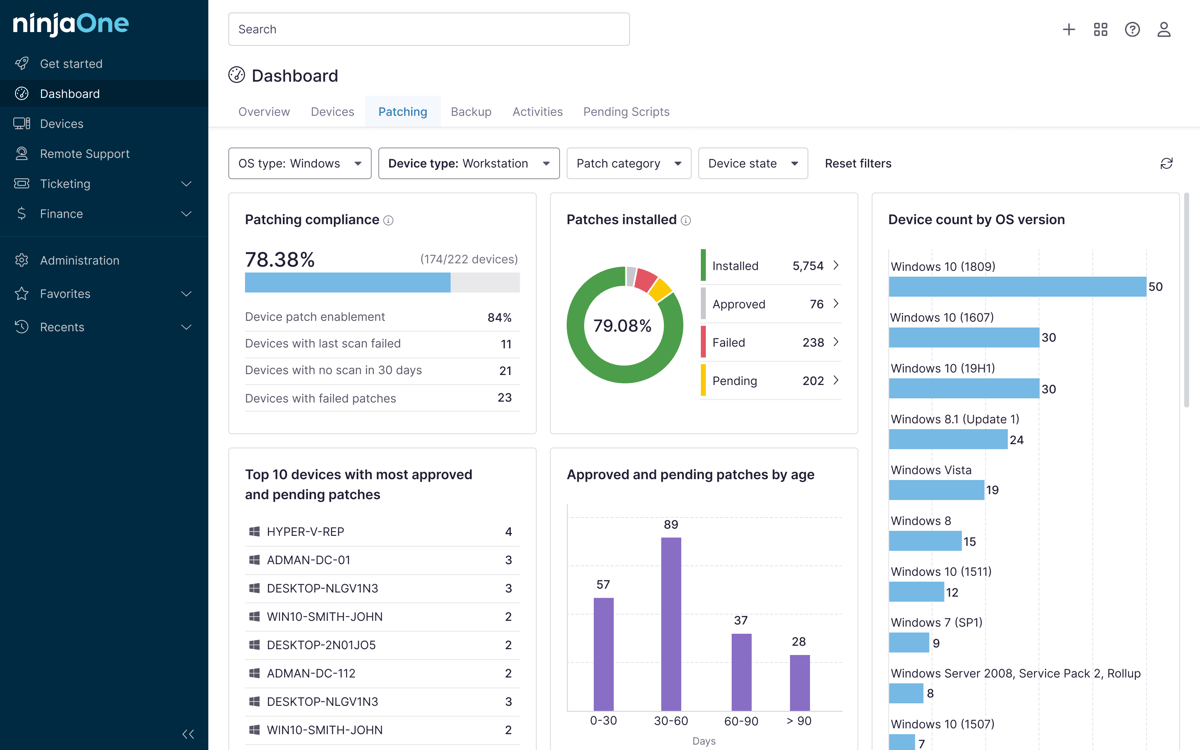
Implement an ongoing compliance dashboard per client environment to track the real-time status of important security controls. At the very least, this should flag configuration drift, failed authentication events, patch compliance gaps, and user privilege changes, giving your MSP a live view of your compliance posture.
Collect and present audit evidence
The formal audit involves assessors conducting interviews, reviewing security artifacts, and performing technical validation to determine control status. Once logs, configuration files, training records, and other files are collected, they’re submitted to a CMMC Third-Party Assessment Organization (C3PAO) for review.
Your documentation must prove three things: that controls are implemented, operational, and consistently enforced. The C3PAO team checks each of the 110 NIST controls to see which ones you’ve met. And if your client meets at least 88/110, they achieve Conditional CMMC Status.
Before your assessment, build an evidence library sorted by NIST 800-171 control family to streamline compliance needs. For each control, attach:
- An output or screenshot proving implementation
- A log showing that the control is active
- A reference to the policy document governing it
Support clients throughout the audit process
MSPs play a critical role in helping clients meet CMMC requirements. Gap analysis, remediation, documentation, evidence collection, SSP development, and ongoing monitoring are all essential for effective controls between assessments.
MSP support for CMMC audits also prepares you for assessor interviews, which might involve speaking directly with external contractors. If the MSP seems unfamiliar with CMMC practices, it may reflect poorly on your client.
Post assessment, your MSP should also help clients during the 180-day grace period to close gaps in the current infrastructure, facilitating the transition from Conditional status to Final certification.
To achieve this, create a pre-assessment readiness checklist for each client that covers:
- Accomplished SSP and POA&M
- Evidence library mapped to each control family
- Briefed personnel during assessor interviews
- A confirmed shared-responsibility matrix
- Documented incident response plan
MSP support for CMMC audits is direct, not advisory
MSPs take a more hands-on role during CMMC Level 2 audits. Before your client’s next assessment, make sure you’ve mapped out a shared responsibility matrix. From there, use centralized tools to monitor and record your compliance posture, following NIST SP 800-171 to streamline the process.
Related topics: