
Key Points
- Begin by establishing a performance baseline and defining clear Service Level Objectives (SLOs) to measure against.
- Instrument endpoints to identify which specific devices and applications are consuming the most bandwidth.
- Monitor network devices to validate the health of the infrastructure and pinpoint physical bottlenecks.
- Deploy flow analysis to map network conversations and attribute usage to users, apps, and destinations.
- Implement policy-based controls like QoS and scheduled updates to protect critical business traffic.
- Sustain improvements with automated alerting, documented evidence, and regular performance scorecards.
When video calls stutter and cloud apps slow to a crawl, everyone feels the pain, but the cause could be a single device, a congested router, or recreational streaming.
This guide will walk you through a proven three-layer method to holistically monitor network bandwidth, pinpoint the true source of issues, and implement controls that deliver lasting performance.
A Framework for Controlling Network Bandwidth Across Your Entire Fleet
Effectively managing your network requires a proactive strategy that combines visibility, analysis, and control. This structured framework gives you a repeatable process to move from reactive firefighting to predictable performance.
📌Use case: Use this framework when facing chronic slowdowns, justifying bandwidth upgrades, enforcing usage policies, planning cloud migrations, or investigating security incidents. If you’re constantly troubleshooting network issues, it’s time for this approach.
📌Prerequisites: Before you start, ensure you have done the following:
- Establish clear SLOs for metrics like utilization, latency, and packet loss.
- Secure access to three data sources:
- Capture a baseline of normal traffic before making changes.
When you’re ready, follow the steps below to start building your framework.
Step 1: Establish your performance baseline and SLOs
Define “good performance” with data before implementing any controls. The goal is to create measurable performance targets and a clean pre-change dataset.
Actions:
- Set SLOs: Establish per-site Service Level Objectives (SLOs) for critical metrics like utilization (e.g., keep core links below 70%), latency, jitter, and packet loss. This sets a measurable target for your network control efforts.
- Capture baseline: Allow 7 to 14 days for your monitoring tools to collect data with no intentional network changes. This captures a full business cycle, including weekends and peak times.
- Analyze trends: Note the peak and 95th percentile usage values from this period. These numbers help you set realistic, intelligent alert thresholds that ignore normal bursts of activity.
With this foundation, you can now precisely measure the effectiveness of the bandwidth control policies applied in the next steps. This provides a factual baseline and clear SLOs to measure all future changes against.
Step 2: Utilize your endpoints for visibility
To effectively control bandwidth, you must first see what each device and application is actually using. The goal is to identify which endpoints and applications are consuming the most resources.
Actions:
- Collect device data: Use tools to gather per-adapter throughput, Wi-Fi signal strength, and per-application bandwidth usage on Windows devices.
- Identify background services: Pinpoint traffic from Windows Delivery Optimization, update services, backup clients, and cloud sync tools that often run unnoticed.
- Flag high-usage devices: Create alerts for endpoints that consistently exceed your thresholds or experience performance degradation during peak hours.
The outcome should provide a ranked list of the “loudest” endpoints and applications, providing you with clear targets for your bandwidth control efforts. With this, you can now correlate data with the network-level view from Step 1, creating a complete picture that informs precise policy decisions in the next steps.
Step 3: Instrument your network devices
Your network hardware provides the ground truth about traffic flow and health. This step can help validate the health of network paths and identify physical bottlenecks.
Actions:
- Poll critical interfaces: Monitor WAN and core switch links for utilization, errors, and packet drops.
- Check device health: Track CPU and memory on routers and firewalls to spot devices failing under load.
- Identify chronic issues: Flag interfaces with persistent congestion or physical errors for immediate remediation.
This step should provide a clear map of physical and logical bottlenecks that explains the symptoms observed from your endpoints. It will give you a complete picture of your traffic flow, enabling you to move from observation to implementing precise bandwidth control policies in the final step.
Step 4: Map network conversations with flow analysis
Flow data connects your endpoint and network views to show complete traffic conversations. This will help you attribute bandwidth consumption to specific users, applications, and destinations.
Actions:
- Enable flow export: Configure NetFlow, IPFIX, or sFlow on firewalls and core switches.
- Analyze traffic patterns: Identify top talkers, business applications, and recreational usage.
- Correlate with baseline: Capture flow data during your established baseline window for accurate trend analysis.
This provides clear attribution of bandwidth usage, answering exactly “what is NetFlow and how does it work” in practice, by revealing the who, what, and where of network traffic.
With full visibility across all three planes (Steps 2 to 4), you now have the evidence needed to implement targeted policies that control recreational usage and prioritize business-critical applications, achieving measurable bandwidth control.
Step 5: Implement control with policy guardrails
Now, use your collected intelligence to enforce policies that protect critical business functions. These guardrails should reduce bandwidth impact without breaking essential applications.
Actions:
- Manage endpoints: On Windows, set connections as “metered” to limit background data, configure delivery optimization, and schedule update windows.
- Configure network QoS: On routers and firewalls, implement Quality of Service (QoS) to prioritize VoIP and key apps, and rate-limit recreational traffic.
- Control cloud services: Apply policy settings in SaaS admin consoles to schedule large file transfers and backups for off-peak hours.
This will provide predictable bandwidth consumption where priority traffic is consistently protected, achieving true network control. You can now return to your monitoring dashboards to verify that utilization stays within SLOs and priority applications perform as required.
Final step: Alerting, evidence, and performance scorecards
Sustaining network improvements requires converting data into actionable business intelligence. This maintains gains and demonstrates continuous value to stakeholders.
Actions:
- Set smart alerts: Configure your network bandwidth monitor to trigger on SLO breaches, abnormal traffic growth, and persistent top talkers.
- Document evidence: Attach before-and-after bandwidth graphs to every remediation ticket for clear impact analysis.
- Publish regular scorecards: Deliver monthly performance reports to leadership showing trends, SLO compliance, and recommended next actions.
This provides operational visibility that proves ROI, justifies investments, and creates a culture of continuous improvement.
This makes your bandwidth management become a documented, repeatable process that consistently proves its value, making it easier to secure approval for future improvements and maintain optimal network performance long-term.
Quick-Start Guide
NinjaOne includes robust network monitoring capabilities that allow you to monitor and control bandwidth across endpoints, routers, and NetFlow data.
Key features include:
- Native SNMP Monitoring: Monitors SNMP-capable devices (routers, switches, printers, etc.) for performance metrics like CPU, memory, and network traffic.
- NetFlow Support: Collects traffic data from devices that support NetFlow, jFlow, or sFlow for detailed bandwidth analysis and troubleshooting.
- Device Discovery Wizard: Automatically discovers network devices on your infrastructure for easy setup.
- Syslog Integration: Centralizes log data from network devices for monitoring and alerting.
- Real-Time Alerts and Reporting: Provides real-time alerts for bandwidth anomalies and generates reports for trend analysis.
Streamlining bandwidth management with NinjaOne
NinjaOne integrates bandwidth monitoring and control into a single, automated platform that simplifies management for MSPs.
- Discovery and tagging: The platform automatically discovers and groups endpoints by site and device role. NinjaOne enables you to apply consistent monitoring and control policies across logical device groups, ensuring proper coverage across your entire fleet.
- Comprehensive monitoring: NinjaOne collects essential data from all three monitoring planes (Steps 2 to 4). This gives you complete visibility into bandwidth usage across your infrastructure.
- Automated control: Through automated policies, you can enforce update windows, configure Delivery Optimization settings, and schedule bandwidth-intensive tasks during off-peak hours. This ensures critical business operations aren’t impacted by background activities.
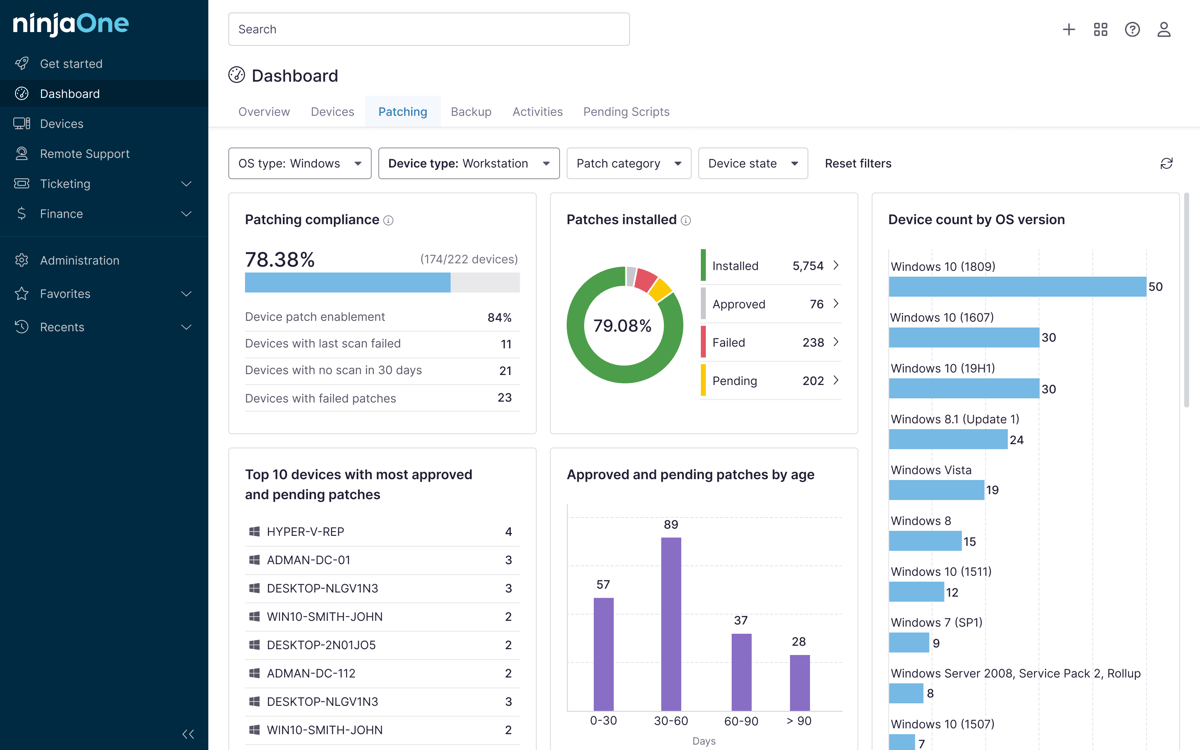
- Unified reporting: The platform generates tenant-level bandwidth scorecards and provides dashboard visibility into network performance. You can easily attach performance evidence to tickets and prepare client reports, streamlining your QBR process.
By implementing NinjaOne, you create a streamlined bandwidth management system that maintains network performance, reduces manual effort, and demonstrates clear value to clients through measurable results.
Make bandwidth governance effortless for every tenant. Monitor, control, and report from one console.
→ See how NinjaOne groups endpoints and applies consistent bandwidth policies automatically
Achieve ideal performance with network bandwidth monitoring
Effective bandwidth management requires a strategic approach that combines endpoint, network, and flow visibility with policy-based controls.
By establishing SLOs, implementing intelligent monitoring across all three planes, and enforcing automated guardrails, you transform network performance from a constant worry into a measured outcome.
This framework ensures critical applications remain seamless while providing the concrete evidence needed to justify investments and drive continuous improvement.
Related topics