Key Points
- Unmanaged AI Use Creates Risk: Without clear rules, teams may expose sensitive data, rely on incorrect output, or lose accountability for decisions.
- AI Should Support Work, Not Replace Judgment: AI can help draft content and suggest ideas, but final decisions and approvals must stay with people.
- Clear Boundaries Required Before Broad Adoption: MSPs must define what tasks AI can assist with, what data can be shared, and when to disallow AI use.
- AI Must Follow Existing Workflows and Controls: It should not bypass escalation paths, documentation standards, or compliance requirements.
- Governance Makes AI Adoption Sustainable: Assigning ownership, training staff, and reviewing usage regularly keeps AI use consistent and controlled.
Artificial Intelligence (AI) tool usage is rising across industries, and MSPs are no exception. From drafting emails to automating repetitive tasks, AI has become a fixture in every workflow. However, in many cases, these tools are adopted informally without strict guidelines and policies, defined ownership, or review. In turn, this leads to data breaches, creates inconsistent results, and weakens operational oversight.
This guide explains how AI adoption for MSPs can be performed in a disciplined, compliant, and controlled way, helping teams integrate AI seamlessly and risk-free into their operations.
How MSPs can use AI and integrate it into their workflows without operational and security risks
Although AI can support MSP operations, it can only do so when it is introduced with clear rules and oversight.
Why unmanaged AI adoption is risky
Utilizing AI without rules and human oversight can lead to problems, especially if there is a lack of operational discipline around it.
Unstructured AI adoption often leads to:
- Inconsistent outputs across teams, where different people get different answers for the same prompt or question.
- Unclear responsibility for AI-driven decisions, which leaves no one accountable when something goes wrong.
- Accidental exposure of sensitive information, because AI tools may pull data from prompts and uploaded files without proper access controls.
- Overreliance on unverified results, where teams trust AI output, which are sometimes hallucinations, without checking.
- Difficulty explaining decisions to clients or auditors, because AI does not document how it reached its answers or conclusions,
It’s important to note that AI cannot replace the human factor. It is not perfect; it can still make mistakes, produce outputs that are incorrect or misleading, and require reviews by experienced people.
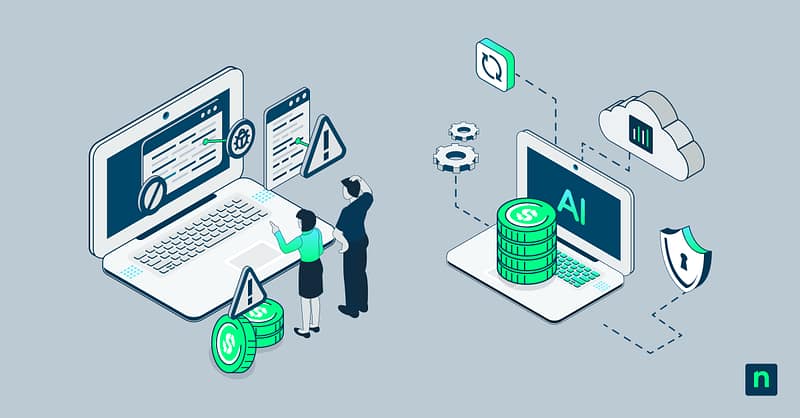
For example, in coding and development work, research has shown that AI-generated code can contain more bugs and errors than human-written code. This led to companies that laid off staff in favor of AI, to rehire staff and hire human experts to fix mistakes of AI-generated work, adding time and cost rather than reducing it.
AI itself isn’t risky, but if it operates without clear policies, human oversight, and accountability, the work required to correct them can outweigh the initial benefits.
AI as a decision support tool, not a decision maker
AI can help MSP teams move quickly, but it should never replace human judgment and expertise. It works well when it supports people, not when it acts on its own.
AI should be treated as:
- An assistant that accelerates work
- AI can help in drafting documentation, summarizing logs, suggesting troubleshooting steps, or reviewing written content. It can act as a second pair of eyes or help generate ideas, but it should never be the one that makes decisions.
- A tool that suggests, not decides, especially when teams are stuck or exploring options
- AI can propose solutions or outline the next steps to help teams move forward, but a human should select what is appropriate based on context and experience.
- A system that requires validation, meaning every output should be reviewed for accuracy, relevance, and completeness
- AI can produce incorrect, incomplete, or misleading information, given that AI can hallucinate.
Final accountability for actions and recommendations must remain with human operators. In a nutshell, AI should not do an MSP team’s job, but it should help them accomplish their tasks.
MSP AI governance: Establishing clear usage boundaries
AI can support workflows and daily tasks, but it should not perform them on its own. MSPs need clear rules about where AI fits into operations and where human control must remain.
Safe AI adoption requires clear boundaries, such as:
Which tasks could AI support?
Examples include drafting internal documentation, suggesting troubleshooting steps, and generating report outlines. However, AI should not be allowed to determine final configuration and security changes, and communicate client decisions without review.
What data may be shared with AI systems?
These could include limits on client information, credentials, system logs, or personal data. Teams should define what is acceptable to paste into an AI tool and what must never leave internal systems.
How are outputs reviewed and approved?
These could require technician or manager expertise to verify AI-generated content before being sent to a client or used in a change request. The review steps should be documented, clear, and consistently enforced.
When is AI use prohibited?
It could be prohibited during active security incidents, handling sensitive client data, or when tasks require direct human oversight.
Overall, documented boundaries will help avoid misuse. MSPs can publish organization-wide or team-level AI guidelines that approve use cases, restrictions, and review steps. Having clear guidelines will help employees understand what is allowed and will reduce the chances of risky and inconsistent AI usage.
Aligning AI with existing operational processes
Aligning AI with existing processes means using it within rules and workflows the MSP already follows. It should integrate with:
Escalation standards
For example, AI can help suggest next steps in a ticket, but not bypass approval levels. AI can help draft a response, but it’s essential for a senior engineer to still review and approve high-impact actions.
Documentation practices
AI can help draft runbooks or summarize case notes, while technicians verify and finalize the content. However, AI-generated notes still need to follow the same format and review process utilized for human-written documentation.
Security and compliance requirements
For this, AI should not be used to process restricted client data unless approved. MSPs should be able to define what types of information can be shared and ensure logs or outputs are stored according to policy.
Client communication workflows
AI may help draft updates or summaries, but final messages to clients must be reviewed for accuracy and tone before being sent.
When AI bypasses established processes, it leads to inconsistency and risk. This can lead to missed approval steps, incorrect information being given to clients, security policy violations, and confusion about who is responsible for making decisions.
Governance considerations for MSPs
AI use should not depend on individual preferences. Governance means setting clear rules, assigning responsibility, and reviewing how AI is actually being used across the organization.
Effective AI governance includes:
- Ownership of AI policies, meaning one team or leader is responsible for defining and updating AI rules. For example, operations or leadership should approve what tools are allowed and what tasks they can support.
- Periodic review of AI usage, such as checking how teams are using AI in tickets, reports, or client communication. If misuse or overreliance appears, you can make adjustments early.
- Training on limitations and risks, so employees can understand that AI can produce incorrect or incomplete results. For example, technicians should know to verify troubleshooting steps prior to client systems.
- Clear guidance for client-facing use, including when AI-generated content must be reviewed before being sent. This prevents inaccurate summaries or poorly phrased updates from reaching clients.
Governance enables AI use to grow in a controlled way. Without it, employees can use AI differently across teams, rely on unverified outputs, or skip review steps. Over time, this leads to uneven quality, inconsistent client communication, and increased operational risk.
How to avoid AI-driven false confidence
AI responses can sound confident and well-written, even if they are not factual and lack substance. That tone can make users trust the output without questioning it. MSPs should consider guarding against:
- Blind trust in generated content, especially since AI systems can hallucinate and produce information that sounds accurate, but isn’t
- Be wary of incorrect troubleshooting steps, outdated best practices, or made-up explanations.
- Skipping verification steps, where employees copy AI-generated content into tickets, reports, or client messages without reviewing it
- AI output should always be checked against known standards, documentation, or real system data before being used.
- Allowing AI to replace professional judgment, like approving changes, recommending configurations, or drafting client-facing advice without review
- Editors, engineers, and reviewers still have to validate and take responsibility for the final result.
Clear review steps, documented standards, and human oversight ensure that AI supports work without lowering quality or increasing risk.
Common misconceptions MSPs have about adopting AI
AI adoption often comes with assumptions that do not hold up in practice. MSPs need to separate marketing claims from what’s happening on the ground.
- AI automatically improves quality: Although AI can generate content quickly, it’s important to note that speed does not equate to accuracy. Without human review, AI-generated work can incorporate mistakes into reports, documentation, and client communication.
- AI reduces responsibility: Even when AI assists with tasks, responsibility does not shift to the tool. If an AI-generated suggestion causes an issue, the MSP remains responsible.
- AI adoption must be fast to stay competitive: Moving quickly without oversight and established policies can cause long-term problems. Uncontrolled AI use can expose sensitive data, lower the quality of work, and lead to inconsistent practices across teams. This is why a controlled rollout with concrete guidelines is recommended.
Keep your MSP AI governance secure, risk-free, and aligned with internal operations
AI can provide real value to MSPs, but only when it is introduced with clear rules and oversight. Without structure, even well-intentioned use can create inconsistency and risk.
MSPs that define governance, set boundaries, and maintain clear accountability before expanding AI use reduce operational risk and protect client trust. Responsible AI adoption is not about moving fast. It is about putting the right controls in place, so AI supports work without weakening standards.
Related topics: