

Key Points
- Strong endpoint security reduces the likelihood of ransomware outbreaks and device failures. It also limits the potential damage they can bring to an enterprise’s operations.
- Effective patch management shrinks exposure windows, which is crucial given that 60% of breaches involve vulnerabilities with available patches.
- Automatic compliance reporting reduces the manual effort needed to collect audit evidence and documentation that frameworks like NIST CSF and ISO 27001 typically require.
- Real-time visibility across the entire device ecosystem allows IT teams to catch issues before they become breaches by giving them a clear picture of device health at any given time.
- Mobile device management (MDM) closes the gaps that mobile and remote devices introduce into an enterprise environment.
- Combining endpoint security with enterprise endpoint management creates a more consistent foundation for reducing risks across the entire organization.
The benefits of endpoint security are often framed in highly technical terms, with most IT teams focusing on how it reduces attack surface and neutralizes advanced threats before they’re executed. While these capabilities are important in strengthening an organization’s security posture, they don’t always resonate with every decision-maker in the boardroom.
Most executives are less concerned about its technical mechanics and more interested in the business outcomes it can deliver. You want to think of goals that don’t just matter to a security team, like less downtime, stronger compliance, and more predictable IT costs.
That disconnect is why some enterprises struggle to justify investing in endpoint security. They want to be able to demonstrate the broader impact on the business of a mobile device management (MDM) tool instead of solely highlighting its technical capabilities.
In this guide, we’ll explore how you can translate the benefits of endpoint security into real, measurable enterprise value that business leaders can actually get behind.
The benefits of endpoint security to enterprise operations
The primary purpose of endpoint security is to protect enterprise endpoints (for example, laptops, desktops, mobile devices, servers, and virtual machines) from threats that may compromise data, disrupt operations, or give attackers access to crucial systems.
But for enterprise teams, the benefits it offers go beyond threat prevention.
Visibility into device health and risk
Unmanaged or unknown endpoints are one of the most common sources of enterprise risk, and the first step to reducing them is maintaining visibility across the entire device ecosystem.
Endpoint security gives IT and security teams a clear picture of which devices are exposed, healthy, or out of compliance before they become a major liability.
Reduced risk from the most common threats
According to the Verizon 2025 Data Breach Investigations Report (DBIR), credential abuse was the most common initial access vector, accounting for 22% of confirmed breaches, followed by vulnerability exploitation at 20% and phishing at 15%.
Endpoint security effectively reduces the chances of success by enforcing controls at the device level, which is where most attacks start in the first place.
Faster identification and remediation
The longer a vulnerable or misconfigured device sits neglected, the bigger the window for attack gets.
Recent studies show that companies take an average of 74 days to patch critical application vulnerabilities and 55 days for network vulnerabilities, creating a systematic exposure window where attackers can operate freely.
Having endpoint security allows teams to spot these devices before the attackers do and get ahead of the issues before they become actual attack vectors.
Stronger policy enforcement
Encryption standards, access controls, and configuration requirements all help keep a business network, but they’ll never be as effective as they can be if they’re not applied consistently.
When you have endpoint security, you can easily enforce these policies across every device within your environment.
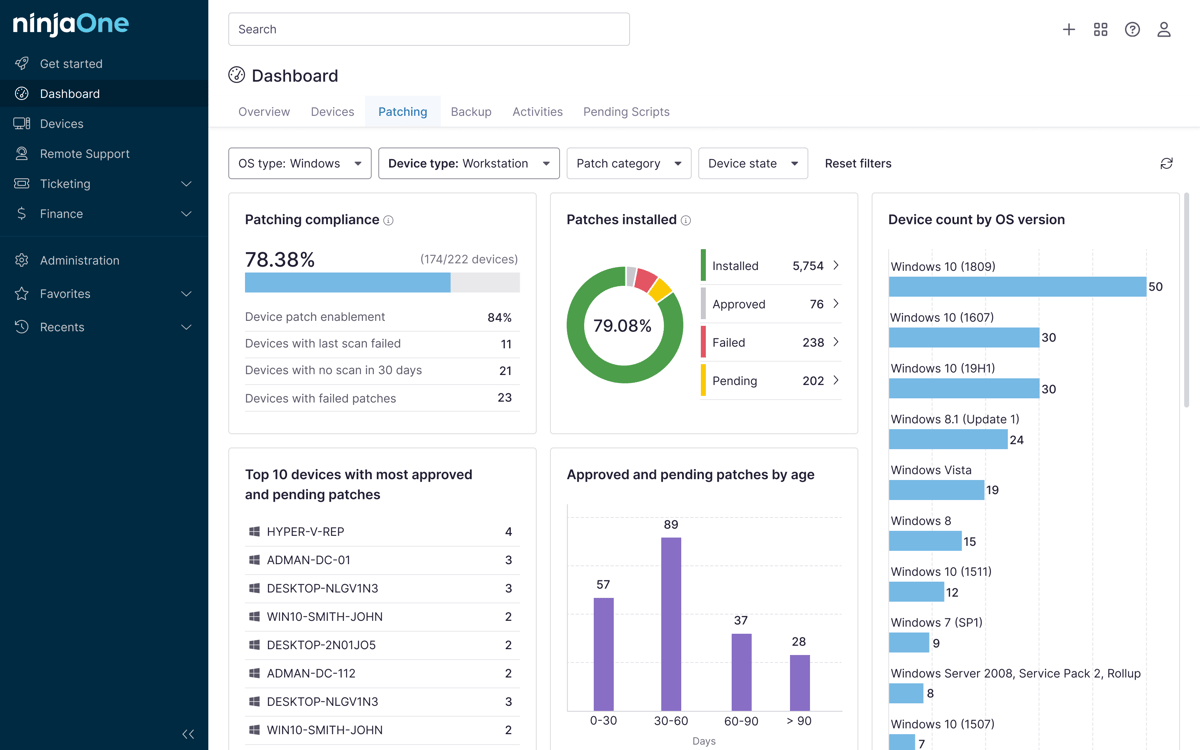
Improved patch and vulnerability management
Unpatched devices remain one of the most reliably exploited attack vectors out there, with 60% of breaches involving known vulnerabilities with readily available patches. In other words, the threats weren’t necessarily new; the patch just wasn’t applied on time.
Endpoint security changes this by helping your team build patching workflows that shrink the exposure window across your entire device fleet.
Reduced business disruptions
Endpoint-related incidents, whether caused by a ransomware outbreak or a wave of device failures, are expensive. The good news is that having strong endpoint security can reduce the likelihood of these incidents and their potential damage to your operations and finances.
Better compliance reporting and readiness
Most regulatory frameworks, like the NIST Cybersecurity Framework (CSF) and ISO 27001, require documented evidence of endpoint controls. With endpoint security, you can easily produce the audit trails and policy records that auditors and regulators typically ask for automatically.
Now, these benefits don’t happen automatically just because you’ve deployed a few endpoint security tools. To get the most value from your investments, those tools should be connected to the broader workflows that allow you to monitor, maintain, and manage devices across your organization, which is exactly where endpoint management comes in.
How enterprise endpoint management strengthens endpoint security
Some organizations treat enterprise endpoint management and endpoint security as the same operation. When in reality, they serve very different purposes.
The primary objective of endpoint security is to protect devices from threats. It’s designed to detect malware, enforce access controls, isolate compromised devices, and respond to incidents.
The goal of enterprise endpoint management, on the other hand, is to keep those devices visible, updated, configured, and compliant throughout their lifecycle. It ensures that the environment those threats are trying to exploit is as well-maintained as possible.
In practice, endpoint security heavily relies on effective endpoint management. Even the most sophisticated security tools can fail if the devices they’re supposed to protect are missing critical patches, running outdated software, or always falling outside IT visibility.
Enterprise endpoint management addresses this problem by giving security teams an infrastructure they can use to keep the entire device ecosystem in order. It typically covers:
- Device inventory and lifecycle tracking
- Patch deployment
- Configuration enforcement
- Software deployment
- Remote remediation
- Policy enforcement
- Compliance reporting
- Automation for repetitive tasks
Without this infrastructure, endpoint security tools will be operating in an environment full of blind spots. Sure, they’ll be able to catch the threats they were meant to catch, but they’ll be doing it without the visibility and consistency needed to keep the entire ecosystem safe.
How to choose the right enterprise endpoint protection
When it comes to comparing enterprise endpoint protection tools, you should evaluate your options based on whether they can reduce risk in your environment and how well they can integrate with your existing workflows instead of focusing on their features.
Here’s a quick rundown of what your evaluation criteria should include:
Threat detection, response, and containment
- How quickly does the tool surface threats once something gets through?
- How much noise does it generate, and how much of it is actually actionable?
- How much manual effort does your team need to put into it before they can respond to an alert?
- How does it contain an active threat? Can it isolate a compromised device from the rest of your network before lateral movement occurs?
- How quickly and reliably does that isolation happen once the tool detects a threat?
Patch and vulnerability management
- Can the tool give you patch and vulnerability data in addition to threat findings?
- Can your team connect security alerts to specific remediation priorities without having to switch between systems?
- How much visibility does it give your team into unpatched devices or endpoints running vulnerable software at any given time?
Integration with endpoint management tools
- How well does the tool integrate with your existing endpoint management infrastructure?
- Does it allow security findings to feed directly into your IT management workflows? Or does it require manual handoffs?
Reporting and compliance
- Can the tool produce reporting that’s actually useful across security analysts, IT managers, and executive stakeholders?
- How easily does it produce the documentation and audit evidence required by frameworks, like NIST CSF or ISO 27001?
- Can compliance teams get what they need without manually pulling data from different sources?
Alert management and response workflows
- How does the tool prioritize alerts, and what context does it include alongside them?
- How much analyst judgment is required before your team can take action on a finding?
- Does it support automated remediation without requiring manual intervention at each step?
- Can your team define response actions in advance and trust the tool to execute them consistently?
- Do those automated workflows hold up in a large, distributed environment?
Coverage and scalability
- Does the tool cover every operating system, device type, and form factor in your environment?
- Does that coverage extend to remote devices, mobile endpoints, and any specialized hardware your business uses?
- Can it handle the volume of devices across your entire environment without performance issues?
- Can it be managed centrally without creating excessive administrative burden for your IT and security teams?
- Does it accommodate different compliance requirements across different regions or business units?
Running through these questions may take more time than the standard feature comparison, but it’ll give you a much clearer picture of how a tool will actually perform in your environment.
Measuring the true value of endpoint security
Choosing the right endpoint security tool can be challenging, but measuring whether it’s actually delivering real value to your business is harder.
Most teams default to tracking tool costs, license counts, and feature usage, but the true worth of endpoint security shows up in outcomes, such as:
- Improved visibility and fewer unmanaged endpoints
- Faster remediation and containment
- Fewer repeat incidents and less downtime
- Reduced manual effort across patching, remediation, and support
- Stronger compliance coverage and audit readiness
These are the metrics you want to track. They will show your executives that the tool isn’t just running, it’s actually working.
The overlooked ROI: Mobile Device Management (MDM)
Mobile device management often gets overlooked in conversations around the benefits of endpoint security. Organizations treat it as another administrative function and not a meaningful contributor to the value story that would justify broader investment in endpoint management and security.
The phones and tablets that MDM manages are also endpoints that carry risks, which means that the operational savings MDM creates belong in the same case you’re making.
Here are the areas where MDM typically delivers the most measurable value:
- Faster provisioning and reduced operational overhead
- Consistent policy and access enforcement
- Remote lock and wipe capability for lost or stolen devices
- Improved compliance evidence and device visibility
Ultimately, the advantages of MDM aren’t limited to mobile administration. It strengthens the business case of endpoint security and management by closing the visibility gaps that remote and mobile devices create.
Translating endpoint security benefits to outcomes stakeholders actually care about
Endpoint security creates real business value by reducing endpoint risk, improving visibility, strengthening compliance, and helping IT and security teams respond faster to device-level threats.
However, these benefits rarely come from security tools alone. Endpoint security can detect and block threats, but endpoint management ensures that devices stay visible, properly configured, and patched over time.
Combined, they give enterprise teams the infrastructure to reduce risk consistently across the entire device ecosystem. More importantly, it enables them to measure and communicate that risk reduction into broader business outcomes that executives actually care about.
Related topics: