
Key Points
- Every MSP document must move through five stages (Draft → In Review → Published → Stale → Archived) to stay accurate and prevent outdated SOPs from degrading service delivery.
- Security and backup SOPs every 30–60 days, operational SOPs every 90 days, and general technical references every six months.
- Assign document ownership using a three-role structure (Contributors, Editors, Owners) to ensure every update has a clear approver and no document goes unmanaged.
- Automate staleness detection with PowerShell scripts or PSA-integrated tickets to flag unreviewed documentation and trigger review workflows before stale content causes errors.
- Embed documentation into daily workflows by linking SOPs inside ticket templates, project handoffs, and runbooks so technicians can access accurate information at the point of need.
MSP documentation can degrade quickly if there’s no system in place to keep it current and relevant. This can severely impact overall decision-making processes and client service delivery.
This guide will discuss documentation strategies that convert documentation into a living asset that is versioned, visible, and automatically reviewed.
For a quick visual overview, watch our video guide on 6 Effective Strategies for MSP Documentation.
Poorly maintained records make audits and troubleshooting difficult.
Strategies for effective MSP documentation workflow
Documentation acts as a dictionary containing SOPs, troubleshooting guides, and emergency handling processes. Stale content can drift from standard documentation, causing misdiagnosis or repeat work that lengthens an MSP’s mean time to repair (MTTR).
This means that MSPS must update documentation regularly to ensure its content is always fresh and usable.
📌 Use Cases: A clear, repeatable documentation strategy helps MSPs maintain accurate information and avoid stale content that can compromise service delivery.
Strategy #1: Creating a documentation lifecycle system
Documentation strategies should follow a standard lifecycle system. This is to provide structure and clarity regarding the life of every document. With clear context, documentation becomes transparent. This should help provide insights into a document’s version and validity.
Complying with a standardized documentation lifecycle ensures documents progress in a controlled sequence, maintaining accuracy, reliability, and accountability.
Sample documentation lifecycle system
- Draft: The initial creation of a documentation whose contents are unverified and incomplete
- In Review: The validation stage of a document, where accuracy and clarity are ensured
- Published: Approved documentation and an active source of truth for MSPs
- Stale: Automatically flags published documentation after a set period (e.g., 90 days) for re-verification purposes
- Archived: Retired documentation replaced by an updated version, but stored as a reference
Sorting according to tags and criticality
While lifecycle stages ensure documentation remains current, not all documents require the same level of attention. For this reason, MSPs should also tag documentation by criticality. This ensures that vital strategies, particularly for backup and disaster recovery strategies, are reviewed more frequently than general references.
The example below shows multiple tagged documentation by type and urgency:
| Documentation | Type | Urgency | Review frequency |
| Security backup and recovery | Standard Operating Procedures (SOPs) | Critical | 30 to 60 days |
| Operational SOPs | Standard Operating Procedures (SOPs) | High | Every 90 days |
| General troubleshooting methods | Technical reference | Moderate | Every 6 months |
| Vendor installation manual | Informational | Low | Annually |
Integrate documentation tasks via PSA or project workflows
Proactively monitor documentation by automating ticket creation inside PSAs once stale documentation is found. This way, the assigned technician can get real-time alerts, integrating document review into daily operations to ensure accountability.
Strategy #2: Assigning ownership and editorial oversight
Assign a specific owner for clear accountability and transparency regarding documentation tasks. Additionally, role separation streamlines documentation creation by allowing multiple teams to tackle different segments simultaneously.
Sample role separation
Role | Responsibility |
| Contributors | Create drafts or suggest updates |
| Editors | Validate content for clarity and technical accuracy |
| Owners | Approve and publish final changes |
Before an in review draft passes as published, an owner should review and approve changes.
Strategy #3: Using automation for freshness checks and metadata updates
Technicians can leverage PowerShell scripts to flag documents exceeding a specific amount of time without updates. Schedule scripts to regularly run queries and automate documentation status scans.
Sample PowerShell scripts to spot stale documentation:
The following script lists any documentation files that have not been modified within the specified threshold (e.g., 90 days). For each file, you will see the word Stale, the full file path, and the last modified date so you can easily understand why it was flagged.
Get-ChildItem "C:\Docs\Clients" -Recurse |Where-Object { $_.LastWriteTime -lt (Get-Date).AddDays(-90) } |ForEach-Object {Write-Output "Stale: $_.FullName | Last modified: $_.LastWriteTime"}
💡 Note: Replace C:\Docs\Clients with an existing documentation storage path and change 90 to define the review threshold in days.
Strategy #4: Implementing access control and version histories
Documentation editing privileges should be limited to owners, editors, and approved contributors, reducing unapproved changes caused by drive-by edits. Clear version naming conventions (e.g., v2025-09-25) are also important when tracking documentation history.
Additionally, leveraging transparent version control systems on capable platforms allows for clearer tracking of changes over time.
Strategy #5: Building documentation health dashboards for better visibility
Visualize key metrics, such as document age, review status, and ownership, using an easy-to-read custom dashboard format. Pair this with color-coded update indicators to help technicians spot stale documentation at a glance.
Each dashboard entry should also tie into ownership and review cycles to remind technicians and owners of upcoming review schedules.
Sample documentation health dashboard content
Legend:
- 🟢 Current
- 🟡 Review due
- 🔴 Stale
| Documentation | Owner | Last updated | Lifecycle status | Update status |
| Backup and recovery SOPs | John (Ops lead) | 2025-08-10 | Published | 🟢 |
| Firewall Configuration | Maria (network) | 2025-05-15 | Review due | 🟡 |
| Endpoint security documentation | Elysha (Security) | 2025-02-01 | Stale | 🔴 |
Strategy #6: Seamlessly integrating MSP documentation into workflows
Onboard new technicians on documentation review processes to upskill them in surfacing confusing or outdated content as time progresses. With appropriate training, technicians can flag issues and offer improvements that owners can review.
Additionally, linking documentation in ticket templates, project handoffs, and runbooks ensures technicians get the relevant information when executing a task. This practice ensures everyone can access reliable sources, saving time and preventing errors.
How to reverse common documentation pitfalls
| Pitfalls | Potential Consequences | Reversals |
| Stale documentation | Without regularly updated documentation, staff and technicians can unknowingly follow outdated steps, leading to misconfigurations and errors. | Carefully track the documentation’s lifecycle, along with regular review reminders to owners, before they go stale. |
| No explicit ownership in key documentation areas | Without owners, everyone can simply assume someone else will fix it, resulting in stale documentation. | Assign document ownership per key area to ensure clear task distribution and accountability. |
| Allowing open editing with limited or no version control | If everyone has the power to edit, the risk of bad edits, lost information, and compliance gaps can significantly increase. | Restrict editing rights using permissions and leverage version logs for better tracking of changes. |
| Existence of data silos | When access to information is constrained, techs tend to rely on tribal knowledge and ignore referencing documentation altogether. | Integrate documentation into workflows by linking documentation within ticket templates, project handoffs, and runbooks. |
| Non-existent documentation feedback loop | Without feedback loops, documentation can’t offer actual solutions to existing problems encountered by technicians. | Create a feedback channel and incorporate gathered insights so updates reflect real issues technicians face. |
NinjaOne documentation tools for MSPs
NinjaOne offers automation services that provide all–around endpoint visibility, allowing technicians to easily spot and review stale documentation. This ensures sources of truth for MSPs are regularly reviewed for validation and reliability.
- Documentation tool. The NinjaOne built-in documentation tool standardizes and centralizes MSP documentation practices, improving IT efficiency while maximizing knowledge sharing across technicians.
- Versioning and tracking. Get an overview of a documentation’s version history and last modified timestamps to easily track changes and identify potentially stale documentation.
- Documentation automation. Leverage automation, CLI, and API interactions within NinjaOne to streamline documentation reviews and updates.
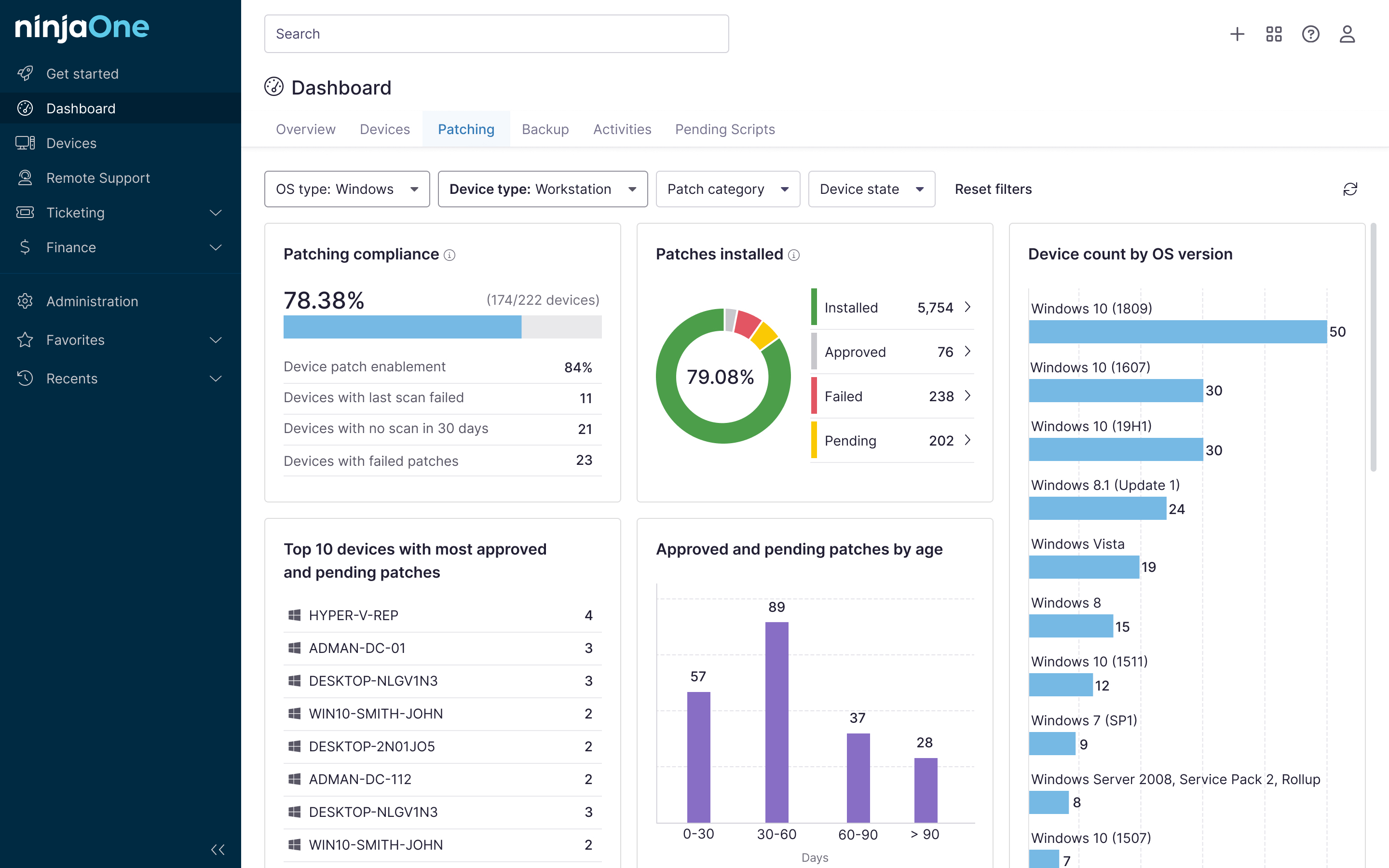
- Dashboard inventory alerts. Leverage dashboard inventory alerts to monitor device status and health metrics. These alerts can be referenced alongside documentation to help technicians identify systems that may require updated or additional documentation.
Poorly maintained records make audits and troubleshooting difficult.
Improve service delivery through effective MSP documentation practices
A good documentation strategy is key to delivering fast, quality service, resulting in stronger client partnerships. To achieve this, dynamic practices should supplement documentation to avoid stale content and maintain reliability.
By incorporating proactive lifecycle management, clear ownership assignments, automation, and visibility, MSPs can ensure their documentation stays accessible and accurate.
Related topics:
- 5 IT Documentation Best Practices for 2026
- Understanding the Importance of Documentation for Effective IT Management
- 6 Key Benefits of Automated Documentation
- Complete Guide to Document Management for MSPs: Tools, Processes, and Best Practices
- The Complete Guide to MSP Automation
Quick-Start Guide
NinjaOne Documentation Features
NinjaOne offers a robust Documentation tool that allows MSPs to:
- Manage global knowledge base documents
- Create custom wikis
- Document and standardize contextual information about IT environments
- Integrate with Microsoft Word for easy editing
- Create public or shared links to documents
- Use a migration tool to import/export templates
- Create checklists for organizations
Key capabilities include:
- Knowledge Base feature for creating wikis with files and folders
- Ability to create checklists at global/division or organization levels
- Microsoft document integration
- Customizable document sharing options
The Documentation tool is designed to help MSPs keep their documentation current, organized, and easily accessible. It provides flexible options for managing internal and external documentation, making it easier to maintain up-to-date and usable documentation for managed environments.