

Key points
- MDT Is Retired: Microsoft Deployment Toolkit (MDT) is officially end-of-life, with no future updates, fixes, or compatibility support for new Windows releases.
- Cloud-Based OS Deployment: On-premises imaging tools like MDT struggle to support hybrid and remote workforces, driving demand for cloud-native platforms.
- The Best Microsoft Deployment Toolkit (MDT) Alternatives of 2026:
-
- NinjaOne
-
- SmartDeploy
-
- ManageEngine OS Deployer
- NinjaOne Is a Leading Cloud-Native MDT Alternative: It offers modern OS deployment with low-touch provisioning and agent-assisted automation.
- Traditional Imaging Tools Fit On-Prem Use Cases: Solutions like SmartDeploy and ManageEngine OS Deployer may suit organizations that use on-prem provisioning.
- Key Differentiators: Important evaluation factors include deployment speed, support for remote devices, reporting and visibility, and automation depth.
- Future-Proofing Matters: The best MDT alternative reduces operational complexity, supports modern device management, and scales with evolving IT strategies.
With Microsoft announcing the immediate retirement of its Microsoft Deployment Toolkit (MDT) in early January 2026, you may be searching for an OS deployment alternative to MDT that accomplishes secure and straightforward device provisioning for your business.
In this article, we suggest the best MDT alternatives of 2026 and discuss their respective use cases, features, and shortcomings—all to help you decide on the most fitting OS deployment solution for your organization’s needs.
What is Microsoft Deployment Toolkit (MDT)?
Microsoft Deployment Toolkit (MDT) is an integrated set of free tools and processes to help administrators automate the deployment of Windows operating systems, applications, and servers. It also supports integration with the Windows Assessment and Deployment Kit (ADK) and the Microsoft Configuration Manager for enterprise-level deployments.
MDT’s key features include:
- default task sequence templates (along with template creation),
- offline user-state migration through its User State Migration Tool (USMT),
- a central deployment workbench for increased visibility, and
- Lite Touch Installation (LTI) to minimize user interaction during deployment.
Microsoft Deployment Toolkit’s end of life (EOL)
MDT was introduced in 2003 as Business Desktop Deployment and has since undergone several improvements, even going on to become a popular deployment tool among IT administrators. However, on January 6, 2026, Microsoft announced that MDT would be retired immediately and no longer receive updates, fixes, or support.
While this doesn’t mean that MDT would stop working for users, those looking to still download and install the software will likely encounter some difficulty. Microsoft added that not only will MDT download packages be removed or deprecated from stores, but also there will be “no future compatibility updates for new Windows releases.”
Why IT pros look for MDT alternatives
Now that MDT has reached its end of life, IT professionals likely prefer to turn toward other options, including third-party solutions, for these reasons:
- Complex setup. MDT’s setup and maintenance require significant time and resources as they involve dedicated servers as well as frequent attention to drivers and boot images. Alternative deployment software with more streamlined installation and fewer maintenance demands would thus be more preferable.
- Primarily on-prem. With organizations moving from traditional imaging to more modern methods of device management, MDT may not fit well with these adjustments as it’s built around thick images and on-premises deployment rather than low-touch, cloud-based provisioning.
- Limited hardware support. MDT’s limited support for modern hardware and scenarios means more difficulty in not only driver management for new devices but also off-network deployments. Admins might prefer solutions that better support hybrid or even fully remote workforces.
- Subpar reporting and monitoring. As MDT possesses minimal reporting and monitoring capabilities—with troubleshooting often requiring manual log analysis—users would likely search for an alternative providing these features at a more enhanced (perhaps even fully automated) level.
- Rigid workflows. MDT workflows can often feel rigid given the aforementioned limitations of the software, leading admins to seek out a tool that offers faster provisioning, user-driven workflows, and even post-deployment automation.
With all these points in mind, it’s no wonder that IT professionals would turn toward MDT alternatives for their OS deployment tasks. If you’re part of this crowd, we have some noteworthy solutions to suggest which can aid your decision making and deliver you one step closer to a deployment tool that quickly brings your business up to speed.
Best Microsoft Deployment Toolkit (MDT) alternatives of 2026
1. NinjaOne
Serving tens of thousands of customers across the globe, NinjaOne offers an extensive suite of IT solutions that boost efficiency, visibility, and productivity through advanced automation and remote monitoring capabilities. Its commitment to faster resolutions without compromising quality, as well as world-class customer support, have made it a trusted unified management platform used by MSPs and IT teams worldwide.
In particular, NinjaOne’s cloud-based endpoint management platform features the OS deployment capability, which enables IT teams to simplify endpoint provisioning, minimize operational overhead, and deliver secure, fully configured devices from the start.
Reasons to choose NinjaOne over MDT
- Cloud-based solution. As a cloud-native platform, NinjaOne is designed to help modern IT environments through low-touch provisioning workflows as well as full support for remote and distributed workforces. With NinjaOne, OS deployment requires no VPNs, no on-premises servers, and no domain dependencies.
- Deployment at scale. Through NinjaOne, IT administrators faced with an increasing number of devices to provision can push prebuilt OS images containing all the apps and policies needed to these devices simultaneously. As a result, OS provisioning can take minutes instead of days, ensuring productivity from day one.
- Agent-assisted automation. Every step of the deployment process, all the way to follow-up configuration, is handled by NinjaOne’s lightweight automation agent, reducing the need for manual intervention by IT personnel and enabling them to focus on more strategic initiatives.
- Faster and more consistent outcomes. IT admins who use NinjaOne for device provisioning would find that the software’s policy-based automation, unified capabilities, and lightweight workflows make for faster deployment across their environments, leading to fewer errors and more predictable outcomes.
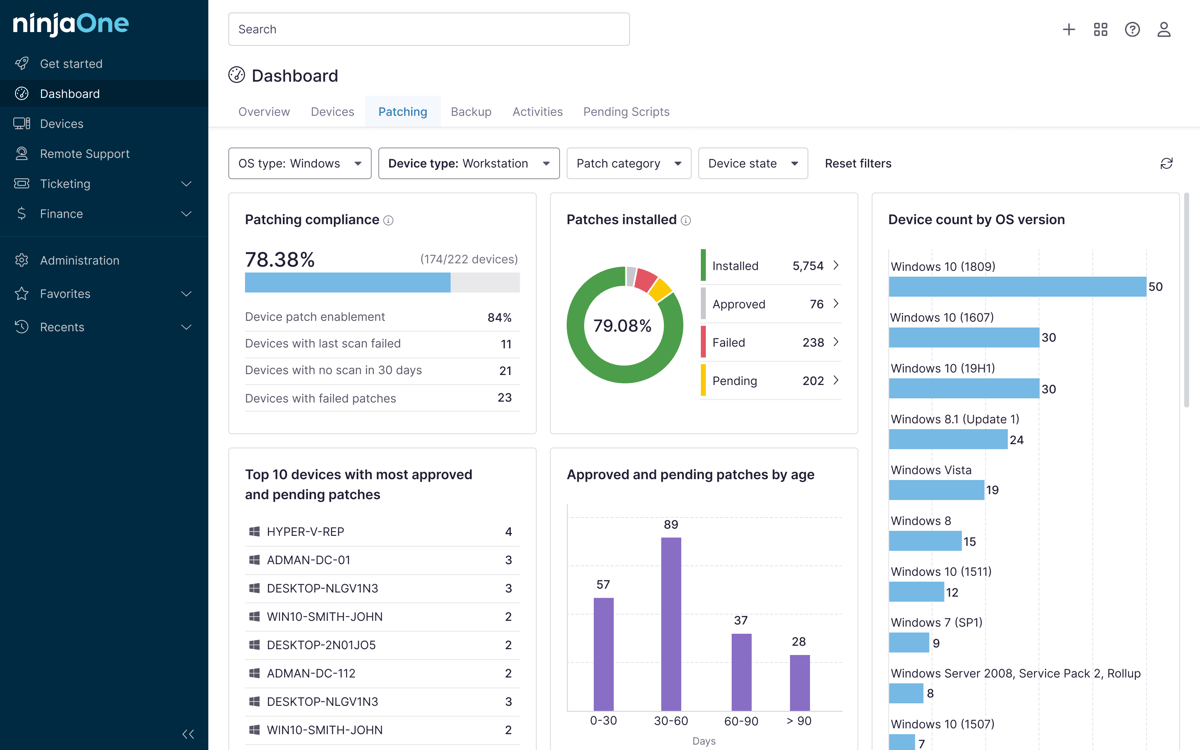
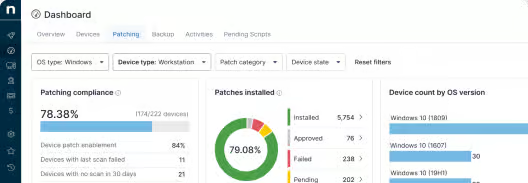
- Better visibility. Lastly, NinjaOne includes real-time dashboards for better asset health and lifecycle visibility, and users can monitor whether their OS deployments have succeeded by leveraging the platform’s Boot Verify Reporting feature.
Customer story
Randy Rybakowicz, IT director of Milwaukee-based Horizon Home Care & Hospice (HHCH), was tasked with updating the organization’s entire IT environment, which included deploying Windows 10 to over 200 devices. With NinjaOne, he accomplished this with zero disruptions, saving over 400 hours of manual labor.
Rybakowicz said, “Migrating systems is a massive undertaking. NinjaOne’s capability to deploy and monitor software packages made it possible for us to completely implement a new system in just seven months. […] Without NinjaOne, that would never be possible.”
Read more NinjaOne customer stories or check out NinjaOne reviews.
Pricing
NinjaOne offers per-device pricing, and its endpoint management software has no forced commitments and no hidden fees.
You can request a free quote, schedule a 14-day free trial, or watch a demo.