
Most MSPs design service tiers around features or price, but this misses a key factor: client IT risk appetite. Risk-averse clients in regulated industries demand compliance, security, and uptime, while risk-tolerant clients may accept more risk for lower cost.
Without alignment, MSPs face frustrated clients, weak protection, and renewal challenges. Mapping risk appetite to tiers ensures services meet expectations, build trust, and justify pricing. This guide shows how to align MSP service tiers with a client’s IT risk appetite.
Steps for aligning MSP service tiers with client IT risk appetite
📌 General prerequisites:
- A structured list of service levels that clearly define what each tier includes (scope, response time, and cost), such as Bronze, Silver, or Gold.
- A documented process to evaluate each client’s IT risk tolerance, using tools such as a questionnaire, a compliance checklist, or insurance requirement reviews.
- A Service Level Agreement (SLA) and KPI benchmarks tied to each service tier
- Documentation or QBR reporting system (NinjaOne Documentation, IT Glue, Power BI, Excel)
- Consistent alignment and communication between sales, technical, and compliance teams to ensure a unified understanding of client risk and service tiers.
Step 1: Assess client risk appetite
Before you align service tiers with client needs, you must first agree on the client’s risk appetite. This step defines how much risk the client is willing or able to tolerate in areas such as downtime, data loss, and incident response.
📌 Prerequisites: Agreement across sales, technical, and compliance teams on the assessment framework.
Sub-steps:
- Create a simple framework for categorization:
- Define three levels of risk appetite: Low, Medium, or High
- Collect input through structured methods.
- Use surveys, compliance checklists, or guided discovery calls.
- Ask direct questions like:
- How long can you afford to be offline?
- What’s your acceptable data loss window (RPO)?
- Identify regulatory drivers.
- Assess tolerance for downtime, data loss, or incident response delays.
- Deliver the client risk appetite profile:
- Low risk appetite: Requires maximum protection, strict compliance, and minimal disruption tolerance.
- Medium risk appetite: Balanced needs, accepts some disruptions with defined safeguards.
- High risk appetite: Cost-sensitive, willing to accept longer recovery times.
Step 2: Map service tiers to risk categories
Once the client’s risk appetite has been assessed, the next step is to map it to the right service tier. This step creates a tier-to-risk matrix that aligns your offering with the client’s tolerance for risk, budget, and compliance needs.
📌 Prerequisites:
- A clear risk appetite profile from Step 1.
- A defined set of service tiers with documented features.
Sub-steps:
- Define how each tier addresses risk:
- Basic Tier (High risk appetite) – Reactive support, limited monitoring, longer recovery windows. Fits cost-sensitive clients who accept greater risk.
- Standard Tier (Medium risk appetite) – Balanced monitoring, patching, and scheduled backups. Fits clients with balanced needs and moderate tolerance.
- Premium Tier (Low risk appetite) – Full compliance coverage, advanced security controls, and 24/7 monitoring. Fits clients with strict regulatory requirements and low tolerance for disruptions.
- Deliver a tier-to-risk appetite matrix that maps:
- Tier name
- Risk appetite level
- Key features
- Typical client profile
Step 3: Use risk indicators in QBRs
Quarterly Business Reviews (QBRs) are the checkpoint to confirm that a client’s current service tier still matches their risk appetite. Use QBRs to present risk indicators showing how well the current tier performs against the agreed tolerance.
📌 Use Cases: Reviewing service tier fit, supporting upgrade or downgrade discussions.
📌 Prerequisites:
- Access to operational and security data from client environments.
- Agreement on which indicators to track.
Sub-steps:
- Collect client-specific risk metrics:
- Patch compliance: Number of unpatched systems or missed updates.
- Backup testing: Success and failure rates for restore tests.
- Uptime and SLA: Actual performance vs. promised availability.
- Security event: Number of incidents, response time, and resolution status.
- Compare results to the client’s tolerance levels (from Step 1).
- Show where they are within acceptable ranges and exceeding their stated tolerance.
- Deliver the QBR summary.
- Provide a QBR slide or visual summary that shows:
- Alignment or misalignment with the current tier.
- Any identified gaps or signs of overprotection.
- Suggested actions or adjustments.
- Provide a QBR slide or visual summary that shows:
Step 4: Document the business impact of misalignment
Any gaps between a client’s risk appetite and current tier should be documented in business terms. A misaligned risk appetite can mean wasted spending or increased exposure. This step translates technical gaps into financial and operational impact.
📌 Use Cases: Helping clients understand the cost of risk and misalignment.
📌 Prerequisite: Access to client-specific metrics.
Sub-steps:
- Translate gaps into business terms.
- Use real numbers to show impact:
- Example: “At your current tier, expected downtime is 8–10 hours annually. Based on your average productivity cost, that equals roughly $50,000 in losses.”
- Example: “Moving to the higher tier reduces downtime risk to under 1 hour annually.”
- Use real numbers to show impact:
- Show side-by-side comparisons.
- Present risk exposure at the current tier versus higher tiers.
- Highlight the difference in downtime, cost, and compliance risk.
- Deliver the business impact summary.
- Create a client-facing document that includes:
- Current tier vs. recommended tier.
- Associated risks and costs.
- Estimated savings or protection gained from switching.
- Create a client-facing document that includes:
Step 5: Build risk-driven upgrade paths
To keep alignment intact, you need structured upgrade paths tied to risk triggers. The goal is to show clients when their current tier no longer fits and what the next step should be.
📌 Use Cases: Supporting long-term planning and budgeting.
📌 Prerequisites: A documented risk appetite profile.
Sub-steps:
- Create structured upgrade conversations.
💡 Tip: Use client-specific data to guide the discussion.
- Identify upgrade triggers that shift the risk profile.
- Business growth (new locations, employees, or systems)
- New or stricter compliance regulations
- Rising downtime, data loss, or security incidents shown in QBR metrics
- Present higher tiers as risk mitigation tools.
- Avoid upselling language.
- Show how the higher tier reduces exposure.
- Use historical incident data to justify recommendations.
- Deliver the upgrade pathway that documents:
- Current tier
- Risk indicators
- Recommended tier
- Triggering events
Best practices summary table
| Component | Purpose and value |
| Risk assessment | Establishes client baseline for risk tolerance |
| Tier-to-risk mapping | Aligns service tiers with client appetite and compliance needs |
| QBR risk indicators | Validates tier fit with operational and security data |
| Business impact translation | Converts technical risk into financial and operational terms |
| Upgrade paths | Enables proactive conversations based on risk triggers |
Automation touchpoint example
Automation makes risk alignment measurable and repeatable. This example shows how you can use scripting and monitoring tools to extract patch compliance data and compare it against SLA thresholds.
📌 Use Case: Present the CSV results in a QBR to highlight compliance gaps or demonstrate strong patching alignment with the client’s risk profile.
Patch Compliance Export (PowerShell + RMM CSV)
Get-WmiObject -Class Win32_QuickFixEngineering | Select CSName, HotFixID, InstalledOn | Export-Csv “PatchCompliance.csv” -NoTypeInformation
This script exports installed patch data into a CSV file with system name, hotfix ID, and install date. You can then compare the output to SLA thresholds to confirm whether the client’s current tier meets the agreed risk appetite.
NinjaOne integration
NinjaOne can support this risk-based tier alignment approach by:
- Providing patch-status, backup, and monitoring compliance data for building risk profiles
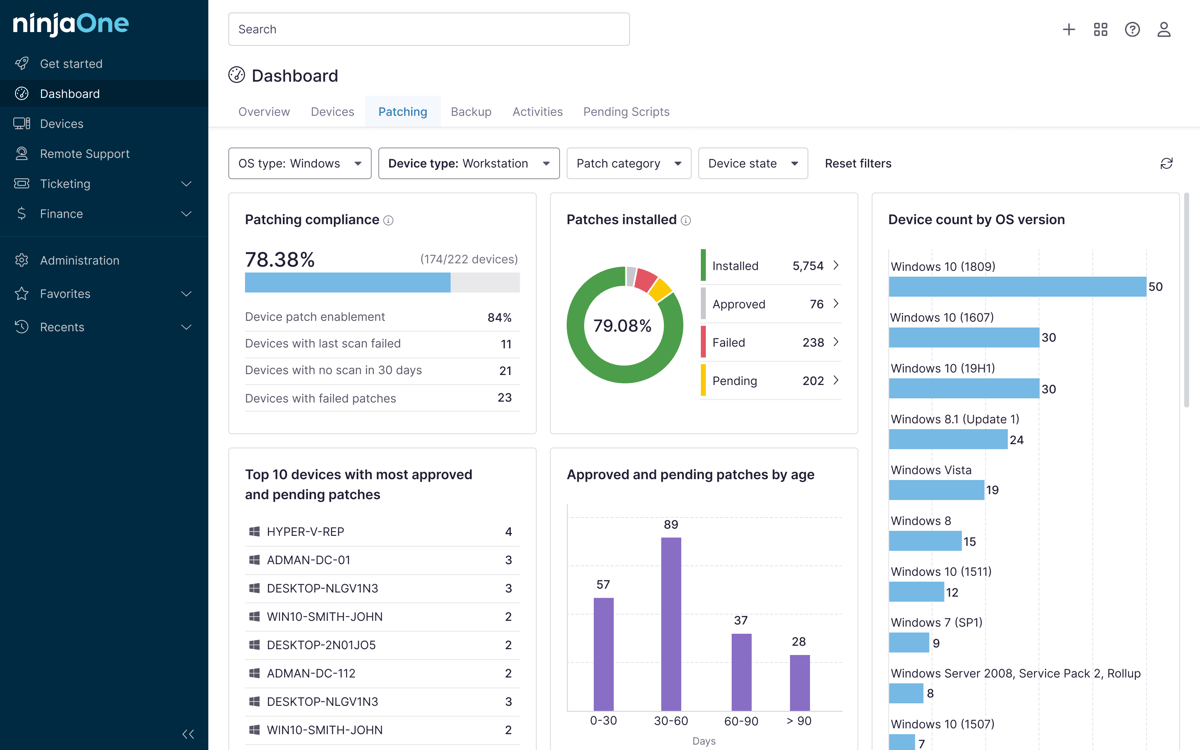
- Viewing detailed patch-status and installation history directly in NinjaOne reports to validate system update compliance
- Tracking SLA adherence metrics and using these reports in QBRs to evaluate service performance by tier.
- Hosting risk appetite questionnaires and tier mapping in NinjaOne Documentation.
- Using tags or custom fields in NinjaOne to categorize clients or endpoints by risk level.
- Automating alerts when monitored metrics (e.g., patch failures, backup issues) indicate higher risk exposure than expected from the client’s current tier.
These features help MSPs track client risk exposure and keep service tiers aligned.
Quick-Start Guide
NinjaOne can help align MSP service tiers with client risk appetite through several features and capabilities:
1. Risk-Based Policies
Create custom policies that apply different security measures based on client risk levels (e.g., high-risk clients get stricter patch management, endpoint monitoring, and backup retention).
2. Tiered Monitoring & Alerts
Set up tiered alert thresholds so high-risk clients receive more frequent monitoring and notifications (e.g., real-time alerts for critical vulnerabilities).
3. Custom Reporting
Generate reports that highlight compliance gaps, security posture, and risk exposure specific to each client tier, helping MSPs prioritize resources effectively.
4. Automated Workflows
Automate ticket routing and escalation based on client risk level. High-risk clients can be routed to senior technicians or have tickets escalated faster.
Align MSP service tiers with client IT risk appetite to match business needs
Aligning MSP service tiers with client IT risk appetite strengthens trust and reduces churn. Instead of selling services as fixed packages, you can present them as tailored responses to client IT risk tolerance.
This positions tier selection as a governance decision, not only a financial one. You can use NinjaOne data to support and maintain risk-driven tier alignment.
Related topics:
- What to Include in Your Managed Service Offering to Land the Right Customers
- How to Create a Tiered Technician Playbook for First Call Resolution
- What is GRC (Governance, Risk, and Compliance)?
- MSP Pricing Guide: Which pricing model is right for you?
- Service Excellence: The Competitive Edge MSPs Need in 2025