
Key Points
- Software end-of-support dates, not just hardware age, should drive refresh timing.
- A hardware-software alignment matrix maps device age against vendor EOL dates to flag real risk.
- Feeding the matrix into QBRs turns refresh recommendations into a documented business case.
- Automation and RMM/PSA tagging make lifecycle tracking repeatable across large device fleets.
Most hardware refresh cycles are planned around age, warranty status, or performance benchmarks. Software end-of-support (EOL) timelines are often missed. Whenever Microsoft stops supporting an operating system or a client’s core application reaches its last update, new hardware can quickly become a risk.
Aligning refresh cycles with software EOL ensures devices will remain secure, compliant, and compatible with business applications and workflows. This approach can prevent clients from running unsupported systems, reduce exposure to vulnerabilities, and help managed service providers (MSPs) avoid last-minute replacement costs.
This guide provides a structured and straightforward process for integrating software lifecycle events into hardware planning. With the right framework and tools, like NinjaOne, refresh cycles become proactive tools for risk mitigation, budgeting, and client engagement.
For a quick visual overview, watch our video guide on How to Align Hardware Refresh Cycles with Software End of Support Dates
Steps to Align Hardware Refresh Cycles with Software End-of-Support Dates
Aligning hardware refresh cycles with software EOL will help MSPs plan proactively and find alternatives early instead of reacting to issues.
📌 Prerequisites:
- You will need access to the client’s inventory with hardware age and software version details.
- This requires a concrete list of upcoming vendor-published EOL dates. For example, Windows 10 will lose support on October 14, 2025.
- You will need a spreadsheet tool or app, like Google Sheets or Microsoft Excel, to build alignment tables.
💡 Note: You need to have RMM (Remote Monitoring and Management) or Professional Services Automation (PSA) tags to flag EOL-bound systems.
Step 1: Identify Key Software End-of-Support Dates
The first step in aligning refresh cycles is knowing when critical software will reach its end of support. These dates will determine when hardware could become a liability, since unsupported systems will no longer receive patches or vendor support.
📌 Use Cases:
- This step will help you anticipate when hardware needs replacing due to software EOL, not just age.
- You will be able to flag at-risk environments before they become security or compliance problems.
- This step gives you concrete timelines for budgeting and client communication.
📌 Prerequisites:
- Before performing this step, you need to have a list of operating systems and applications crucial to clients.
- You need to be aware of vendor-published lifecycle documentation for each product.
- You will need an inventory report that links installed software to specific endpoints.
Here are some software with past and upcoming end-of-support dates:
| Software | EOL Date | Notes |
| Windows 10 | October 14, 2025 | Microsoft no longer issues security updates. |
| Office 2016, Office 2019 | October 14, 2025 | MS Office no longer receives support. |
| Adobe Acrobat 2017 | June 2022 (already EOL) | If Adobe Acrobat is still a part of your workflows, be sure to highlight in your reports if it’s still in use. |
What are the Risks of End-of-Support Software?
Devices running unsupported software cannot be secured or updated, even if the hardware is still operable.
Step 2: Build a Hardware-Software Alignment Matrix
Once you know the key software EOL dates, the next step is to connect them directly to client hardware. A hardware–software alignment matrix shows at a glance which devices need replacing due to age and which are tied to critical software reaching the end of support.
📌 Use Cases:
- This step helps you create a client-facing visual that simplifies lifecycle planning.
- It enables you to prioritize refresh schedules around real risk, not just warranty status.
- It provides evidence for regular reports, Quarterly Business Reviews (QBRs), and budget-related conversations.
📌 Prerequisite:
- To complete this step, you need an accurate hardware inventory that includes device age and deployment dates.
| Device Name | Device Age | OS/App Installed | EOL Date | Suggested Refresh |
| Laptop A | 4.5 years | Windows 10 | October 2025 | Q3 2025 |
| Desktop 1 | 3 years | Office 2016 | October 2025 | Q2 2025 |
| Laptop B | 6 years | Windows 11 | N/A | Q1 2026 (based on age) |
This matrix gives you a clear visual that aligns hardware refresh planning with software lifecycle demands, reducing surprises and keeping systems compliant.
Step 3: Incorporate into QBRs and Budget Planning
The alignment matrix in Step 2 is effective when it’s part of ongoing client conversations. You can integrate this into QBRs and budget planning to demonstrate the importance of proactive lifecycle management and reduce the chances of last-minute replacements.
📌 Use Cases:
- This step will demonstrate lifecycle risk in a clear, visual format that clients understand.
- MSPs can connect device replacement plans directly to fiscal and budget cycles.
- You will be able to highlight legacy hardware and software that can cause compliance issues.
📌 Prerequisite:
- You will need a finalized hardware-software alignment matrix for each client (see Step 2).
You can then use the matrix during QBRs to:
- Show clients which systems are due for replacement based on software lifecycle timelines and requirements.
- Highlight legacy software issues that may cause unnecessary risks to a client’s business operations. It is also prudent to highlight needed hardware upgrades, especially if older systems pose a risk.
- Tie software and hardware refresh recommendations to upcoming fiscal cycles.
This supports proactive planning, strengthens client trust, and avoids costly surprises when hardware or software suddenly becomes unsupported.
Step 4: Automate Endpoint Data Collection (optional)
If your MSP manages large fleets of computers, manually tracking age and software EOL dates can be time-consuming. You can automate this process with scripts to make the process faster without manual work, reduce errors, and flag devices at risk sooner.
📌 Use Cases:
- This step will help your lifecycle tracking tasks across dozens or hundreds of endpoints.
- It reduces manual review effort by auto-tagging devices that meet refresh criteria.
- It will provide you with a repeatable process for monthly or quarterly refresh checks.
📌 Prerequisites:
- You will need access to an up-to-date device inventory (gathered manually or exported from RMM or PSA tools).
- You will need accurate deployment dates and OS information included in the inventory file.
Here’s an example PowerShell script:
Import-Csv device_inventory.csv |
ForEach-Object {
$age = (Get-Date) – [datetime]$_.DeploymentDate
if ($age.Days -gt 1460 -or $_.OS -eq ” Windows 10″ ) {
$_ | Add-Member -NotePropertyName “RefreshNeeded” -NotePropertyValue ” Yes”
}
} | Export-Csv aligned_output.csv -NoTypeInformation
This script checks each device’s deployment date and OS, flags devices older than four years or still running Windows 10, and exports the results into a new CSV. Moreover, the output also helps MSPs quickly identify and tag devices approaching planned EOL transitions. In turn, this makes refresh recommendations easier to track and communicate.
⚠️ Things to Look Out For
| Risks | Potential Consequences | Reversals |
| Overlooking software EOL dates | Devices may remain in service after support ends. This will expose clients to security and compliance risks. | Track vendor lifecycle announcements and maintain an updated EOL calendar. |
| Relying only on the hardware age | Hardware may still function, but run unsupported or insecure software. | You can align refresh planning with both device age and software lifecycle events. |
| Having inconsistent inventory data | Missing or inaccurate deployment dates/software versions lead to poor refresh planning. | Use RMM/PSA exports and verify accuracy before building a matrix. |
| Lack of client-facing communication | Clients may see refresh recommendations as arbitrary costs. | Present the alignment matrix during QBRs, but use plain language and connect it to business outcomes so clients will understand the business value. |
| Failure to automate at scale | Manual hardware and software reviews become unmanageable. | Utilize scripts or RMM automation to flag at-risk devices and generate reports consistently. |
Best Practices for Aligning Hardware Refresh Cycles
| Component | Purpose and value |
| Software EOL timeline mapping | To anchor refresh cycles to vendor risk and support status; to ensure devices won’t be left running unsupported software |
| Alignment matrix | To present the recommendations, visuals, making it easy to present to clients in reviews and discussions |
| QBR integration | To help communicate urgency and tie refresh planning to a broader IT roadmap |
| Optional scripting | To reduce manual review effort and scale tracking in large environments |
| Fiscal planning time-in | To support smoother budgeting and phased rollout of device refreshes |
Automation Touchpoint Example for Aligning Hardware Refresh Cycles
Automation can help simplify the process of linking hardware refresh cycles with software end-of-support timelines. You can turn export and lifecycle data into a repeatable workflow, helping you quickly identify at-risk devices and present refresh plans in client meetings.
Here’s a sample refresh planning workflow:
- Export hardware and software inventory from NinjaOne or your PSA platform.
- Add software EOL dates using vendor-published lifecycle documentation.
- Next, cross-reference device age and EOL milestones to identify overlaps.
- You can use conditional formatting in Excel or Google Sheets to flag priority refresh candidates.
- Present findings in QBRs and incorporate recommendations into upcoming budget proposals.
NinjaOne Integration Ideas for Aligning Refresh Cycles with Software EOL
The features of NinjaOne features make it easy to conduct refresh planning thanks to its inventory and reporting tools, which make it easy to tag, track, and flag devices for refresh planning.
| Feature | What it does |
| Custom fields to tag devices by OS and refresh date | Enables you to track refresh eligibility directly in inventory records |
| Scheduled reports for EOL-bound software | Generates recurring lists of systems running software near or past the end of support |
| Creation of alerts or workflows tied to OS version or age thresholds | Flags devices nearing replacement based on lifecycle triggers |
| Export software inventory | Provides data you can cross-map with the vendor lifecycle timelines to build an alignment matrix. |
Quick-Start Guide
NinjaOne offers several features to help manage hardware lifecycles and software end of support:
1. Warranty Tracking
- Automatically track warranty information for devices
- Color-coded indicators for warranty status:
- Red: Warranty expired
- Yellow: Warranty expiring within 90 days
- Green: Warranty valid for more than 90 days
2. Patch Management
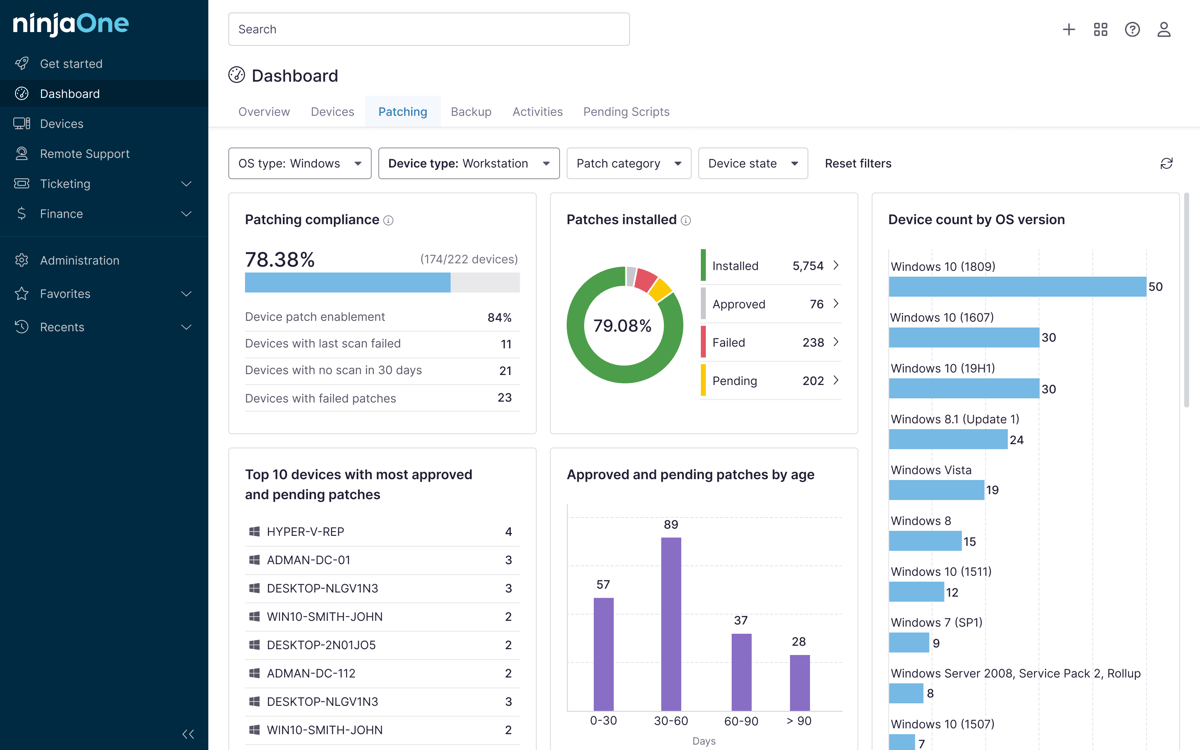
- Comprehensive patch management dashboard
- Track patch compliance and installation status
- Monitor device OS versions
- Set up ring deployments for staged updates
3. Device Lifecycle Monitoring
- Warranty tracking for Dell, Toshiba, HP, and Lenovo hardware
- Automatic weekly warranty syncs
- Manual warranty date entry for servers and virtual hosts
4. Reporting and Filtering
- Filter devices by warranty start/end dates
- Add warranty columns to device search grid
- Generate reports on device health and patch status
Align Refresh Cycles with Software EOL to Improve Security and Compliance
Legacy hardware rarely becomes a problem, especially if it’s still more than capable of supporting an environment’s workflows. However, issues arise when the software it runs is no longer supported, leaving systems exposed and at risk.
Tracking EOL dates alongside hardware age can help MSPs turn lifecycle management into a proactive strategy that can reduce risk and enhance security. Tasks involve creating an alignment matrix to guide replacement and creating client-facing presentations for QBRs and budget planning. Automation minimizes surprises and helps refresh cycles to deliver consistently positive results.
Related topics: