Self-Healing Automation

As MSPs manage larger and more complex environments, maintaining reliability without adding technician overhead becomes a critical priority. NinjaOne’s self-healing automation supports this goal through automated issue remediation that can detect common problems and resolve them instantly. NinjaOne applies predefined fixes the moment an issue appears, helping keep systems stable and minimizing client disruptions.
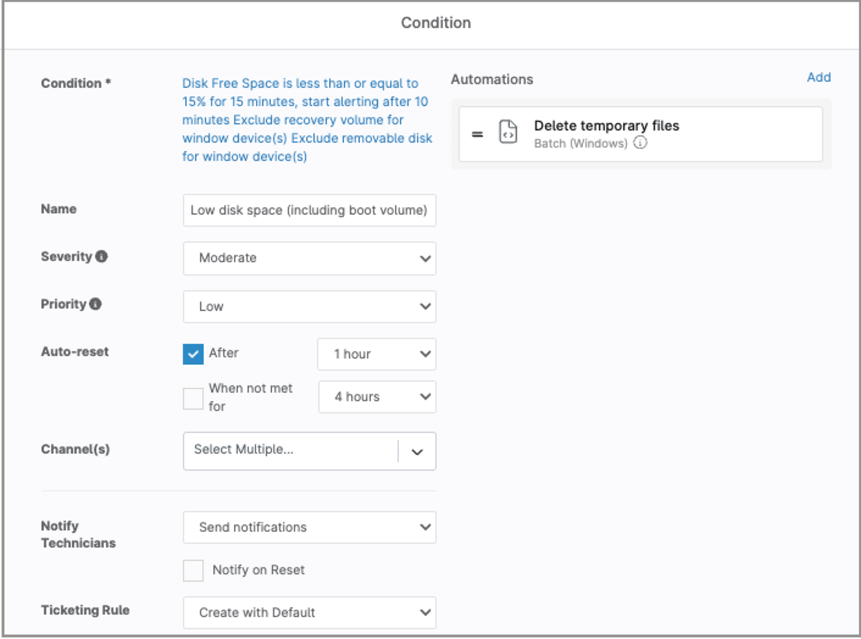

Self Healing IT Automation
IT business logo
Provide logo
Advantage Technologies logo
Dedicated IT logo
Alticap logo
Network Coverage logo

Self-healing automation built for scale

Proactive Stability

NinjaOne detects and resolves issues instantly through remote script automation, preventing minor problems from escalating and keeping client systems running smoothly around the clock.

Reduced Ticket Volume

By handling repetitive tasks automatically, NinjaOne lowers the number of inbound tickets, freeing technicians to focus on higher-value work while improving SLA performance and overall efficiency.

Consistent, Standardized Fixes

Automations follow proven, repeatable workflows across all environments, ensuring every client receives the same high-quality resolution regardless of technician availability or skill level.

Scalable Service Delivery

NinjaOne enables MSPs to support more clients without expanding headcount by automating routine remediation tasks, improving operational capacity and strengthening long-term business growth.

Engineered for autonomous endpoint recovery

Automated Issue Remediation

NinjaOne automatically identifies and corrects common endpoint issues—such as service failures, low disk space, or stuck processes—without requiring technician intervention.

Policy-Driven Workflow Execution

Automations can be triggered based on conditions, or thresholds, allowing MSPs to define precise, reliable workflows that execute consistently across all environments.

Centralized Visibility & Logging

Every automated action is recorded and accessible from a unified dashboard, giving teams full insight into what was triggered, when it ran, and the outcome of each remediation.

Cross-Platform Endpoint Coverage

NinjaOne supports automated remediation across Windows, macOS, and Linux endpoints, allowing MSPs to maintain a consistent self-healing strategy across mixed device fleets.

Automated IT workflows for optimal reliability

Clearing Low Disk Space

Identify endpoints nearing storage limits and execute automated cleanups—removing temp files, logs, or cached data—to prevent performance degradation and application failures.

Fixing Stalled or Hung Processes

Monitor for frozen or resource-heavy processes and terminate them automatically, ensuring devices remain responsive and avoiding costly user interruptions.

Unlock the Power of Self-Healing IT

Cut tickets fast with automated issue remediation that fixes problems instantly.

Boost technician efficiency by eliminating repetitive manual tasks.

Deliver dependable, consistent service across all managed environments.

Related Resources

This is why customers love us

Ready to simplify the hardest parts of IT?

Self-Healing Automation FAQs

Self-Healing Automation is the ability to detect common IT issues and automatically resolve them before users are impacted. It keeps systems healthy, reduces tickets, and delivers a smoother, more reliable service experience.

It proactively fixes issues the moment they appear, preventing small problems from turning into outages. By automating repetitive remediation tasks, technicians spend less time firefighting and more time on high-value work, resulting in fewer disruptions and a lighter, more efficient IT workload.

Yes. NinjaOne policies can be configured to run automated actions whenever specific conditions or thresholds are met. This allows common endpoint issues to be detected and remediated automatically, without requiring user or technician intervention.

NinjaOne can automatically handle a wide range of common endpoint issues. Typical examples include restarting failed services, clearing low disk space through automated storage cleanup, stopping hung or resource-heavy processes, and resolving patch or update failures. These automated fixes help keep devices stable without requiring technician intervention.

NinjaOne goes beyond basic alert-triggered scripts by offering policy-driven, condition-based automation that continuously monitors endpoint health and executes remediations with precision. Instead of reacting to alerts alone, NinjaOne evaluates thresholds, system states, and predefined logic to apply the right fix at the right time—ensuring consistent, reliable, and repeatable results across all managed environments.

Yes. NinjaOne allows full customization of self-healing workflows so MSPs can tailor automations to specific operating systems, device roles, or problem types. You can define conditions, thresholds, and remediation steps that match each environment’s needs, ensuring precise, targeted automated issue remediation across diverse device fleets.

it automatically eliminates many of the routine problems that normally generate tickets, drastically reducing manual troubleshooting. With fewer repetitive issues to handle, technicians can focus on more strategic work, resolve complex cases faster, and support more endpoints without increasing workload—making the entire IT team more productive and efficient.

Yes. NinjaOne records every automated remediation action and makes those details available through centralized logs and reports. This gives IT teams full visibility into what was triggered, when it ran, and the outcome—ensuring transparency, accountability, and easier troubleshooting if further follow-up is needed.

Yes. NinjaOne’s self-healing automation is designed with strict security boundaries, ensuring all actions run under defined policies and permissions. Automations only execute the tasks you approve, on the devices you specify, preserving full administrative control while safely automating routine remediation.

Self-healing automation reduces the volume of routine tickets and minimizes time spent on repetitive fixes, which directly lowers labor and operational costs. By resolving issues instantly—often before users notice—systems stay stable, outages decrease, and service reliability increases. MSPs gain a more predictable workload, stronger SLAs, and a smoother, more efficient service delivery model overall.