NinjaOne Patch Management dashboard for patch status and compliance visibility
NinjaOne Patch Management centralizes patch status across Windows, macOS, and Linux endpoints, with real-time visibility into installed, pending, and failed patches.
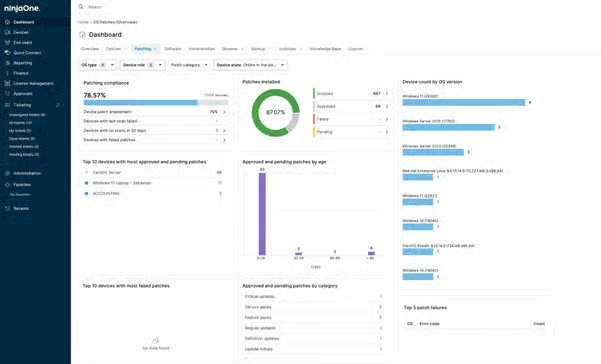
NinjaOne Patch Management centralizes patch status across Windows, macOS, and Linux endpoints, with real-time visibility into installed, pending, and failed patches.






IT teams need a clear way to understand patch activity across managed endpoints. Here is how the NinjaOne Patch Management dashboard addresses common visibility and tracking challenges.
Problem | How NinjaOne Patch Management resolves it |
Hard to see patch status across all devices | The NinjaOne Patch Management dashboard brings patch status into one view across Windows, macOS, and Linux endpoints. |
Difficult to find devices that need attention | The NinjaOne Patch Management dashboard helps IT teams identify endpoints with pending or failed patches that require follow-up. |
Too much manual work to track patch compliance | The NinjaOne Patch Management dashboard centralizes patch data so IT teams can review compliance across managed endpoints. |
Patch failures are easy to miss | The NinjaOne Patch Management dashboard surfaces patch results so technicians can identify failures and investigate affected endpoints. |
See patch status across managed Windows, macOS, and Linux endpoints from a centralized dashboard, reducing the effort required to understand the overall state of patching.
Identify pending and failed patches more easily so technicians can focus their attention on endpoints that may require investigation or follow-up.
Review centralized patch information to understand which managed endpoints are up to date and where gaps remain, without relying on manual tracking across devices.
Use consolidated patch data to spend less time checking endpoint status individually and more time addressing patching issues that need technician attention.
Maintain visibility as the number of managed endpoints grows, giving IT teams and MSPs a more practical way to oversee patch activity across larger environments.
The NinjaOne Patch Management dashboard gives IT teams a centralized view of patch activity, helping them monitor status, review compliance, and identify endpoints that need attention.

View patch information across Windows, macOS, and Linux endpoints from a centralized dashboard. IT teams can see installed, pending, and failed patches without reviewing devices individually.

Review patch compliance across managed endpoints to identify devices that are missing updates. Centralized visibility helps technicians determine where follow-up or remediation may be needed.

Identify failed patch activity and the endpoints affected by it. Technicians can use this information to investigate issues instead of relying on manual checks to uncover unsuccessful patching.

Access patch information at the endpoint level to better understand the update state of individual devices. This gives technicians additional context when investigating devices that require attention.

Monitor patch activity for supported Windows, macOS, and Linux endpoints from the NinjaOne Patch Management dashboard. IT teams can oversee patching across different operating systems without maintaining separate views for each platform.
The NinjaOne Patch Management dashboard helps IT teams and MSPs monitor patch activity across different endpoint environments. These examples show how centralized patch visibility supports common day-to-day workflows.
IT teams managing endpoints across offices, remote locations, and hybrid environments can use the dashboard to review patch status from one place. Technicians can identify pending or failed patches and focus follow-up on devices that require attention.
IT teams can use centralized patch information to review the update state of managed endpoints and identify gaps. This provides a clearer picture of patch compliance without checking devices individually.
MSPs can use the NinjaOne Patch Management dashboard to monitor patch activity across the endpoint environments they manage. Centralized visibility helps technicians identify patch issues and prioritize follow-up across customer environments.
100,000
Endpoints managed
“NinjaOne is a scalable solution. It’s built on a modern SaaS architecture and it’s future-proof.”

40%
More Cost Effective
“NinjaOne’s price point is 40% less than any other endpoint management tool on the market, while being more powerful and easy to use.”

10-15
Tools Replaced
“Before, I needed 10-15 different tools to execute what NinjaOne does in its centralized, single pane of glass.”

30%
Less time for patching
“We observed a 30% reduction in the time taken for patch deployments compared to our previous solution.”

2,000
Endpoints managed
“NinjaOne gives me much more flexibility and security in my work”

30%
Annual ROI
“[NinjaOne] has already shown its value in ROI…it’s at least a hundred thousand dollars annually.”

24x
Faster Endpoint Management
“Our processes have become 24x faster with NinjaOne.”

20-40
Hours Saved Each Week
“Leveraging the automations feature within NinjaOne has enabled me to save upwards of what would likely be 20 to 30 to even 40 hours per week.”
Review patch compliance, installed, pending, and failed patch counts as soon as endpoints report in.
Narrow the view by OS type, device role, patch category, or device state to focus on the environment that matters.
Select a device count or patch list to see affected endpoints, CVE and CVSS context, and patch age.
Approve, reject, or uninstall patches directly from the dashboard, or export the list for follow-up.
Reducing time spent on patch deployments
Al Abbar Group uses NinjaOne Patch Management to improve patch deployment efficiency, reporting a 30 percent reduction in patch deployment time compared with its previous solution.
“We observed a 30% reduction in the time taken for patch deployments compared to our previous solution.”
Al Abbar Group
Source: NinjaOne
Get a centralized view of patch activity with NinjaOne Patch Management. Monitor patch status across managed endpoints and identify areas that need attention from one platform.
The NinjaOne Patch Management dashboard brings critical patching data into a centralized view. IT teams can use it to review patch status and patching activity across managed endpoints.
NinjaOne provides views for Pending, Approved, Rejected, Installed, and Failed patches. Technicians can use these status views to review patches throughout the patch management process.
NinjaOne technicians can approve or reject supported patches from dashboard patch views, with available actions depending on the patch’s current status. Windows patches that support rollback can also be uninstalled from the Installed patch list.
Patch lists include a Devices field showing the number of managed devices associated with a patch. The dashboard also provides device-level information for reviewing patch status across managed endpoints.
Patch lists can display CVE identifiers and CVSS scores for applicable patches. This gives technicians vulnerability context that can help them assess which patches should receive attention first.
NinjaOne allows technicians to export listed patch data as a CSV file from the Patch Management dashboard. This data can then be used outside the console for additional review or operational workflows.