NinjaOne Critical Patch Prioritization for Smarter Endpoint Security

NinjaOne’s critical patch prioritization gives IT teams the severity context, AI-driven insights, and policy-based automation to identify and act on the most dangerous vulnerabilities first. Stop treating every patch the same and start remediating what matters most, faster.
Critical Patch Prioritization
IT business logo
Provide logo
Advantage Technologies logo
Dedicated IT logo
Alticap logo
Network Coverage logo

Prioritization built around real risk, not release schedules

Risk-Based Patching That Puts Security First

NinjaOne’s risk-based patching maps every update to its actual threat impact using vendor severity ratings and CVE/CVSS data.

Automated Patch Prioritization at Scale

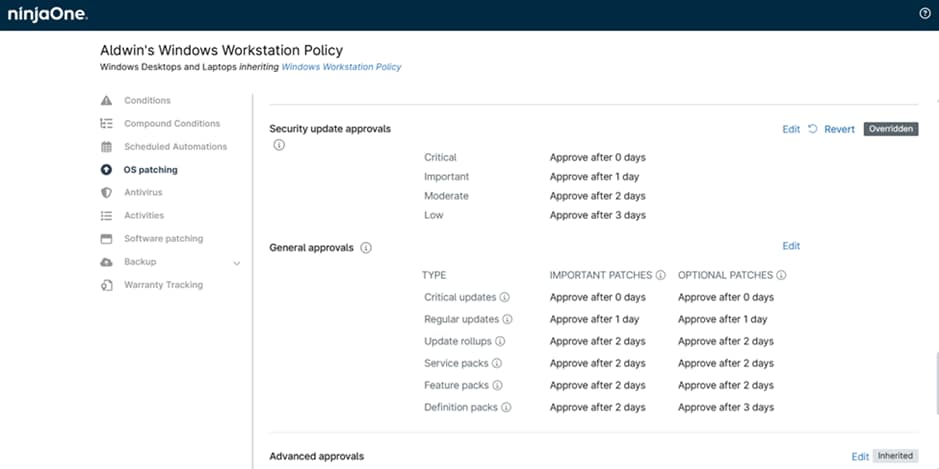
Policies enable IT teams to prioritize critical patches by defining approval rules based on vendor-provided severity. This policy-driven approach ensures the most urgent vulnerabilities are addressed quickly without requiring administrators to manually triage every patch.

Security Patch Prioritization Tied to Compliance

NinjaOne’s security patch prioritization tracks and remediates high-severity vulnerabilities within audit-ready timeframes, generating detailed compliance reports and a full audit trail that simplifies the documentation process during security reviews.

Endpoint Patch Prioritization Across Every Device

NinjaOne delivers consistent endpoint patch prioritization across servers, workstations, and remote devices — on-network or off — with no infrastructure required.

Vulnerability-Based Patching Powered by AI

Patch Intelligence AI enriches vulnerability-based patching by analyzing deployment signals and vendor advisories, automatically pausing risky patches, so IT teams can focus remediation efforts on stable, verified critical updates.

The technical backbone of smarter patch deployment prioritization

Built better, from day one icon

Patch Deployment Prioritization Through Severity Policies

Define patch approval and deployment behavior by severity, ensuring critical updates are approved and deployed as quickly as possible, while lower-risk updates follow a controlled schedule. Policies can be applied at the organization, location, or device level, allowing different environments to follow tailored patching rules.

Simplicity by design icon

CVE/CVSS Integration for Vulnerability-Based Patching

NinjaOne links patches to known CVEs and surfaces severity context, helping IT teams understand the risk behind each update. This visibility allows administrators to align patch approvals with real-world vulnerability impact and make more informed decisions from within a single console.

Audit icon

Automated Patch Prioritization via Policy Workflows

Configurable approval workflows drive automated patch prioritization across thousands of endpoints, with options for full automation, manual gates, or hybrid models tuned to organizational risk tolerance.

Instant visibility and control icon

Critical Patch Management Dashboard

A real-time dashboard centralizes critical patch management across the full inventory — filterable by severity, OS, and device group — so teams see exactly what’s exposed and what’s pending.

Patch Urgency Management for Ad-Hoc Deployment

For zero-days and active exploits, NinjaOne supports ad-hoc patch scanning and deployment outside scheduled windows, giving IT teams the ability to push critical updates immediately without waiting for the next maintenance cycle.

Built for every environment where speed and security both matter

Enterprise IT Teams Managing Large Endpoint Fleets

Large environments generate enormous patch backlogs. NinjaOne gives IT teams the severity context and policy-based automation to act on critical vulnerabilities first, deploying high-priority updates through configurable approval workflows without adding headcount. Centralized dashboards provide real-time visibility into patch status and known vulnerabilities across managed endpoints.

MSPs Securing Diverse Client Environments

MSPs need security patch prioritization that adapts to each client’s risk profile without sacrificing consistency across organizations. NinjaOne supports organization-specific policies for critical patch management while Patch Intelligence AI prevents risky updates from reaching client endpoints. Consolidated reporting makes it easy to demonstrate patching activity across every account.

Regulated Industries with Compliance-Driven Patch Programs

For organizations with compliance-driven patch programs, risk-based patching isn’t optional — it’s a requirement. NinjaOne enforces severity-based deployment schedules and provides patch reporting that documents deployment activity by device, patch, and status, giving audit teams the documentation they need without manual data assembly.

Related Resources

This is why customers love us

Ready to simplify the hardest parts of IT?

Critical Patch Prioritization FAQs

Critical patch prioritization in NinjaOne is driven by visibility into patch severity and vulnerability context, rather than release date alone. During patch scans, NinjaOne surfaces vendor-provided severity classifications (such as Critical, Important, Moderate, and Low) across the endpoint inventory, helping IT teams quickly identify systems that require urgent attention. This is complemented by CVE and CVSS information, giving administrators additional context on potential impact and exploitability to support informed patching decisions.

NinjaOne uses the severity rating assigned by the software vendor as the primary classification for each patch. NinjaOne integrates CVE and CVSS scoring and supports automated imports from third-party vulnerability scanners like Tenable, Qualys, and Rapid7 — giving IT teams the additional exploit context needed to make prioritization decisions that go beyond a simple severity label.

Deploying critical patches first shortens the window during which attackers can exploit known vulnerabilities. Unpatched systems represent one of the most common entry points in modern cyberattacks, and the longer a critical vulnerability remains open on production endpoints, the greater the exposure. By structuring patch deployment around severity rather than convenience, organizations can systematically reduce their attack surface and ensure that the vulnerabilities most likely to be exploited in the wild are addressed before lower-priority updates.

Yes. NinjaOne integrates CVSS scoring as part of its vulnerability and patch management workflows. This allows IT teams to evaluate patches not just by vendor severity level, but also by exploitability, impact score, and whether active exploit code is known to exist in the wild.

Yes. NinjaOne allows IT teams to build policy-driven patch workflows that automatically approve, defer, or escalate patches based on severity classification. Critical updates can be configured to deploy within your defined deployment windows, while optional or lower-priority patches are handled separately or rejected outright. These policies can be applied globally across all devices or scoped to specific device groups, environments, or roles, giving teams precise control over how automation operates at scale.

Patch policies eliminate the need for individual technicians to manually review and approve every incoming update, which becomes unmanageable at scale. By codifying the organization’s risk tolerance into automated rules, NinjaOne ensures that critical patches receive immediate attention without requiring human intervention at each step. Teams spend less time triaging routine updates and more time handling exceptions, zero-day situations, or cases where manual judgment is genuinely needed.

Yes. NinjaOne supports multiple patch policies that can be scoped to specific device groups based on device role, operating system, organizational unit, or deployment environment. This means a server running production workloads can be governed by a more conservative policy requiring manual approval for non-critical updates, while workstations might follow a more automated schedule. MSPs can apply tenant-specific policies across client environments, and enterprise IT teams can segment policies by department, geography, or risk classification.

Compliance frameworks typically require organizations to demonstrate that critical vulnerabilities are identified and remediated within defined timeframes. NinjaOne supports this by applying severity-based deployment schedules, generating detailed patch compliance reports, and maintaining a full audit trail of which patches were applied, when, and to which devices. These reports can be scoped by severity classification, making it straightforward to pull the documentation an auditor needs without manual data assembly.

With automated patch policies in place, NinjaOne can push critical patches to endpoints within your configured deployment windows — giving teams the flexibility to set aggressive SLAs for high-severity fixes while applying a more deliberate schedule for lower-priority updates. For zero-day vulnerabilities or active exploit scenarios, NinjaOne also supports ad-hoc manual deployment that bypasses scheduled windows entirely, so IT teams can push emergency fixes immediately without waiting for the next maintenance cycle.

By surfacing critical and high-severity patches at the top of the remediation queue and filtering out optional or low-risk updates from immediate attention, NinjaOne allows IT teams to concentrate their limited time and resources where they have the greatest security impact. Without prioritization, teams risk spending equal effort on a cosmetic application update and a CVE with active public exploit code. NinjaOne’s risk-based approach ensures that effort is allocated proportionally to actual threat exposure rather than patch volume.