NinjaOne Software License Billing Automates Precise Client Invoicing and IT Asset Costs

NinjaOne helps eliminate manual reconciliation for service providers by connecting IT Asset Management (ITAM), PSA, and Billing workflows into one unified platform. It converts live technical data into accurate financial records by syncing verified license usage directly with specific client service agreements.
Software License Billing
IT business logo
Provide logo
Advantage Technologies logo
Dedicated IT logo
Alticap logo
Network Coverage logo

How software license billing in NinjaOne strengthens financial control across IT operations

Reduce manual reconciliation overhead

Automated cost tracking helps reduce spreadsheet-based processes by mapping verified endpoint inventory data to billing items. This allows finance teams to process invoices with less manual data entry and fewer cross-checks against asset records.

Prevent revenue leakage from inaccurate license counts

Automated synchronization helps keep billing quantities aligned with current device and user allocations. This reduces the risk of underbilling active endpoints or overbilling retired assets.

Align IT spending with business units

Configured allocation rules can route software license charges to specific departments, cost centers, or client accounts. This helps organizations track IT spending more accurately.

Support predictable budget forecasting

Automated billing cycles deliver intelligent billing insights, providing consistent financial data for IT planning and resource allocation. Finance teams model software expenses with confidence using verified usage patterns.

Enable transparent client billing for service providers

MSPs present itemized software charges backed by verified endpoint data from the NinjaOne platform. Client relationships strengthen through clear cost attribution and usage documentation.

What Does This Product Do?

Built better, from day one icon

Dynamic quantity source configuration

Administrators can choose between active device counts or purchased seat totals as their primary billing metric. NinjaOne supports multiple calculation methods to ensure your billing always aligns with your specific contract and licensing model.

Role-based license assignment

Billing rules target specific device groups or user roles to enforce precise cost distribution. NinjaOne applies configured assignment logic to match organizational structures.

Service agreement product mapping

Software license products link directly to active service contracts for automated recurring billing. NinjaOne defines pricing tiers, billing cycles, and included quantities within a single configuration pane.

Simplicity by design icon

Usage-based billing automation

NinjaOne can use detected software inventory and assignment rules to automate usage-based billing calculations. Quantities are updated during scheduled syncs to reflect current device and asset counts.

Automated lifecycle tracking

NinjaOne continuously monitors active endpoint allocations to maintain an accurate, real-time structural inventory state without manual intervention. Finance teams export these verified, itemized reports for month-end closing and vendor audit preparation.

Real-world scenarios where NinjaOne software license billing delivers measurable financial results

Managed service providers tracking multi-tenant software consumption

MSPs struggle to bill clients accurately when software licenses span multiple endpoint configurations and tenant environments. NinjaOne software license billing isolates device inventories by client organization and syncs consumption metrics directly to service agreements. NinjaOne applies role-based allocation rules to generate tenant-specific invoice lines without manual cross-referencing. Service providers eliminate billing disputes by presenting clients with verified usage data tied to actual endpoint counts. Scalable billing systems stabilize recurring revenue streams while reducing administrative overhead for finance teams.

Enterprise IT departments tracking internal asset allocations

Large organizations require precise endpoint attribution when distributing software assets across multiple business units and departments. Administrators configure custom ITAM fields to associate endpoints with designated cost centers within the NinjaOne console. IT leaders utilize these structural tags to map software deployments against internal operational requirements. Department managers access inventory data reflecting real-time software deployment rather than static baseline estimates. IT asset managers verify active endpoint distribution against departmental limits without manual asset audits.

Compliance teams auditing vendor license agreements and utilization

Software vendors frequently audit enterprise deployments to verify compliance with purchased seat allocations and usage terms. NinjaOne utilizes automated lifecycle tracking to continuously monitor active endpoint allocations without requiring manual intervention. Compliance officers configure automated sync cycles to align billing quantities with current endpoint inventories before external reviews. Auditors export itemized billing trails that demonstrate exact license utilization against contractual purchase thresholds. Organizations reduce penalty exposure and negotiation friction by presenting vendor-compliant usage documentation generated directly from NinjaOne.

Streamline financial reporting by syncing active endpoint inventories directly with automated billing workflows. Reduce administrative workload using precise cost attribution and role-based assignment rules. Maintain accurate financial records through automated usage tracking and strict group-based filtering.

Related Resources

This is why customers love us

Ready to simplify the hardest parts of IT?

Software License Billing FAQs

NinjaOne automates billing by connecting asset inventory data with billing settings. Verified endpoint counts can be mapped to billing items, helping generate accurate charges while reducing manual effort.

NinjaOne uses configurable billing settings to determine whether charges are based on active device counts or total purchased licenses. Administrators can define billing groups and role assignments so only active, billable environments are included in billing calculations

NinjaOne supports seat-based, device-based, and user-based billing for software licenses tracked within the ITAM dashboard. Administrators map any custom license configuration to billing products for automated recurring charges.

NinjaOne IT Asset Management feature provides centralized visibility into software deployments across all managed endpoints and assigned contacts.

Yes, NinjaOne accepts both active device inventories and assigned user roles as primary quantity sources. Configuration rules allow inclusive or exclusive grouping logic to match organizational billing preferences.

Real-time inventory synchronization identifies underutilized software allocations that can be reassigned or retired. IT leaders utilize structural endpoint tagging to align organizational deployment limits with active utilization patterns.

NinjaOne generates structured billing exports that map directly to accounting codes for financial reconciliation. Finance administrators download itemized usage reports for month-end closing and vendor audit preparation.

Usage synchronization occurs during scheduled billing cycles defined in service agreements or product configuration settings. NinjaOne recalculates quantities automatically to align invoices with current endpoint states.

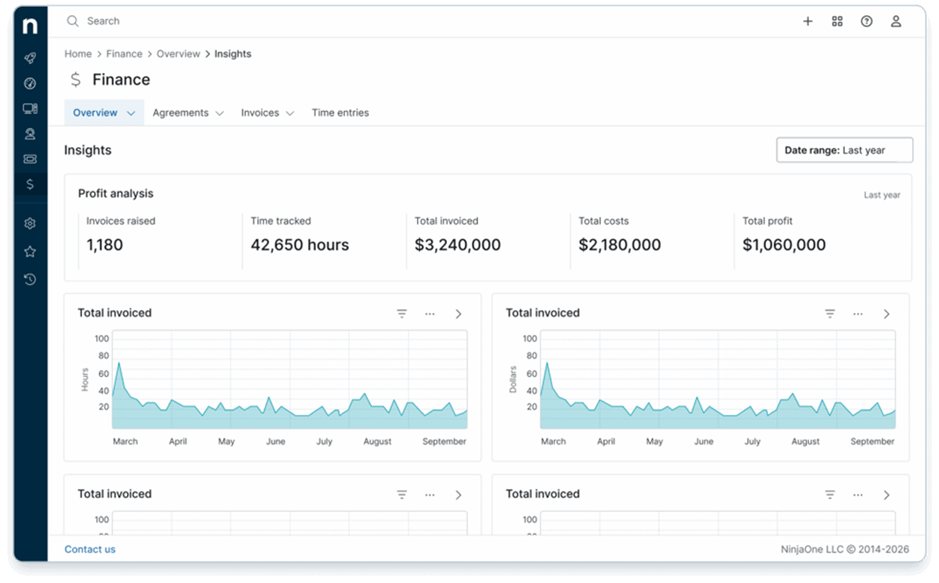
Billing metrics feed into the unified NinjaOne finance dashboard alongside active agreements, time entries, and invoice records. Administrators build custom reports that correlate license utilization trends with financial outcomes.

Automated charge attribution routes software expenses directly to designated departments or client accounts. IT leaders gain precise cost allocation data that supports budget forecasting and contract negotiation strategies.