
Modern IT environments are more interconnected and complex than ever. When incidents recur, the impact extends beyond downtime and reduces stakeholder confidence, consumes engineering capacity, and increases operational risk. High-performing IT organizations don’t just restore service quickly; they systematically remove the conditions that caused the failure in the first place.
Root cause analysis (RCA) provides the discipline to do exactly that. It shifts teams from short-term remediation to long-term resilience by identifying underlying causes and implementing corrective actions that prevent recurrence.
When applied consistently, RCA can reduce ticket volume, improve uptime, and create a clear link between technical improvements and business outcomes.
What is root cause analysis in IT?
Root cause analysis in IT is a structured approach to identifying the underlying cause of an incident. It shifts teams from “fix it fast” to “fix it permanently.”
Rather than stopping at the first visible failure, RCA asks deeper questions:
- What conditions allowed this to happen?
- What process gaps, configuration issues, or systemic weaknesses contributed?
- What changes will ensure it doesn’t happen again?
Common RCA frameworks include:
- 5 Whys: Asking “why” repeatedly to move past surface symptoms and uncover the primary cause.
- Fishbone (Ishikawa) diagrams: Mapping contributing factors across categories such as hardware, software, processes, and people.
- Formal postmortems: Structured reviews documenting timelines, contributing factors, decisions, and corrective actions.
The method matters less than the discipline. Effective RCA is always systematic, evidence-based, and repeatable.
Why IT teams use root cause analysis
Following the Root Cause Analysis best practices helps you spend less time firefighting and more time improving systems.
Reducing recurring incidents and ticket churn
The fastest way to reduce ticket volume is to eliminate systemic flaws that cause recurring issues. Structured RCA exposes:
- Misconfigurations that trigger cascading failures
- Brittle integrations that fail under load
- Incomplete patch sequences or update dependencies
- Process gaps that allow errors to propagate
For example, correcting a DHCP lease misconfiguration or automating a failed patch workflow can eliminate dozens of recurring tickets. Over time, fewer escalations mean less burnout and more predictable operations.
When incidents stop “boomeranging” back into the queue, engineers see their work producing permanent change rather than temporary relief, thereby improving workforce morale.
Connecting RCA to business impact
Start by estimating the cost of incidents. Factor in downtime multiplied by affected users, lost productivity, overtime labor, and any SLA penalties. Where relevant, include customer churn risk or rebate exposure. Even a directional cost model helps you prioritize which recurring issues warrant deeper RCA.
Then report improvements using metrics leadership already tracks: fewer major incidents quarter over quarter, reduced mean time to resolution (MTTR), improved uptime for critical services, and lower ticket reopen rates. When these indicators are displayed on executive dashboards, the impact of RCA becomes measurable rather than anecdotal.
Finally, use RCA findings to inform roadmap decisions. If one integration drives a disproportionate share of Sev 1 incidents, that data supports redesign, replacement, or vendor escalation. When stakeholders see that RCA reduces operational risk and protects revenue, it earns long-term sponsorship, not just post-incident attention.
Root cause analysis best practices for IT teams
To get consistent results, build a simple operating model around RCA.
Selecting the right RCA framework
Not every incident requires a full postmortem. Match the depth of analysis to the severity and business impact, so teams move quickly without losing rigor.
Use lightweight methods, such as the 5 Whys, for isolated, low-impact issues. Apply structured approaches such as fishbone analysis when multiple factors are involved. Reserve formal postmortems for Sev 1 outages, security events, or incidents with contractual or customer impact.
In regulated environments, define escalation triggers and documentation requirements in advance to ensure consistency and avoid delays.
Embedding RCA into incident management workflows
RCA should live where your teams already work, within your ticketing and service desk systems.
Effective integration includes:
- Clear triggers (Sev 1 incidents, recurring tickets, SLA breaches)
- Documented timelines and hypotheses attached to tickets
- Assigned corrective actions with owners and due dates
- Brief post-incident reviews to validate findings and update SOPs
Embedding analysis directly into incident workflows preserves context, clarifies accountability, and ensures follow-up work doesn’t disappear into disconnected documents.
Centralizing data for effective analysis
Fragmented tooling can slow investigations and create blind spots. Centralize logs, metrics, alerts, and endpoint telemetry so your team can accurately reconstruct events and quickly identify patterns.
Bring monitoring data from networks, servers, applications, and security tools into a unified view, then correlate related events across systems to reveal cause and effect. Instead of chasing isolated alerts, teams can work from a shared timeline that serves as a single source of truth, shortening the path from symptom to confirmed root cause and reducing debate over what happened.
Teams that consolidate endpoint data and logs move faster during post-incident reviews and build stronger detection rules, because they can compare evidence consistently across incidents.
Using automation to improve root cause analysis
Automation makes root cause analysis in IT scalable and repeatable. Without it, investigations depend too heavily on individual effort and institutional memory.
Automating log collection and correlation
Manual log gathering slows investigations and increases the risk of incomplete analysis. Instead, implement centralized log and telemetry collection across endpoints, servers, cloud services, and network infrastructure.
Real-time ingestion allows you to reconstruct events without scrambling for missing data. Layer in correlation rules that connect related signals across systems, for example, tying a configuration change to a spike in authentication failures and downstream application timeouts.
To make this actionable:
- Standardize log retention policies so historical comparisons are always available.
- Normalize log formats to simplify cross-system analysis.
- Create saved queries for common incident patterns to accelerate repeat investigations.
When collection and correlation are automated, analysts spend more time validating root causes and less time hunting for evidence.
Using pattern detection and anomaly monitoring
Use baseline monitoring and anomaly detection to surface unusual behavior in resource utilization, latency, error rates, or endpoint configurations. Pay particular attention to gradual configuration drift across devices or servers, as these subtle changes often precede larger failures under load.
In practice, this means defining clear performance baselines for critical systems, detecting deviations before they impact users, and integrating anomaly alerts into your incident response playbooks for early validation.
When teams operationalize these signals, RCA shifts from a retrospective exercise to a forward-looking risk management capability.
Closing the loop between RCA and prevention
Analysis alone doesn’t improve reliability. If findings sit in a document without operational follow-through, the same conditions will resurface. To make your root cause analysis effective, build a deliberate handoff from insight to enforcement.
For example, when you identify a configuration flaw, deploy the correction systematically across affected systems rather than relying on manual fixes. When monitoring gaps contribute to delayed detection, adjust alert thresholds and detection logic so similar conditions trigger earlier warnings. After implementing corrective actions, validate them continuously to ensure they remain in place and effective over time.
This closed-loop discipline can transform RCA from a reporting exercise into a prevention engine.
Accelerate IT improvement with RCA
Root cause analysis delivers real value when it’s applied consistently. By selecting the right frameworks, embedding RCA into daily workflows, centralizing your data, and automating corrective actions, you can reduce recurring incidents, shrink outage windows, and improve SLA performance in ways leadership can measure.
Start reducing repeat incidents today
See how unified monitoring, ticketing, and automation can turn root cause analysis into lasting operational improvement. Start your free NinjaOne trial and experience how streamlined IT management helps you cut ticket churn, improve uptime, and resolve incidents faster.
Quick-Start Guide
What NinjaOne Provides:
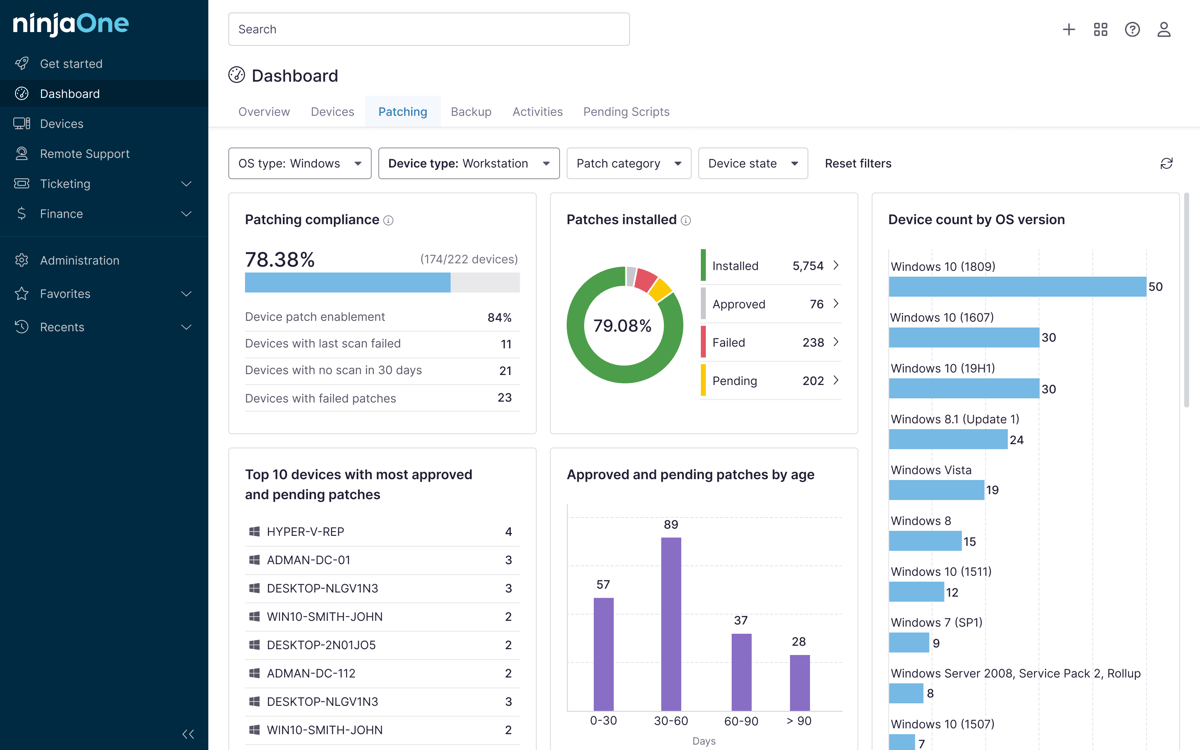
Monitoring & Diagnostics
– Real-time device monitoring and alerting
– Activity logs and event tracking
– Historical data on device performance and changes
Incident Context
– Device lifecycle tracking (from provisioning through decommissioning)
– Asset information and configuration details
– Software patch history and deployment status
Data for Analysis
– Comprehensive device inventory and status
– Policy compliance tracking
– Software and patch management records
How IT Teams Can Use NinjaOne for RCA:
While NinjaOne doesn’t automate RCA, teams can leverage its data to support root cause analysis by:
1. Gathering context — reviewing device history, recent changes, and policy applications
2. Identifying patterns — using monitoring data to correlate issues across devices
3. Tracking remediation — documenting fixes through policies and patch deployments
Bottom Line:
If your organization needs formal RCA capabilities, you’d likely need to combine NinjaOne’s monitoring and diagnostic data with a separate incident management or ticketing system that has RCA workflows built in.